Showing posts with label Fred Astaire. Show all posts

Monday, December 18, 2023

HOLIDAY INN: A 1942 REVIEW

 Here is the original review of the classic Holiday Inn. This appeared in the NY Times on August 5, 1942...


That man Irving Berlin has been whistling to himself again. Not content with turning out the most rousing Broadway show in years, he has scribbled no fewer than thirteen tunes for "Holiday Inn," the light-heartedly patriotic musical which opened last night at the Paramount in conjunction with a gala stage show for the benefit of the Navy Relief Society.

 Mr. Berlin may not know a great deal about notes, as he confesses, but he does know a lot about music. If there are no tunes in "Holiday Inn" that quite match those of his army show, Mr. Berlin still has created several of the most effortless melodies of the season—the sort that folks begin humming in the middle of a conversation for days afterward. At present Paramount prices Mr. Berlin's tunes are being sold dirt cheap.As it happily happens, the film has caught the same effortless moods of the music. Mark Sandrich, director and producer, has taken the inevitable melange of plot and production numbers and so deftly pulled them together that one hardly knows where the story ends and a song begins—a neat trick if you can do it. That it comes off, of course, is largely due to the casual performances of Bing Crosby, who can sell a blackface song like "Abraham" or turn an ordinary line into sly humor without seeming to try, and Fred Astaire, who still owns perhaps the most sophisticated pair of toes in Christendom. 


Mr. Astaire has rarely danced with more alert, carefree abandon than among the exploding torpedoes and red devils of "Say It With Firecrackers." And in Marjorie Reynolds, a very fetching blonde young lady, Mr. Astaire has a new partner who can hold her own at all speeds.Mainly "Holiday Inn" is a series of musical episodes, each of which takes an American holiday for cue. But they have been strung ever so neatly on the amorous rivalries of Mr. Astaire, who wins all the battles except the last, and Mr. Crosby, a musical lazybones who retires to a New England farm which he converts into a night club for holidays only—thus leaving him 300-odd days a year for pure loafing.


And while the pair desperately conspire against each other for the hand of Miss Reynolds, Mr. Berlin's music sets the moods from the romantic "Be Careful, It's My Heart," to nostalgic "Easter Parade," tender "White Christmas" and rollicking "Let's Start the New Year Right."Along the way the author and director have bobbed up with some engaging tricks such as the befuddled Thanksgiving turkey hopping from one Thursday to another or the Washington's Birthday Minuet, in which a bland Mr. Crosby continually breaks up Mr. Astaire's precise and dainty footwork with hot licks in the accompaniment. It is all very easy and graceful; it never tries too hard to dazzle; even in the rousing and topical Fourth of July number it never commits a breach of taste by violently waving the flag. Instead it has skipped back over the year in an affectionate and light-hearted spirit. In a month without a holiday, "Holiday Inn" offers a reason for celebration not printed in red ink on the calendar.

HOLIDAY INN, screen play by Claude Binyon; adaptation by Elmer Rice; based on an original idea by Irving Berlin; produced and directed by Mark Sandrich for Paramount; music and lyrics by Irving Berlin. At the Paramount.Jim Hardy . . . . . Bing CrosbyTed Hanover . . . . . Fred AstaireLinda Mason . . . . . Marjorie ReynoldsLillie Dixon . . . . . Virginia DaleDanny Reid . . . . . Walter AbelMamie . . . . . Louise BeaversCigarette Girl . . . . . Judith GibsonHat Check Girl . . . . . Katharine BoothGirls and Dancers . . . . . Barbara Slater, Aline Brandes, Louise La Planche, Laurie Douglas, Lynda Grey, Lora Lee


Sunday, December 18, 2022

HOLIDAY INN VS WHITE CHRISTMAS


This is a well written comparison of Holiday Inn and White Christmas. I recommend not only reading this article but visiting this great blog from a fellow movie lover...


It’s hard to shoot down the movie that brought us the song, “White Christmas,” (talking about Holiday Inn), but it’s not thought of as a classic in the way White Christmas is. Both star Bing Crosby, both take place more or less around a hotel/inn, and both are full of music and a little dancing. If it wasn’t for Holiday Inn, there wouldn’t be a White Christmas movie, but White Christmas goes farther and leaves us with that warm, fuzzy feeling.

Holiday Inn revolves around Jim Hardy (Bing Crosby) wanting to leave show business for the “good life” where he doesn’t have to work much. He opens an inn which is only open on holidays and gets a pretty girl to perform there for him. When Ted Hanover (Fred Astaire) shows up, he wants the girl as his new dance partner, which would take her away from the inn and Jim, who loves her. It’s a bit stale, and has song and focuses too long on dance routines for holidays such as Abe Lincoln’s Birthday, Washington’s Birthday, Valentine’s Day, Independence Day. Though we think of it as a Christmas movie, there’s not a lot of Christmas in it.


White Christmas, on the other hand, takes place in the days leading up to Christmas. After WWII, song and dance act Wallace and Davis (Crosby and Danny Kaye) meet up with a sister act (Rosemary Clooney and Vera-Ellen) who are on their way to Connecticut. When they arrive there, they find their old army sergeant struggling to make ends meet at an old ski lodge when it’s too warm for snow, so they decide to help out by moving the act out there. In the meantime, there’s music and dancing and a little romance. And then it starts to snow.

White Christmas gives us that feeling that only comes once a year whereas Holiday Inn seems more like a farce – trying to pack in as much singing and dancing without a whole lot of plot. Without the one, we wouldn’t have the other, but we don’t need both. Sorry, Holiday Inn, but I’m dreaming of a White Christmas...


Sunday, May 8, 2022

BLUE SKIES ON BLU-RAY


I almost missed this one, but Bing's 1946 gem Blue Skies has been released on Blu-Ray...

Here is the Blu-Ray review:

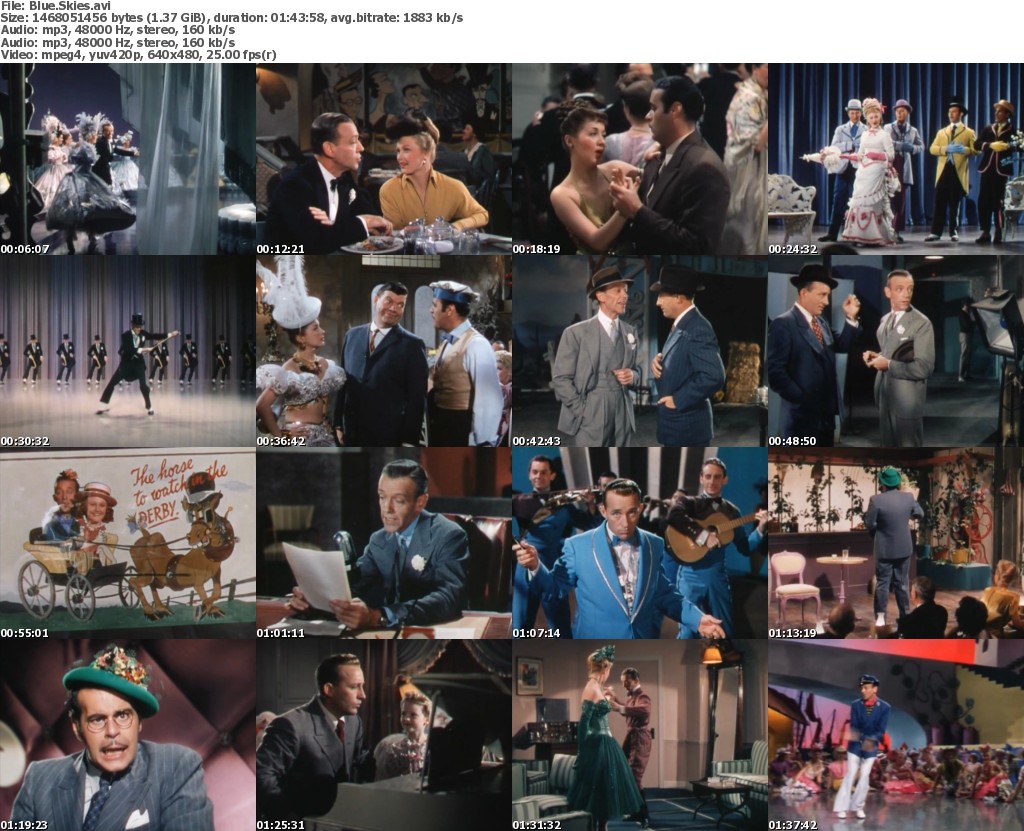
Though it's not as sunny as its title might suggest, Blue Skies reunites Bing Crosby and Fred Astaire in a meandering musical that features more than a dozen Irving Berlin tunes. The story of a hoofer and nightclub owner who vie for the same girl (Joan Caulfield) entertains in fits and starts, but can't come close to recapturing the magic of Crosby and Astaire's previous outing, Holiday Inn.

A brand new 2K master yields a glorious 1080p/AVC MPEG-4 transfer that maximizes the impact of the lush Technicolor cinematography of Charles Lang and William Snyder. Superior clarity and contrast combine with beautifully resolved grain to create a vibrant, well-balanced, very film-like picture. The deep blacks of Astaire's trademark top hat and tails and bright, wispy whites of Caulfield's fur outfit grab attention, but it's those sumptuous Technicolor hues that make the visuals of this musical sing. The bold reds of lipstick, a blazing neon sign, and huge bouquet of roses; the subtle variations of green, from the pale tone of Olga San Juan's gown and matching boa to Billy De Wolfe's Irish-green hat; and an array of pastels, from Crosby's powder blue suit to various pinks and lavenders...all of them are perfectly timed so they never look garish or artificial. Several scenes are intentionally dark and even a tad murky, but excellent shadow delineation keeps the picture well defined. Flesh tones remain natural and stable throughout, sharp close-ups flatter all the players, and only a few errant nicks and marks dot the pristine source material. Kino has done a wonderful job revitalizing this 75-year-old classic, and fans of the film will be delighted by this top-notch presentation...

You can find a copy on Amazon - I ordered mine!


Sunday, December 1, 2019

GUEST REVIEWER: HOLIDAY INN

Bruce Krogan is back to kick off our Christmas season with a review of the popular 1942 Bing flick Holiday Inn...

Finally Paramount gave Crosby a big budget musical and didn't rely on his charm and personality to carry the film. The budget went to hire such outside talent as Fred Astaire and Irving Berlin. And none of them disappoint.

In the first of two films Astaire and Crosby did together the characters are remarkably the same. Astaire is the elegant and charming show business professional who's ambitious for success. Crosby is the talented, but lazy partner who just wants a life of ease and comfort and not to work more than he has to. Small wonder that their double act broke up. But now enter a complication. They both get interested in the same girl who in this film is Marjorie Reynolds.

Crosby dreams up the idea of a nightclub/hotel called Holiday Inn where they only work on holidays. He wants Reynolds to help with the shows there. Astaire wants her for his act after his other girl partner Virginia Dale runs off with a millionaire. And the fun starts. Now since this was Crosby's home studio and he's first billed, just who do you think gets Reynolds in the end? As maid Louise Beavers put it, don't sit and mope because some slicker stole your gal.


Irving Berlin writes a majority of new songs to supplement a couple from his vast trunk of songs mostly about our holidays. By that time Berlin had extracted an agreement which became standard for all the films he wrote for. Not one note of non-Berlin music is ever heard in a score he writes. Just listen to this and just about any other film Berlin is associated with. Even music in the background is his.

The hit song in this was supposed to be Be Careful It's My Heart, the Valentine's Day song, sung by Crosby and danced to by Astaire and Reynolds. It did have a good deal of success. But the success of White Christmas was exponentially phenomenal. It netted Irving Berlin his one and only Academy Award and for Bing Crosby his number one item on vinyl. In fact everyone's number one item on vinyl.

I don't know if Bing Crosby ever set out to become the voice of Christmas, but if he did he was a marketing genius. If he's known and appreciated for anything with today's audience, it's for that. White Christmas became the first Yule song he was identified with although he had recorded some Christmas material before that. After this he started doing the holiday music in serious. Just think, along around Columbus Day, record companies even now reissue his Christmas stuff every year and his totals as largest selling recording artist in history grow once again. That's why the Beatles and Elvis, etc. don't have a prayer of overtaking him.


In fact White Christmas's initial success was so great that Decca wore out the original master putting out records to meet the demand. So in 1945, Decca got Bing, the Ken Darby Singers and John Scott Trotter to re-record it almost note for note. The original 78 had White Christmas with the flipside of Let's Start the New Year Right also from Holiday Inn. The newer version which most people hear has as it's flipside God Rest Ye Merry Gentlemen.

I don't want to ignore Fred Astaire's contribution here. He does a nice comic turn with I Can't Tell a Lie, the Washington's birthday number where Crosby keeps changing the tempo to upset him and Reynolds. The Fourth of July yields a number for each. Reynolds is kept from the show by Bing's machinations and Astaire has to "improvise" something. He "improvises" Firecrackers and anyone who knows anything about Astaire knows how hard he worked to get that spontaneous feeling in his dancing. Bing sings The Song of Freedom, reminiscent of James Cagney's Grand Old Flag number from Yankee Doodle Dandy also out in 1942 and Song of Freedom is also reminiscent of what Paramount could have given Bing in the 1930s had they hired someone like Busby Berkeley to give Bing some of the production numbers that Dick Powell had at Warner Brothers.

So what more is there to say, but sit back and enjoy the fun...

BRUCE RATING: 10 OUT OF 10
MY RATING: 10 OUT OF 10


Wednesday, March 20, 2019

BING AND FRED ASTAIRE: TOP BILLING

Here's a great article from Steve Lewis' "Bing Crosby Internet Museum"...

Virtually all the polls at the end of the 20th century placed Fred Astaire at the top or near the top of professional dancers.

Astaire made some 30 memorable movie musicals, including 10 highly-acclaimed films with co-star Ginger Rogers. The Astaire-Rogers collaboration included "The Gay Divorce," "Roberta," "Top Hat," "Follow the Fleet," "Swing Time," "Shall We Dance?," "Carefree," "The Story of Vernon and Irene Castle" and "The Barkleys of Broadway."

Astaire's success in the movies seemed as improbable as Bing Crosby's. He had a face the shape of a bartlett pear, a beanpole figure and a weak voice. In his first attempt at a movie career a Paramount executive wrote that Astaire "Can't act. Can't sing. Balding. Can dance a little." Astaire succeeded nonetheless. He sweated his way to the top. "He was a dictator who made me work harder and longer than anyone," said Nanette Fabray, one of his female costars.


Astaire introduced 36 hit songs in his movies from 1929 through 1951. According to Joel Whitburn, author of Pop Memories, eight Astaire recordings topped the pop charts: "Night and Day," "Cheek to Cheek," "I'm Putting All My Eggs in One Basket," "The Way You Look Tonight," "A Fine Romance," "They Can't Take that Away from Me," "Nice Work If You Can Get It" and "Change Partners."

In 1942 Astaire and Crosby were paired in the Irving Berlin musical Holiday Inn. In the movie Bing wins the girl (Marjorie Reynolds) to whom he sings what turned out to be the most successful movie song of the century, White Christmas. Bing also dances with Astaire, who later said that "Bing's the kind of dancer that I am a singer." Nevertheless, for many years Fred would answer "Bing Crosby" when asked to name his favorite dance partner -- to avoid alienating any of his female co-stars.

Astaire's best dance scene in Holiday Inn was not with Crosby but when he hot-footed alone on stage to the accompaniment of a 4th of July firecracker display. The famous scene took 38 takes during which Fred lost 14 pounds. The large number of takes were at Fred's insistance. According to Crosby: "Fred's a perfectionist .... Every step, every movement there was a firecracker let off. Some he'd throw down like torpedoes and some he'd kick-off. He had to be in certain positions all the time to hit the right firecrackers so he'd be on camera.... It was pretty elaborately contrivied and had to be done perfectly. I thought the first take he did was great. They all looked alike to me, but there was a little something he didn't like in each one. He about wore out the director and wore out the crew and the sequence took two or three days." (Thompson, pages 93-94)

The success of Holiday Inn led to another Astaire-Berlin-Crosby musical called Blue Skies in 1946. A third collaboration of the ABC boys was supposed to be White Christmas. But when Astaire read the script he found other work. Instead, Danny Kaye was hired to fill Astaire's dancing shoes. "White Christmas" became the leading box office attraction of 1954 and a perennial Christmas holiday tradition.


Astaire appeared several times on Bing's radio and TV shows through the years and they shared mutual interests in golf and horse racing. During World War II their paths crossed while entertaining the troops in Europe. At one point they feared for their safety when trapped for 45 minutes in a Glasgow railway baggage room while surrounded by 35,000 fans demanding a performance. (Crosby, 197-99)

Ken Barnes, Bing's last album producer, persuaded Bing and Fred to record an album of duets in London in 1975. Barnes later recalled the contrasting styles of the two stars:

"Once the material had been decided upon, we paid only one visit to Bing's house which consisted of one hour and a half around the piano during which time Bing would sing each song through no more than twice -- once for the key and then once again for the tempo.... That solitary visit to Crosby's house was in no way comparable to the nine visits we made to Fred's house, each lasting a minimum of three hours. Whereas Crosby would approach each song in a casual, seemingly off-hand manner, Astaire went to the other extreme. He would plan each song routine as though it were an intricate piece of choreography."


When Bing and Fred arrived in London in July, their contrasting styles posed a problem. According to Barnes:

I rang the Connaught and got through to Fred. His first question could not have been more direct. "What time do we meet with Bing tomorrow?" There was no beating around the bush with Astaire either and I plunged straight in. "Bing can't make it tomorrow. He's tied up all day." I waited for Fred's comment but there was only silence from the telephone. "But he'll meet you a half hour before the session," I went on, "and run down each of the songs individually."

For a moment I thought we had been disconnected but after a few seconds Fred spoke and his comments about Crosby were anything but complimentary. He accused Bing of being totally irresponsible and unprofessional, but eventually, after he had got the initial anger out of his system, Fred conceded that this was Bing's way of working and it was too late to expect him to change. "But," added Fred, "it's not my way of working. It may be OK for the great Crosby to stroll into a studio and turn on the magic, but I can't work that way. I've got to rehearse with somebody." (Barnes, pages 47-53)

The Crosby-Astaire duet album turned out to be a hit. Apparently, Astaire held no grudge against Bing, for he agreed to be Bing's guest on his 1975 Christmas TV special, recorded in November. The TV special would be the last time the two worked together. Fred died of pneumonia at age 88 in the wee hours of June 12, 1987, in a Los Angeles hospital, where he had been admitted 10 days earlier for a bad cold...


Friday, March 23, 2018

BING ON FILM: BLUE SKIES - PART THREE


Back to the movie BLUE SKIES though, here is what Bosley Crowther of the New York Times thought of the movie in his October 17, 1946 review:

So many screen exercises in the music-album line have been so cluttered up with "biography" that it is a pleasure at last to see one in which a tune-vender's life and his music are not mutually and mawkishly abused. Such a one is the Paramount's current and cheerfully diverting "Blue Skies," which catalogues some songs of Irving Berlin without catalyzing that gentleman's career. And with Fred Astaire and Bing Crosby as its bright particular stars, everyone's probity is honored by it—especially Mr. Berlin's.

There's a lot to be said for any picture in the musical comedy groove which adheres to the oft-forgotten dictum that a film should be seen as well as heard, that variety and vitality in the visual are the stuff of which musicals are made. And when the evidence of that adherence is so enthusiastically displayed as it is by Messrs. Astaire and Crosby in "Blue Skies," you may depend upon being entertained.

The story? Let's not argue about it. It's a standard and harmless little thing about the casual and genial competition between two song-and-dance men for a girl. One of them very soon gets her, but as he is a rolling stone, his interest is slightly sporadic. On that track, it ambles along. As a plot, it is no more elusive than the peg for "Holiday Inn," in which the two above-mentioned performers and Mr. Berlin's tunes were also combined. And the worst—or the best—to be said for it (you can tolerably take your pick) is that it does have a few soggy moments which are quickly and obligingly dismissed.

But it does serve as adequate hanger for some sparkling and stimulating turns of song, dance and general farcifying to Mr. Berlin's familiar tunes. Best of the lot, for our wampum, is Mr. Astaire's electrifying dance to that ancient and honorable folk-song, "Puttin' on the Ritz." Turned out in striped pants and top hat, Mr. A. makes his educated feet talk a persuasive language that is thrilling to conjugate. The number ends with some process-screen trickery in which a dozen or so midget Astaire’s back up the tapping soloist in a beautiful surge of clickety-clicks. If this film is Mr. A.'s swan song, as he has heartlessly announced it will be, then he has climaxed his many years of hoofing with a properly superlative must-see.

And that's not his only contribution. In company with the redoubtable Bing, he doubles in song while that nipper doubles in dance in a comedy gem, written especially for the occasion, entitled "Two Song-and-Dance Men." He also kicks his heels glibly in a fancy production of the torrid "Heat Wave," and trips through the plot and other numbers with the elasticity of a happy rubber man. Naturally, Mr. Crosby, as the rolling-stone character, has his share of the spotlight and holds it with aggressive modesty. He makes something lively, slick and novel of "Cuba," along with Olga San Juan, and groans with his customary competence a new hit "You Keep Coming Back Like a Song." Joan Caulfield, the "you" of this ditty, is loveliest and passive as the girl who stands none too seriously or firmly between Crosby and Astaire. And Billy De Wolfe, an obnoxious sort of person, is allowed only once to get too much in the way. For the rest, there are no less than twenty of Mr. Berlin's melodious tunes jammed here and there onto the sound-track, either as production numbers or incidental bits. And we must say that Robert Emmett Dolan has directed the music as distinctively as Stuart Heisler has directed the actors—or maybe more so. That's why they sound so good. Or maybe it's because they're used as music and not as milestones in somebody's awesome "life."    


When I showed my wife BLUE SKIES years ago, she thought it was corny but this movie has so much going for it. It features a unique time in American history – between both World Wars that is often over looked in film. The movie also paints a realistic portrayal of what a struggle marriage can be sometimes. Yes, the marriage of Bing and Joan Caulfield was a show biz marriage, but if you looked closely at what broke them up, it is the same problems that face married people even today – lack of communication and trust. For a 1940s musical this film deals with some serious subject matter, which you tend to overlook, because the star of the film is the Irving Berlin music, and the perfect performances of Bing Crosby and Fred Astaire who were just a couple of song and dance men!

THE END...


Friday, March 16, 2018

BING ON FILM: BLUE SKIES - PART TWO

As Jed Potter relates his "album of Irving Berlin songs" to his radio listeners, movie viewers get to to be treated to see and hear such classic tunes including: "A Pretty Girl is Like a Melody" (sung by chorus, danced by Fred Astaire); "I've Got My Captain Watching for Me Now" (Sung by Bing Crosby); "You'd Be Surprised" (sung by Olga San Juan); "All By Myself" (Crosby); "Serenade to an Old-Fashioned Girl" (sung by Joan Caulfield); "Puttin' on the Ritz" (Astaire); "I'll See You in C.U.B.A." (Crosby); "A Couple of Song and Dance Men" (Astaire and Crosby); "You Keep Coming Back Like a Song" (Crosby); "Always" (chorus); "Blue Skies," "The Little Things in Life," "Not for All the Rice in China" (all sung by Crosby); "Russian Lullaby" (Chorus); "Everybody Step" (Crosby); "How Deep is the Ocean" (chorus); "Running Around in Circles" (Crosby); "Heat Wave" (sung by Olga San Juan/danced by Astaire); "Buy Bonds Today" "This is the Army" "White Christmas" and "You Keep Coming Back Like a Song" (all sung by Crosby). "Mandy" and "Some Sunny Day" are those other songs heard as background music.


Astaire's "Puttin' on the Ritz" number, where he dances to eight images of himself, is one of the great highlights. First introduced by Harry Richman for the 1930 musical, PUTTIN' ON THE RITZ, the original lyrics have been changed to fit the Astaire style as well as the changing of times. Crosby and Astaire also provide fine moments with their joint collaboration as "A Couple of Song and Dance Men." Billy De Wolfe supplies much of the comedy relief as Johnny's partner and assistant. Aside from being the love interest to Olga San Juan, he does a five minute one man comedy routine as Mrs. Murgatroyd.

While the story tends to get corny at times, it does get better with its passage of time and its assortment of fine songs. Aside from Crosby's singing, his sentimental moment where he meets with his little girl (Grimes) again is well done, along with Astaire's dancing, which is always first rate. He briefly breaks away from his traditional character where he becomes a troubled dancer who turns to liquor after being jilted. Joan Caulfield, then new to the movies, would work again with Crosby in WELCOME STRANGER (1947), an underrated drama with songs. Crosby and Astaire wouldn't work together again (except for a radio show together in 1951) until being reunited again for their TV special, "A Couple of Song and Dance Men" (CBS, 1975). Also in 1975, the two would make an great album together of the same name that I recommend.

TO BE CONTINUED...


Friday, March 9, 2018

BING ON FILM: BLUE SKIES - PART ONE

When I first started watching movie musicals (and Bing Crosby movies for that matter), the 1946 film BLUE SKIES was my favorite musical. As the years have gone by other musicals has pushed Blue Skies down on the list, but I still love the film. There is really not much to not like about the film. The film had it all from beautiful technicolor to over two dozen Irving Berlin songs. It had two of the giants of the musicals with the singing ability of Bing Crosby and the dancing wizardry of Fred Astaire. Throw in a beautiful leading lady like Joan Caulfield, and there is no reason why BLUE SKIES would not be one of the biggest musicals of 1946.

The movie that was proposed was a lot different than the movie the film became. Leading lady Joan Caulfield was the protégé of Mark Sandrich, who directed many of the Astaire-Ginger Rogers musicals. Sandrich was originally slated to direct this film, but died of a heart attack during pre-production and Stuart Heisler was drafted in to replace him. Heisler wanted Caulfield replaced, but Crosby, who had approval of his leading ladies, insisted she remain in the film. Reportedly Heisler and Crosby did not get along, and the following year Heisler would direct Susan Hayward in SMASH UP: THE STORY OF US which was based on an unflattering portrayal of Dixie Lee Crosby. Also Paul Draper, a Broadway dancer was supposed to star with Bing, but he left the film early on as well. Bing and Draper did not get along. Crosby was laid back to his way of filming, while Paul approached every scene and nuance of the movie as if he was choreographing and intricate ballet. Draper did not endear himself to Crosby either but trying to get actress Joan Caulfield removed from the picture. He was constantly complained about her lack of singing and dancing ability. During the first week of production Draper's speech impediment and his trenchant criticism of Caulfield's dance ability led Crosby to insist on his replacement by Fred Astaire who, then forty-seven, had already decided that this would be his final film and that he would retire.


In common tradition to many 1940s movies, most commonly found in the "film noir" genre, BLUE SKIES is told in flashback, starting in modern day setting at a radio station, Broadcast Network of America in New York City's Rockefeller Center, where Jed Potter (Fred Astaire), a former dancer now a radio personality, relates his life story and career to his listeners, a story with a beginning but without a finish. Dating back circa 1919 following World War I finds Jed attracted to Mary O'Hara (Joan Caulfield), a girl, a "very pretty girl," working in the chorus. He invites her to accompany him for dinner at a night club owned by Johnny Adams (Bing Crosby), his Army buddy. Almost immediately, Mary is attracted to Johnny, but in spite of Jed's warning that Johnny is not the marrying kind, she cannot resist him. Johnny and Mary marry, and during their union have a daughter, Mary Elizabeth (Karolyn Grimes). All goes well until Mary finds that Jed is right in his assumption of Johnny being selfish and unstable, buying and selling nightclubs (one of them called "Top Hat") at a moment's notice, and unable to settle down at in one place they could call home. After their divorce, Mary becomes engaged to Jed. Finding she's unable to marry Jed, Mary disappears, leaving Johnny as well as Jed, through his narration, to wonder whatever became of her.

TO BE CONTINUED...


Monday, June 20, 2016

PAST OBITS: FRED ASTAIRE

I can not believe it has been nearly 30 years since Fred Astaire's death. Here is just the partial obituary that appeared in the NY Times on June 23, 1987...

Fred Astaire, whose flashing feet and limber legs not only made him America's most popular dancer but also set standards for motion picture musical comedies that have rarely been met and never exceeded, died of pneumonia yesterday at Century City Hospital in Los Angeles. He was 88 years old.

Mr. Astaire blithely danced his way into the heart of an America tormented by the Depression and edging toward World War II. His deceptively easy-looking light-footedness, warm smile, top hat, cane, charm and talent helped people to forget the real world that nagged at them outside the movie house.

In a statement released by the White House press office, President Reagan said: ''Nancy and I are deeply saddened by the loss of a very dear friend. Fred Astaire, an American legend, has died. We join the entire nation in mourning his passing, and our heart-felt sympathies are with his wife, Robyn, and his family.'' 'The Ultimate Dancer'

''Fred was, in every sense of the word, a 'superstar,' '' Mr. Reagan said. ''He was the ultimate dancer -the dancer who made it all look so easy.''


The Astaire legend, which spanned more than six performing decades on stage, screen and television, began before he was 10 years old when his mother paired him as a dancer with his sister, Adele, the partner with whom he first found success.

Mr. Astaire starred in more than 30 film musicals between 1933 and 1968. Eleven of these co-starred Ginger Rogers, his most durable dancing partner. The music they danced to was written by the cream of the popular-music world, including Cole Porter, Irving Berlin, Jerome Kern and George and Ira Gershwin.

There were other famous dancers, but few could match the sophistication and inventiveness of Mr. Astaire in such films as ''Flying Down to Rio,'' ''The Gay Divorcee,'' ''Top Hat,'' ''Swing Time,'' ''Follow the Fleet,'' ''Blue Skies'' and ''Easter Parad For all the lushness of his films, often in settings of splendor and champagne, Mr. Astaire projected a down-to-earth personality, that of a good-hearted fellow whose effortless steps, even at their most dazzling, matched his casual demeanor.

His dance numbers fit neatly within the bounds of a movie screen, but they gave the illusion of being boundless, without regard for the laws of gravity or the limitations of a set.

He danced with Rita Hayworth atop a wedding cake (''You'll Never Get Rich,'' 1941), danced on roller skates (''Shall We Dance?'' 1937), danced while hitting golf balls off a tee (''Carefree,'' 1938) and danced up the walls and on the ceiling (''Royal Wedding,'' 1951). He danced while airborne, aboard ships and in countless ballrooms where he glided flawlessly across wide-open spaces. It was the kind of dancing that caught the imagination, even of those who disdained the thought of witnessing any dancing at all.


He was popular and beloved, a thin, sandy-haired man 5 feet 9 inches tall, who fretted and sweated off-camera and offstage to make his dance come across with a spontaneity that few could equal. During a long career in which he went from vaudeville to Broadway to Hollywood and later to triumph in television - his own special, ''An Evening With Fred Astaire,'' won nine Emmy Awards in 1957 - he never failed to delight mass audiences. 'Greatest Dancer in World'

He was also a paragon among his professional peers. George Balanchine, the artistic director of the New York City Ballet and a man whose supreme standards rarely allowed for superlatives, called him, simply, ''the greatest dancer in the world.''

Irving Berlin, in whose musical ''Top Hat'' Mr. Astaire wore the topper and tails that became the dancer's working hallmark, said: ''He's not just a great dancer; he's a great singer of songs. He's as good as any of them - as good as Jolson or Crosby or Sinatra. He's just as good a singer as he is a dancer - not necessarily because of his voice but by his conception of projecting a song.'' On learning of Mr. Astaire's death, Mr. Berlin told The Associated Press yesterday that ''there hasn't been such a talent as his.''


''He was an international star,'' Mr. Berlin added.

Anna Kisselgoff, dance critic of The New York Times, gave this description of the Astaire genius: ''At its most basic, Mr. Astaire's technique has three elements - tap, ballet and ballroom dancing. The ballet training, by his account, was brief but came at a crucial, early age. He has sometimes been classed as a tap dancer, but he was never the hoofer he has jokingly called himself. Much of the choreographic outline of his dancing with his ladies - be it Miss Rogers or Miss Hayworth - is ballroom. But of course, no ballroom dancer could dance like this.''

The Astaire seen in performance was a different Astaire from the one who lived out of the spotlight. He detested formal dress, although his personal wardrobe was stylish, and frequently told interviewers how he regarded top hat and tails as no more than working dress, certainly nothing to be worn on his own time.

The easygoing air that surrounded his own performance was developed by a dancer who was extremely serious and painstaking about his work. He was frequently described as a perfectionist, and the evidence seems to leave little doubt that he worked with more than average diligence to bring his production numbers to final gloss. 'Can't Just Sit and Do It'

''Dancing is a sweat job,'' he said in a Life magazine interview when he was 66. ''You can't just sit down and do it, you have to get up on your feet. When you're experimenting you have to try so many things before you choose what you want, that you may go days getting nothing but exhaustion. This search for what you want is like tracking something that doesn't want to be tracked.''

Monday, September 7, 2015

MEMORIES OF KEN BARNES

It took the mainstream media a lot of time to report on the death of the great Ken Barnes, but finally here is a great article...

One of Britain's most accomplished record producers, film historians and writers, Ken Barnes worked with some of the biggest names in Hollywood. As a record producer he went between London, Los Angeles, Nashville and New York, recording such stars as Bing Crosby, Peggy Lee, Slim Whitman, Frankie Laine, Connie Francis and Jack Jones, selling more than five million records and earning a string of silver, gold and platinum discs.

He enjoyed an enduring working relationship during Bing Crosby's final years, which came about because Crosby had liked the work he had done on two albums with the lyricist and singer Johnny Mercer. Barnes flew to California to meet Crosby at his sprawling Hillsborough residence. He was kept waiting before being shown into a room where Crosby apologised for the delay, explaining that he had been writing a foreword for a book on the songwriter, Harry Warren.

He asked Barnes, "Do you know of Warren's work?", which unleashed a torrent of song titles and knowledgeable facts about the composer, immediately cementing the relationship. Barnes produced Crosby's final six albums, one of which included the reflective song, "That's What Life Is All About" which he co-wrote with a contribution from Crosby.

Particularly adept at working with big stars, with their egos and peccadillos, he was able to bring out the best in them by subtly, but firmly, navigating potential pitfalls. When he was working with Fred Astaire, the record company wanted to include a few seconds of him tap dancing. Barnes said, "We'll clear a space and you can tap for a few seconds." Astaire politely but firmly replied, "No way am I dancing." Barnes tried with a shoe shuffle but it didn't sound convincing. So he told Astaire, "It's no use. But somebody's feet have got to be there. But if I get someone like Lionel Blair to do it, they'll have an after-dinner story of 'How I did Fred Astaire's dancing for him'." Astaire stared at him for a second and said, "You son of a gun. OK, I'll do it right now!"

During the same London sessions, Astaire was about to record the George and Ira Gershwin standard, "They Can't Take That Away from Me" and said to Barnes, "Let's do the alternate lyrics on the way out." Barnes told him that there weren't any so Astaire told him to come up with something. Barnes thought about it and suggested the couplet, 'The way you drove the car, when we were on a spree; No matter where you are – no, no, they can't take that away from me.' Astaire was delighted, exclaiming, "That's it! Wonderful! I'll record it."


Returning to the US, Astaire took an acetate of the recording to Ira Gershwin's home and, after playing the track, asked Ira what he thought of the new lyric. "What new lyric? Isn't that what I wrote?" Gershwin replied.

When Barnes had the idea of recording Astaire and Crosby together, there was a considerable mismatch of approaches to the sessions. Astaire arrived in London a week in advance expecting to be rehearsing with his singing partner. Crosby, meanwhile, was typically relaxed. Barnes eventually tracked him down to a Scottish golf course club house. "How many songs will we be doing?" he asked Barnes, who told him the usual dozen. Crosby replied, "That's a breeze; we'll just need 10 minutes round the piano". This made Astaire nervous, so with the singer Teddy Johnson Barnes recorded demos for Astaire to learn in advance.

Barnes' writing skills resulted in books like Sinatra and the Great Song Stylists, 20 Years of Pop and The Crosby Years, in addition to a recent novel, The Sea Dogs, inspired by the early swashbuckling movies, especially those of Errol Flynn.

He was also an accomplished scriptwriter, delivering nearly 100 scripts for the BBC, as well as material for Michael Parkinson's chat show and British comedians including Roy Hudd and Les Dawson. He also worked with Peter Sellers, producing an album of classic sketches, Sellers' Market.

A great admirer of Frank Sinatra, he went on to become European president of the Sinatra Music Society, and along with his close friend and colleague, Charles Pignone who runs Sinatra Enterprises in Hollywood, he worked on several Sinatra re-issue projects. This led to Pignone recommending Barnes to write the script for the Emmy-nominated TV biopic of Johnny Mercer, The Dream's On Me, produced by Clint Eastwood.

As a film historian, Barnes gave lectures at the National Film Theatre and UCLA in California, and it was his encyclopaedic knowledge of cinema, from silents to the present day, that provided another string to his bow. In 1995 he set up a film restoration company, Laureate DVD, predicting the massive interest in the format, especially restoring and preserving movies that were recorded on film with all its associated fragility. Laureate released the first special editions of Citizen Kane and Holiday Inn as well as box sets of the Marx Brothers, Cary Grant, and the classic collaborations of Astaire and Ginger Rogers, and Bob Hope and Crosby.

Born in Middlesborough in 1933, he was educated in Redcar before doing National Service in the Royal Corps of Signals. He trained as a draughtsman, but his early passion for music in the jazz/swing and Great American Songbook genres led him to London in the 1960s to work as a marketing executive for Polydor and Decca.

His last studio recording was an album in aid of the charity Help for Heroes, recorded in the studio on the RAF Northolt air base with the Royal Air Force Squadronaires and myself. Another recent project was writing liner notes for the 60-page booklet included with the recent four-disc box set, Sinatra In London. And for the Smithsonian Institute he wrote liner notes for a forthcoming album of Sinatra's work which will now be dedicated to Barnes' memory. At the time of his death he had just finished working with Peggy Lee's granddaughter, Holly Foster-Wells, on a CD/DVD box set, Peggy Lee In London, a collection of the recordings Barnes produced in 1997, which will be released later this year.

Tuesday, August 4, 2015

REMEMBERING: KEN BARNES (1933-2015)


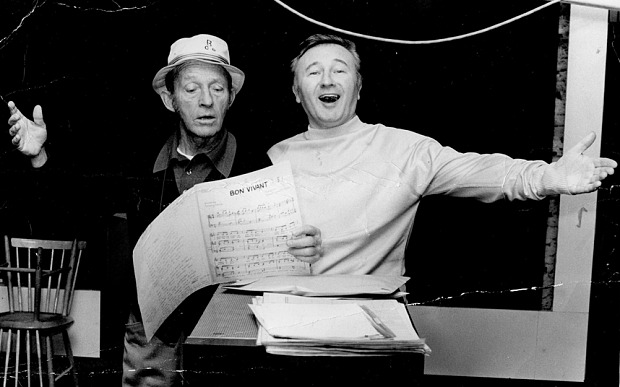
Record producer and musical genius Ken Barnes has died today. No words can express what he meant to Bing's career in the 1970s - so here are a few pictures of the greats he worked with - Bing, Fred Astaire, and Johnny Mercer.

He will be missed...


Monday, March 9, 2015

SPOTLIGHT ON BILLY DEWOLFE

Not many people remember the funny chracter actor Billy DeWolfe. DeWolfe is basically forgotten now, except maybe his voice work in the cartoon FROSTY THE SNOWMAN. For years he was a dependable character actor though.

Born William Andrew Jones in the Wollaston neighborhood of Quincy, Massachusetts on February 18, 1907, DeWolfe was the son of a Welsh-born bookbinder who encouraged him to become a Baptist minister. Instead, "Billy" developed an interest in the theatre. He found work as an usher before becoming a dancer with a band. It was at this point that he changed his last name to De Wolfe, which was the last name of the manager of the Massachusetts theatre where he worked.

He signed with Paramount Pictures in 1943 and became a reliable comedian. His pencil-mustached and often pompous character contrasted humorously with the films' romantic leads.  His best-known role of his Paramount tenure is probably the ham actor turned silent-movie villain in the fictionalized Pearl White biography The Perils of Pauline. De Wolfe became known for his portrayal of fussy, petty men ("Never touch!," he would say imperiously whenever someone accosted him physically).


His connection with Bing Crosby were large roles in two of his Paramount movies. In the movie Dixie (1943), Bing played actual songwriter Dan Emmett, Wolfe played his rival and protaginist. He schemed Bing at every turn, and he stole Dorothy Lamour away from Bing. (However, Bing was actually in love with Marjorie Reynolds in the movie). The second movie they appeared in together was Blue Skies in 1946. It was one of Bing's musical film masterpieces, and this time around Billy played a more likeable character. Billy was Bing's right hand man who stuck by him through the years. While Bing and Fred Astaire fought over Joan Caulfield in the movie, Billy got another girl - Olga San Juan.

After his Paramount contract lapsed, DeWolfe returned to the stage. He appeared in the revue John Murray Anderson's Almanac in 1953 and 1954, and starred in the last edition of the Ziegfeld Follies, in 1957.

Generations of TV viewers know Billy DeWolfe only by his voice: his is the voice of the frustrated magician in the Christmas perennial Frosty the Snowman. DeWolfe gave the role his usual fussy diction: "Mes-sy, mes-sy, messy! Bus-y, bus-y, busy!"

He died from lung cancer in 1974 in Los Angeles, California...

Sunday, February 17, 2013

MOVIE REVIEW: BLUE SKIES

For over two decades, Bing Crosby was the number one star at Paramount. He successfully rescued the studio from bankruptcy in the early 1930s. Despite that, Paramount rarely put Bing in a technicolor movie. However, when the studio did put Bing in a big budget musical, the result was always out of this world. That was the result of 1946's Blue Skies.

As in Holiday Inn (1942), Blue Skies is designed to showcase the songs of Irving Berlin. The plot, which is presented in a series of flashbacks with Astaire as narrator, follows a similar formula of Crosby beating Astaire for the affections of a leading lady. Comedy is principally provided by Billy De Wolfe.

Joan Caulfield was the protege of Mark Sandrich - who directed many of the Astaire-Rogers musicals - and who was originally slated to direct this film. He died of a heart attack during pre-production and Stuart Heisler was drafted in to replace him. Heisler wanted Caulfield replaced, but Crosby - who was reportedly having an affair with Caulfield - protected her. Stuart Heisler had never directed a musical, and Bing and the director did not get along. A year after Blue Skies came out, Heisler directed Susan Hayward in a movie called Smash-Up, the Story of a Woman, which was supposedly the life story of Bing's first wife Dixe Lee Crosby.

Tap dancer Paul Draper was the initial choice to partner Bing Crosby, however, during the first week of production Draper's speech impediment and his trenchant criticism of Caulfield's dance ability led Crosby to insist on his replacement by Astaire who, then forty-seven, had already decided that this would be his final film and that he would retire, having spent over forty years performing before the public. The film was billed as "Astaire's last picture" and its very strong performance at the box office pleased him greatly, as he had dearly wanted to go out on a high note.

The reasons for Astaire's (temporary) retirement remain a source of debate: his own view that he was "tired and running out of gas", the sudden collapse in 1945 of the market for Swing music which left many of his colleagues in jazz high and dry, a desire to devote time to establishing a chain of dancing schools, and a dissatisfaction with roles, as in this film, where he was relegated to playing second fiddle to the lead. Ironically, it is for his celebrated solo performance of "Puttin' On The Ritz," which featured Astaire leading an entire dance line of Astaires, that this film is most remembered today.


The story is told in a series of vignettes and musical numbers that serve to show events in flashback. Our narrative link is New York radio star Jed Potter, who once was a renowned Broadway hoofer. The conceit is that he is on the air, telling his life story... which does not yet have an ending. The tale starts just after World War I and centers around two men who became friends while serving in the Army: rising dancer Potter and the business-minded Johnny Adams. While young, hardworking Potter dreams of and works for stardom, the more laid-back and less disciplined Adams has hopes of becoming a successful nightclub owner.

In time, dancer Potter falls in love with a band singer, a "very pretty girl" named Mary O'Hara. He takes Mary to Adams' nightclub, and she takes a shine to Adams. Potter warns Mary that his old buddy is not the marrying kind. So, of course, she marries Adams. The union is not a happy one, despite the birth of a child. Adams' nightclub business is anything but a resounding success, and it turns out Potter was right: Adams is self-centered and unable to commit to his nightclubs, his marriage, or his daughter. The couple divorces, and Mary tries again with Potter. The two even become engaged. But Mary can't go through with the wedding and takes off. A devastated Potter turns to booze and subsequently suffers an accident that puts an end to his dancing career. He winds up behind a radio microphone, sharing his story with his audience, hoping that wherever Mary is, she can hear him.


Blue Skies was one of the biggest money makers of 1946. On a personal note, the film contains one of my favorite Bing songs "You Keep Coming Back Like A Song". The song was nominated for an Oscar for best song but lost to the Judy Garland song ""On the Atchison, Topeka and Santa Fe" from The Harvey Girls (1946). Filmed in beautiful technicolor, it was a shame that the majority of Paramount's movies, even the musicals, were filmed in black and white. Bing Crosby's eyes never looked bluer than in this film. The movie  ranks as one of Bing Crosby's best movies for Paramount, and it is a shining reason why Paramount kept Bing under contract for nearly twenty-five years. The plot today may seem corny, but if you are sentimental as I am, you will still like the film. Definitely thouigh if you are a Bing Crosby fan and/or a Fred Astaire fan, then this movie is for you. Blue Skies has got it all...

MY RATING: 10 OUT OF 10
 

Saturday, December 17, 2011

PHOTOS OF THE DAY: HOLIDAY INN

It's hard to believe but nearly 70 years ago the classic holiday favorite HOLIDAY INN was first shown. The movie started off as just a little film combining the talents of singer Bing Crosby, dancer Fred Astaire, and song writer Irving Berlin, but the film spawned the hit song "White Christmas" as well as shot Bing further up the ladder of super stardom. Here are some great scenes and pictures from that classic movie...


BING CROSBY (1903-1977), FRED ASTAIRE (1899-1987), MARJORIE REYNOLDS (1917-1997) and VIRGINIA DALE (1917-1994)


THIS IS A DIFFERENT PUBLICITY PHOTO, SHOWING BING WITH VIRGINIA DALE AND FRED ASTAIRE WITH MARJORIE REYNOLDS


HERE IS THE GREAT SCENE WHERE BING FIRST SANG WHITE CHRISTMAS ON FILM. IT WAS SUNG AS A DUET WITH MARJORIE REYNOLDS. HOWEVER, REYNOLDS VOICE WAS DUBBED IN BY MARTHA MEARS (1910-1986).


HERE IS THE NOW CONTROVERSIAL "ABRAHAM" BLACKFACE SCENE. IN 1942, IT WAS NOT CONSIDERED RACIAL AT ALL.


HERE IS BING AND FRED ASTAIRE WITH THE GREAT CHARACTER ACTOR, WALTER ABEL (1898-1987).


A FEW YEARS AGO, THE MOVIE WAS RE-RELEASED AS A COLORIZED MOVIE. I RECOMMEND EVERYONE TO SEE THIS VERSION. IT IS EXCELLENT!