Showing posts with label Dennis Crosby. Show all posts

Sunday, July 1, 2018

THE CROSBY BOYS: A 1961 REVIEW

Bing's Boys Sing Out In Latin Quarter Debut

Music in harmony, clear and sweet and rhythmic, approached intelligently, often humorously and always with a timing that is a thing of beauty in itself, is the essence of an act starring Phillip, Dennis and Lindsay Crosby, three of Bing's sons, which E. M. Loew and Ed Risman presented last night at the Latin Quarter.

Advance notices from Las Vegas, where the boys were enthusiastically received, do not exaggerate. It is no fly-by-night act, built on a father's reputation. Rather, does it subtly recognize talent handed down to another generation that carries on in its own proficient way.

Much credit is due John Bradford and William Friml, who added some apt lyrics for the opening "This is a Lovely Way to Spend an Evening" and the following "You're a Good Group." The numbers are the boys' introduction of themselves to the audience, and they are solid.

The next two numbers "Mamselle" and "Dinah," are purely the harmony, indicating the range of each voice and pinpointing the personalities in little ways. There isn't a solo all night, but each boy takes a brief turn in introducing a segment or singing a few bars.

Charles O'Curran staged and produced this superior act of the Crosy Bros., Bill Thompson did the orchestration and vocal arrangements and drummer Lloyd Morales sat in with Joe Lombardi's orchestra as Fred Otis conducted from the piano.

A folk medley of "Scarlett Ribbons," "Little White Duck," "Old Dan Tucker," "Lil' David" and "Joshua" made up the second segment of the act, with each number interpreted in an original manner.

Then came the finale, as the boys did excerpts from about 30 songs made famous by their father. This could have been an ear-bending, wearying number without proper editing. As they present it, it is a closely woven tapestry of song and sentiment, bringing the past to the present with taste and skill.

As they closed, in tribute to Bing, with "The Blue of the Night," I felt deeply moved and awfully glad I attended the opening.

Earlier, before and during the show, I realized the familiar antics of Frank Libuse, the mad "waiter," as well as other variety acts and the beautiful girls in Fred Wittop's scintillating costumes.

The Crosby Bros. and the Latin Quarter have a rare treat for all comers.

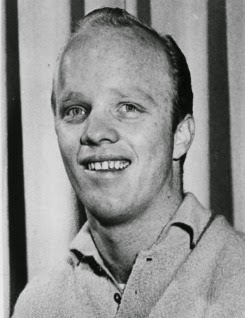
Pictured above are the twins Phillip (top) Dennis (bottom) and Lindsay (the youngest). Eldest brother Gary is not with the group at this time...


SOURCE

Monday, February 23, 2015

THE TRAGIC LIFE OF DENNIS CROSBY

Of all Bing Crosby's sons from his first marriage to Dixie Lee (1911-1952), there is the least information on the one twin - Dennis. In the new documentary on the legendary crooner, it is reported that twins Dennis and Phillip Crosby might have suffered from fetal alcohol syndrome due to their mother's alcoholism, which was common knowledge to Hollywood insiders in the 1930s and 1940s.

Sadly, Dennis ended his life. Bing Crosby's 56-year-old son Dennis turned a 12-guage shotgun on himself following a drunken night of heartbreak just two weeks after his divorce became final.

"It was drink and the disease of alcohol that caused him to do this," Dennis' ex-wife Arlene told STAR in an exclusive interview.

"Over the years, I'd urged him to go to Alcoholics Anonymous, but he had gone only a couple of times. Someone has to decide for themselves that they are going to make the effort to stop drinking."

The May 4, 1991  tragedy in a California boarding house where Dennis had been living mirrored the suicide of alcoholic younger brother Lindsay, who ended his life with a single shotgun blast to the head in 1989.

Arlene says Dennis moved to Novato, Calif, 18 months ago. She admits he walked out on her because she was "difficult to live with," but insists that her only desire had been to encourage him to stop boozing.


"I think he had his own pain about him," she says. "But you will not find anyone who would say a bad word about him. He was sweet, kind, gentle and a wonderful father. He had a wonderful sense of humor.

"But Lindsay's suicide devastated him. He was very close to him. For the last two years, he's been distraught. Everything builds up on him. His trust fund also ran out two years ago and he had been living on very little money."

According to Marin County Sheriff's Lt. William Donovan, Dennis was found late that Saturday night by his roommate. Arlene identified the roommate to STAR as Peter Murphy.

"They were old army buddies," she says. "They had been best friends since serving together in Germany."

Arlene met Dennis in 1963 when he worked for Bing Crosby Productions in Los Angeles. She was a secretary at the time. "We fell in love and married," she says. "We had been married for 27 years."

Dennis also had three daughters - who are now are 53, 47, and 43 respectively.

Arlene last saw Dennis a couple weeks before his death: "We had lunch together just one and half weeks ago, and he was saying how very glad he was that our three children were doing so well. But it was clear that, like me, he was also very sad about our divorce.

"It's very sad. I think we both felt alone, although we still saw each other and he knew that I would always be there to support him."

In addition to his three daughers with Arlene, Dennis was the father of Denise Crosby, 56, who played Security Chief Tasha Yar in the syndicated TV series Star Trek: The Next Generation.


On May 4, 1958, Crosby married Pat Sheehan, a Las Vegas showgirl and model who had once dated his father. She was also Miss San Francisco of 1950, Playmate of the month of October 1958, and part-time actress. Within days, Crosby was sued by another woman, Marilyn Miller Scott, over the paternity of her daughter, Denise Crosby. The sensational lawsuit lasted three years and ended with Dennis being ordered to pay Scott child support and legal fees. This and the marriage to Sheehan and other details caused deep embarrassment for both him and his famous father. Although Bing died when his granddaughter was 19, the two reportedly never met.


Crosby and Sheehan had two sons: Dennis Michael, Jr., and Patrick Anthony. In 1963, while working in Los Angeles for Bing Crosby Productions, he met Arleen Newman. On July 3, 1964, Crosby and Sheehan were divorced. Later that year, Crosby married Newman, with whom he had three daughters, including Kelly Lee Crosby and Erin Colleen Crosby. Dennis was the second of four sons born to the legendary crooner and his first wife, Dixie Lee Crosby. The quietest of the four, Dennis joined his brothers in a nightclub act during the late Fifties, often appearing on the Ed Sullivan Show.

But Dennis always had trouble coping with showbiz. "I guess I wasn't cut out to be an entertainer," he once acknowledged. "I was always painfully self-conscious out here in the spotlight with my brothers."

Bing Crosby died on October 14, 1977, at the age 74 while playing golf in Spain. On January 14, 2006, Dennis's former wife, Pat Sheehan, died at the age of 74. Their son Dennis Michael Crosby, Jr. died on January 15, 2010, and the other son, Patrick Anthony Crosby (born New Year's Eve 1960), died at Cedars-Sinai Medical Center in Los Angeles, on September 19, 2011, after a lengthy illness. He was 50. Of all the Crosby sons, I think Dennis Crosby was probably the most tragic of all of them. They all deserved happiness in their life, but the shadow that Bing Crosby cast was impossible to overcome especially when you mix in depression and alcoholism...


Monday, December 8, 2014

BING'S TWINS AND FETAL INFANT ALCOHOL SYNDROME


But a new documentary called Bing Crosby Rediscovered – which aired on December 2nd at 8 p.m. ET on PBS as part of the American Masters series – sheds fresh light on Crosby's first family with Dixie Lee, a shy actress who drank herself to oblivion before succumbing to ovarian cancer in 1952 at the age of 41.

She and Crosby had four sons, two of whom were twins named Dennis and Phillip, who experts believe suffered from their mother's heavy drinking.

"I had been hearing about it and then the twins, they didn't look quite right," Robert Trachtenberg, the documentary's director, tells PEOPLE. "Something had told me that it was fetal alcohol syndrome, so I took existing photos of the twins and showed it to a couple of specialists at USC. When they’re born [with fetal alcohol syndrome], it affects their skull and their nose, and it manifests itself physically as well. The specialists looked at them and said 'Yeah, this is a like a textbook case of fetal alcohol syndrome.' "

It's not clear whether Crosby ever suspected that his first wife's drinking had an adverse affect on their twins, Trachtenberg admits. Dennis Crosby killed himself in 1991, and Phillip died of a heart attack in 1994. (The two other brothers, Gary and Lindsay, died in 1995 and 1989).


"I couldn't find anything where he blamed her," Trachtenberg says. "That's the other tragedy of this whole situation. She died at 41. Nobody really had any significant way to treat that. Kathryn, Bing's second wife, says in the film it was a terrible way to die. So to add insult to injury, you have this situation [with the twins] on the one hand and then she dies on the other. We could have done a whole other film just about that."

The rest of the documentary features interviews with Crosby's second family – including wife Kathryn and their daughter, Dallas actress Mary Crosby – and focuses on the singer's many contributions to the business, like how he revolutionized radio when he began taping his popular radio shows.

"I think people have this idea of him from those Christmas specials from the end of his life, which even Mary said was bad variety TV," Trachtenberg says. "But what they don’t remember was how cool he really was in the '30s and '40s and '50s. He is just so revered as a musician’s musician to this day … his timing, his phrasing. People still cite him as one of the most influential singers of the 20th century."


SOURCE

Monday, May 13, 2013

INTERVIEW: DENISE CROSBY


Here is an excellent interview that was done with model, actress, and Bing Crosby's grand-daughter Denise Crosby...


Sometime in 1987 the talk amongst the lunch tables at my junior high school was, “Who is the cool new-wave chick inStar Trek: The Next Generation?” At the time we had a lot of interesting women to look up to in music, but this one was living in a future where a woman could be the head of security on a starship. The character was named Tasha Yar, and her backstory was even more inspiring. She was an orphan who had to scavenge for the bare necessities of life, escaped rape gangs, overcame a drug addiction, and through her bravery and determination made her way into a high-profile job aboard the Starship Enterprise. For a bunch of teenage girls facing an uncertain future ourselves, she was the ultimate heroine. Until she was killed by Armus, a malevolent life form made from the byproduct of human negativity and evil. Tragically, our heroine had become a memory contained in a hologram.

But Denise Crosby, the actor who made Tasha Yar legendary, lives on and continues to appear in films and on television as heroines in all sorts of universes. I met her recently at a Star Trek convention, where I saw her walking down the hallway with a small group of admirers. My opening line was one of pure fandom: “You’re awesome!” Surprisingly, we hit it off like old friends, discovering we grew up in the same neighborhood and had a deep affection for anything Fiorucci. As we spoke, the fandom subsided, and I became very much inspired by her legacy. A month later I found myself in her backyard discussing her career over coffee and cookies.


VICE: Being the granddaughter of Bing Crosby and the daughter of Dennis, you were born into the entertainment industry. Was there ever a time when you thought you would not go into showbiz?

Denise: Absolutely. In my youth I had that rebel spirit in me that didn’t want to do anything people assumed I would do. Instead I would purposefully go out and do the opposite. I moved away from home and out of Los Angeles as soon as I could. I loved journalism and wanted to be like Christiane Amanpour or Diane Sawyer. I knew I wanted to be on camera, but I wanted to do investigative reporting or work in the field, so I studied journalism and drama at a college in Santa Cruz. On a fluke I auditioned and got the part in the spring production of the school play, which put me in touch with a part of myself that I enjoyed but wasn’t ready to embrace. I took a year off and bummed around the world, scored a few modeling jobs in London and Paris. Eventually I came back home to my parents’ place in Los Angeles, and it was there that I was contacted by a casting agent who had seen some pictures of me in Playboy.

But before you became a sensation, you worked at a furniture shop on Melrose called Dodson’s, which went on to become famous because it was owned by the world’s most achieved bank robber, Eddie Dodson, a.k.a. the New York Yankees Bandit. How did that come to be?

I knew Eddie Dodson because he was the center of the party scene. He was a great friend and the most fun person to be around… probably because he was insane! There were a lot of drugs and always a lot of cocaine. Eventually Eddie gave me a job at his shop. I would rehearse scenes while working, and in my off time I would go on auditions. I worked there until I got a role in the film 48 Hrs.

Did you know Eddie was robbing banks in his spare time?

My goodness, no. But sometimes I would show up for work and he wouldn’t be there and the shop would be closed. By this time his drug use was so out of hand I figured he was passed out—but now I know he was either running from the cops or robbing a bank somewhere.

After 48 Hrs. you started getting regular work as an actor appearing in several TV movies and the awesome feature Eliminators, where you played a robotics engineer. Then, in 1987, you landed the part of Tasha Yar on Star Trek: The Next Generation. Throughout your career, you are often cast as strong hard-nosed characters—cops, detectives, security chiefs, stock-market executives—basically women who can handle themselves in tough situations. Why do you think that is?

I think a lot of it has to do with the fact that I’m tall and wear my hair short—in Hollywood they look at the physical first.


One of your best loved roles was on Star Trek: The Next Generation. Tell me about thet experience.

I think one of the reasons why Star Trek: The Next Generation continues to be influential is because of the roles the women played on the show. They were equal to the men, and in Tasha’s case the only man who could take over her job was a Klingon!

In my opinion the intentions were good, but they should have taken it even further—that was my main frustration with the show. I hate to burst your bubble, but it was the writers, not Gene Roddenberry, who were fighting to make the female characters more dynamic. There was a real friction with putting the women in power.

Is that why you left the show?

Sexism was involved, and although I understand it is an inherent part of the world, it is something we must continue to fight. You fall in love with what you do and at that point in my career, I was very passionate about acting. It wasn’t a rash decision to leave the show. I was continuously asking my coactors and the writers what the trajectory was. One day Gene Roddenberry told me, “This is the formula for Star Trek and it works. It is not going to change.” I was simply afraid of staying in that uniform for six more years while I was in the prime of my life. I had to take a risk.

What did you do after you left Star Trek?

I did a movie I really loved called Miracle Mile. I also did Pet Semetary, X Files, Southland, and I have a new show about to premiere on Showtime called Ray Donovan. I play a character named Deb who is an interior decorator and Elliott Gould’s mistress. Don’t get me wrong—I loved the Tasha Yar character. In hindsight I think she became more iconic by dying.

When we met what impressed me most about you was seeing you at my first Star Trek convention. It was late at night and the convention was technically closed, but you were sitting at a table full of fans laughing and talking.

Well I don’t see divides between people. At heart, we are all the same. Especially once you get rid of the autograph table...


SOURCE


Friday, March 2, 2012

SPOTLIGHT ON PHIL CROSBY

Any fan of singer Bing Crosby or even anyone acquainted with his work or life know that the sons from his first marriage had a hard time in adulthood. Being the son of Bing Crosby, especially during the height of his fame in the 1940s and 1950s, was very hard. The four boys that Bing Crosby and Dixie Lee had all had tough lives. They had their personal demons that they dealt with - and unfortunately only one of the sons seemingly overcame the demons. Sadly, even though Phil Crosby overcame the turmoil of being the child of a superstar, he died in 2004 at the relatively young age of 69.

Born on July 13, 1934 - Phillip Crosby and his twin brother Dennis Crosby were born in Los Angeles, California. After attending a strict, Jesuit-run boarding school south of San Francisco, Phil served a stint in the Army in the mid-1950s and attended what is now Washington State University in Pullman, where he was a guard on the football team.

Chuck Morrell, the team's star fullback who shared a house with Crosby at the time, recalled that when Philip needed a car in college, his father had a driver deliver him a brand-new Chevrolet.

"He wasn't snooty or anything," Morrell, who remained lifelong friends with Crosby, told The NY Times in 2004. "He was a good, friendly guy and everybody liked him. You wouldn't know he was Bing Crosby's son."


Like his other brothers, Phil never succeeded in entertainment like his father did. Phil sang with his brothers in an act for awhile, but the group broke up as rock 'n' roll took its hold on audiences. Phil appeared with his father in a couple of movies like "Duffy's Tavern" (1945) and "Robin And The Seven Hoods"(1964), and he had more substantial roles in dramas like "Sergeants 3" (1962) and "None But The Brave"(1965).

Phil appeared as a solo singer on The Ed Sullivan show in the late 1960s where he sang a great version of "Let There Be Love". He also appeared with papa Bing on a Hollywood Palace show on April 5, 1969 where he sang with Bing and recreated the songs that Bing and brother Gary had recorded 15 years earlier. Phil also later started a country music label named after his mother Dixie Lee, and recorded some great country western songs.


Like his brothers, Phil Crosby was also married numerous times. He was married four times and had five children - his youngest son, Phil Crosby Jr, is an accomplished musician and singer - who is quite talented in his own right. I recently talked to Phil Jr. and he said that his father should be remembered as "a loyal son, who loved and admired his parents very much. He had a great voice that was unique amongst the Crosbys. He had many friends that appreciated even his late night calls and would receive them and talk for hours and considered him a good conversationalist."


On October 14, 1977 Bing Crosby died. Tragedy struck Phil again a year later when his oldest son Brian Patrick Crosby was killed in a motorcycle crash at the age of 18. Phil remained on good terms with his brothers after Bing died with the exception of Gary. Phil has been quoted as saying that "My dad was not the monster my lying brother said he was, he was strict, but my father never beat us black and blue and my brother Gary was a vicious, no-good liar for saying so. I have nothing but fond memories of dad, going to studios with him, family vacations at our cabin in Idaho, boating and fishing with him. To my dying day, I'll hate Gary for dragging dad's name through the mud."

Phillip gave his final performance at an Elk’s Club party in Burbank in 1983. Phil's youngest brother Lindsay died in 1989, and his twin brother Dennis followed in 1991. (Gary later died in 1995). Despited outliving his brothers, son Phil Jr said his father's health was not good: "His last years were not good. His death could have been avoided if anyone had looked in on him and saw to it that he was taking his prescribed heart medication. But he had pretty much insulated himself and become a shut-in."


There has been rumors through the years that the Crosby boys from Bing's first marriage did not get along with Kathryn Crosby and Bing's second family. Phil Jr wanted to settle the record on that: "My father never spoke ill about Kathryn, that I know of. I don't believe he blamed her for not being in his Fathers will. She was very congenial to me when I met her, introducing me from the stage at Bing's Academy Centennial and standing by my side holding my hand at my fathers funeral. I thought that was very good of her. She also told the audience in Beverly Hills that she thought Phil had the best voice of the boys."


Even though Phil Crosby did not get the fame that I think he deserved, he passed down a lot of talent to his youngest son Phil Jr, who is carrying on the Crosby legacy in music. Phil Jr says that "growing up Crosby was a unique experience. I enjoyed watching the road pictures and every Christmas was a little more special for me. Sometimes it could be strange when I was little and didnt understand peoples reaction to my last name, though."

Phil Crosby Jr is currently working on some new exciting projects: "I'm producing my show 'Finding My Way' a jazz swing, cabaret, song and story, dance and musical history journey and personl reflection on my grandfather and his family and famous friends and the music of the twentieth century. Should be good." It is definitely something that would make his grandfather and his father proud...

I WANT TO EXPRESS MY GRATITUDE AND HONOR TO BE ABLE TO TALK TO PHIL CROSBY JR.