Saturday, December 12, 2020

PHOTOS OF THE DAY: BING AND CHRISTMAS THROUGH THE YEARS

 Bing Crosby was and is definitely Mr. Christmas at this time of the year. No entertainer has sung more Christmas songs or had more Christmas hits than Der Bingle. Here are some great Christmas pictures through the years...


with Marjorie Reynolds


with Frank Sinatra


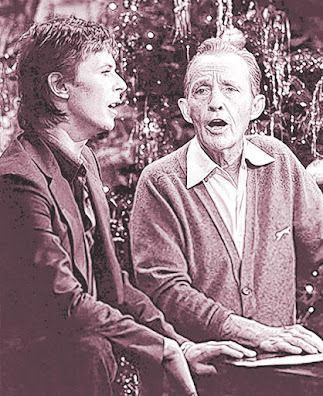
with David Bowie


With his 2nd family


With Rosemary Clooney


Tuesday, December 1, 2020

BING'S HOLLYWOOD


One of my favorite series of LPs of all time was Decca's Bing's Hollywood series. The Bing's Hollywood series was a Decca Records 15-album set by Bing Crosby of commercial recordings of songs used in his films from 1934 to 1956.

Numbered in order from Decca DL4250 to DL4264, the LPs included "Easy to Remember", "Pennies from Heaven", "Pocket Full of Dreams", "East Side of Heaven", "The Road Begins", "Only Forever", "Holiday Inn", "Swinging on a Star", "Accentuate the Positive", "Blue Skies", "But Beautiful", "Sunshine Cake", "Cool of the Evening", "Zing a Little Zong" and "Anything Goes." 

In the UK, Brunswick Records issued the set with the numbers BING1 to BING 15. In 1988 MCA Universal began reissuing "Bing's Hollywood" on compact disc, but poor sales abruptly halted the series following the release of "Holiday Inn", "Swinging on a Star" and "Blue Skies."

Variety gave the background in its issue of March 14, 1962: “The timing was just right for Decca's massive release of Bing Crosby's Hollywood story. It fits perfectly into the programming pattern being adopted by so many radio stations, which in veering away from Top 40, are going in for marathon spinning of an individual personality. This Crosby release is tailor-made for them, in that it consists of 15 separate L.P's containing 189 songs from over 40 pictures. No singer has come close to that mark and it's a record that's sure to stand for a long, long time. For the average consumer the purchase of the complete series will obviously be hard on the pocket-book but each LP can be obtained separately (the suggested retail price is $3.98) and each one is a gem. Not only did Crosby have a solid song-selling way right from the beginning, but he had top tune-smiths turning out material for him all the way...The series is virtually a recorded history of the film musical genre and a credit to all concerned"

On a personal note, I used to have all the albums, but a decade or so ago all of them were damaged in an apartment flood. I have not gotten all of them back in my collection except four. They are rare and hard to come by, but I highly recommend them all!


Saturday, November 21, 2020

BING ON FILM: DOUBLE OR NOTHING - PART TWO

The film was shot quickly in Hollywood from April 26 to June 15, 1937, and even the though the story was much better than previous lighthearted Bing Crosby romps, the big draw of the movie was the music.  Bing opened the film singing “Smarty” – which was written by Burton Lane and Ralph Freed strangely enough and not Bing’s resident songwriters, Arthur Johnston and Johnny Burke. I love how Bing sang the song “Smarty” in the film, competing with an opera singing chef. This is the song that I remember recording with my little handheld recorder. Johnston and Burke wrote a bunch of other Crosby gems for the film like: “The Moon Got In My Eyes”, “It’s The Natural Thing To Do”, and my personal favorite – “All You Want To Do Is Dance”. Unfortunately, Bing never recorded a show stopping number commercially called “After You”. The song was written by Al Siegel and Sam Coslow, and in the film, it was sung by Bing, Martha Raye, Frances Faye, and Harry Barris. Frances Faye, who would emerge as a great jazz singer in the 1950s, played Martha Raye’s sister for the quick musical number, and for a long time I thought they were sisters. The number also marked the first time that Bing and ex-Rhythm Boy pal sang together on film since the Paul Whiteman opus King Of Jazz in 1930. I wish Bing would have recorded the song “After You”, and it looked like Tommy Dorsey and His Orchestra recorded the song, but it never became a hit. 

The critics enjoyed the film, but for 1937 they were a little critical of Bing: 

The New York Times - "It is a tuneful show with three numbers better than average—"It’s the Natural Thing to Do”, “It’s On, It’s Off” and “The Moon Got in My Eyes”—but a show which lacks buoyance and sparkle, perhaps because of unimaginative direction....Although Bing delivers five songs in his customary agreeable voice and makes a pleasant enough suitor for the fair Mary Carlisle, it is really the explosive Miss Raye, the madcap adagio dance team of Ames and Arno and the Calgary Brothers (specialists in inebriation) who provide the brighter moments." 

Variety - "Bing Crosby and Martha Raye are teamed again in Double or Nothing which should give the film big first run sendoffs, as their names are potent on marquees. . . This is not the first time that Crosby has carried a heavy load on his broad shoulders. Point is, can he keep on doing it indefinitely? He is strictly a personality, just passing fair as an actor, but his croon is unique and the wide radio exploitation he has keeps him a valuable asset for theaters. He needs carefully selected vehicles in which his share of the entertainment obligations is limited to his particular talents. . . Value of the Crosby warble is dimmed because he sings in nearly every episode in which he appears. Some of it is so casual that his major effort near the end of the picture falls rather flat." 

The Washington Post - "That gorgeous rowdy-dow, Martha Raye, divides honor evenly with Bing Crosby, now undisputed king of the musicals, his mere crooner days forgotten...Bing Crosby was never better and this critic thinks never so good, as in Double or Nothing. This is praise with a vengeance. But when you see Monsieur Crosby dancing with Mary Carlisle and warbling such numbers as “Smarty”, “It’s the Natural Thing to Do”, “All You Want to Do Is Dance” and “After You” — well, we’ll wager a plugged nickel against a double eagle that you’ll agree. Bing is one of the few Hollywoodites who ripens mellowly." 

The film boasted a great cast of 1930s stars, and one of the most appealing aspect of Bing Crosby’s 1930s movies were the ones when he starred with Mary Carlisle. They definitely have movie chemistry, and in my opinion, Mary was one of the most beautiful actresses of the 1930s. After seeing Martha Raye in this movie, I dug out an old CD I have of Martha’s records. She recorded for Decca in the late 1930s, and her voice was much better than she was given credit for. She definitely had a way with a song. Harry Barris made an appearance as a bandleader as well. Every time I see Harry Barris in a Bing movie I feel sad because he was so talented, and yet because of his drinking Bing had to help him find work and put him in little roles. Harry Barris was so much more talented than the success that eluded him.

Last time around I reviewed a very different movie with Bing’s 1953 Little Boy Lost. The movie Double Or Nothing could not be more different of a movie, but both movies really showcase Bing Crosby’s greatness. With this movie, it not only showed Bing’s growing command of the film screen, but also it showcased his ability to be a fine comedic actor. Bing was not a superstar like he would become in the 1940s, but with every screen role Bing would become more and more of a screen presence. Double Or Nothing was a fun movie to watch, and they do not make movies like this anymore...

MY RATING: 9 out of 10


Saturday, November 7, 2020

BING ON FILM: DOUBLE OR NOTHING - PART ONE


It is amazing how movies can transform you back to a different period in your life. For this review I had the pleasure of watching Bing’s 1937 movie Double Or Nothing. I had not seen the movie in over ten years, but it was one of the first movies I remember watching as a child. Back then I did not have the recordings Bing made for the film, so I had a handheld tape recorder that I held up to the television speaker to record the songs. It is amazing how far we have come in technology since then! When I was younger, I remember watching Double Or Nothing and thought it was a really fun movie. Seeing it now years later, it is just as fun of a movie, and I might have a better appreciation for the talent that was in Double Or Nothing.

The film had its premiere on September 1st, 1937 at the Paramount Theater in New York City. The movie begins with a stranger leaving wallets $100 in them all over the city. In the wallet is an address to return it to. Not everyone returns the wallet, but four honest souls did. They included a performer who hopes to open up a night club (Bing Crosby), a two bit criminal/thief (William Frawley), an ex-dancer who was trying to stay on the right side of the road (Martha Raye), and a clueless buffoon (Andy Devine). Those four people go to the address where they were instructed. It ends up an eccentric millionaire died, and he did not trust his family. What he did trust and believe in was the honesty of strangers. His lawyer tells the four confused people that they will get $5000 to keep. However, the first person who could double that sum within one month, through honest means, would inherit the millionaire’s entire estate. Otherwise, the entire estate would go to the millionaire’s greedy brother who is determined to thwart the plan. 


Each of the four try their hand at doubling their money. However they are sabotaged by the millionaire’s family which includes the greedy brother of the millionaire (Samuel Hinds), his wife (Fay Holden) and their beautiful daughter (Mary Carlisle). William Frawley loses his money very quick by listening to the greedy brother. Martha Raye tries her hand at opening a boat tour run by her old dancer friends. Unfortunately, when a particular song is played – “It’s On, It’s Off”, Martha takes her closes off so guess what happens on their opening night! Andy Devine has what seems like a promising business. He opens a little business where one tries to sink a single golf ball and win a big money prize. The sneaky brother brings in a golf pro to sink a putt, but he cannot. At the very last minute though a drunk stumbles into the business and sinks a hole in one, so Andy Devine loses his money. Bing ends up being the only smart one! He wants to open a nightclub, and he rents the building from the millionaire’s brother, but he reads the fine print and sees the nightclub is only zoned for storage, so he buys the building next door to move the nightclub to on the night of opening...

TO BE CONTINUED... 


Saturday, October 24, 2020

THE SUCCESS AND FAILURES OF PROJECT RECORDS


Here is another great article from our contributor ModernBingFan0377...


Much in the same vein as a certain Francis Albert in the late 50s Bing would create his own record label mainly to issue out his recordings to other companies. His first project, however, promised much more than that it seems, How The West Was Won. Recorded for Project Records it would be released by RCA Victor, it featured many artists besides Bing including Rosemary Clooney and would go on to inspire the movie by the same name. Although I haven't got my hands on the album I've heard it is very good.

Bing would then go on to ruin a big chunk of it's potential by releasing a string a sing along albums which did good at the time, but did not have a good longevity. He did make up for these sing along albums though with 4 great LPs.

The first of these LPs is Bing & Satchmo. A Billy May orchestrated LP featuring Bing and Louis Armstrong. The only disappointing thing about the album is the lack of chemistry/ad-libbing seen in their radio duets and film duets. The good thing is though is the album becomes more replayable to some people due to the absence of these ad-libs. Billy May did some good Dixieland style arrangements and added to the quality of this album.

After this album of duets Bing would go onto create the ‘El Senor Bing’ album which featured some standards mixed in with some south of the border themed songs mixed together with Billy May’s Latin style of arranging here. I very much enjoy this album although it is divisive among some people. It is divisive because of the choice to make each track a medley of 2 songs, which in some cases can work rather well in my opinion, but I can see why one would think otherwise. One disappointing part though is the fact that the master tapes have apparently been misplaced making the CD release have to use the LP mixes.


This next Bob Thompson arranged and Malcolm Lockyer conducted album would feature Bing in a more traditional album, Holiday In Europe. Which is Bing’s European themed version of a travel album. The album was released in 1962 by Decca after being recorded in October of ‘60 and May of ‘61. It features European songs with some of the lyrics on some of the songs were written by Bing himself. He would overdub to the orchestral track on this album, but would still be a successful album quality wise. This album his been released by SEPIA last year with 14 bonus tracks including a session track. I find myself to enjoy this album quite a bit.

The last Project Records album would become the most famous one and the probably the best one. Bing’s I Wish You A Merry Christmas is probably Bing’s best studio Christmas album in contrast to Christmas Greetings and A Time To Be Jolly with a better set of songs than either of those. This time around Bob Thompson, Jack Holloran, and Peter Matz would arrange and conduct the tracks in July of 1962 with Bing recording the overdubs in October of 1962. Despite the variety of arrangers the tracks fit in together well. Bing’s voice is rich and records definitive versions of many of the songs on this album to me. It would be released by Warner but would later and is currently released by Capitol as Christmas Classics expanded with Bing’s Christmas single for Capitol, a Decca recording, and a shortened version of White Christmas from 1957. This would be Bing’s last sessions for Project Records.

I’m not sure if he just decided to stop recording for Project and leasing out the albums or what, but I believe it had to do with his short lived contract at Reprise. It seems he had plans to do more at Reprise besides the multiple collaboration album and Return To Paradise but nothing came into fruition before he left Reprise to become a free agent once again. Bing’s Project Records run would create 4 very solid albums with the rest being sing a-longs. This would be his most heavy recording schedule for many years until he would go to UA and start his albums with Ken Barnes...


Friday, October 16, 2020

REMEMBERING RHONDA FLEMING (1923-2020)

Rhonda Fleming, star of the 1940s and ’50s who was dubbed the “Queen of Technicolor” and appeared in “Out of the Past” and “Spellbound,” died Wednesday in Santa Monica, Calif., according to her secretary Carla Sapon. She was 97.

Fleming appeared in more than 40 films and worked with directors such as Alfred Hitchcock on “Spellbound,” Jacques Tourneur on “Out of the Past” and Robert Siodmak on “The Spiral Staircase.”

Later in life, she became a philanthropist and supporter of numerous organizations fighting cancer, homelessness and child abuse.

Her starring roles include classics such as the 1949 musical fantasy “A Connecticut Yankee in King Arthur’s Court” alongside Bing Crosby whom she later dated, 1957 Western “Gunfight at the O.K. Corral” and the noir “Slightly Scarlet” alongside John Payne.

Her co-stars over the years included Kirk Douglas, Glenn Ford, Burt Lancaster, Bob Hope, Rock Hudson and Ronald Reagan, with whom she made four films. Other notable roles included Fritz Lang’s “While the City Sleeps,” “Pony Express” and “The Big Circus.” One of her last roles was in the Don Adams farce “The Nude Bomb” in 1980, and she spoofed herself as “Rhoda Flaming” in 1976 comedy “Won Ton Ton, The Dog Who Saved Hollywood” along a bevy of other vintage performers from Dorothy Lamour to Stepin Fetchit and Rudy Vallee.

Born Marilyn Louis in Hollywood, she attended Beverly Hills High and was discovered by the famous agent Henry Wilson while on the way to school, she told the Warner Bros. podcast. Wilson changed her name to Rhonda Fleming and she was then signed to a contract with David O. Selznick. Her first major part was as a nymphomaniac in “Spellbound,” and she said she was so naive she had to look up the word in the dictionary when she was cast.


In addition to cinema, Fleming made her Broadway debut in Clare Boothe Luce’s “The Women” and toured as Madame Dubonnet in “The Boyfriend.” In 1957, Fleming made her stage musical debut in Las Vegas at the opening of the Tropicana Hotel’s showroom. Later she appeared at the Hollywood Bowl in a one-woman concert with compositions from Cole Porter and Irving Berlin. In 1960, she was awarded a star on the Hollywood Walk of Fame.

Fleming also routinely guest-starred on television in series including “Wagon Train,” “Police Woman,” “The Love Boat” and a two-hour special of “McMillan & Wife.” Along with Maureen O’Hara, she was bestowed the nickname of “Queen of Technicolor” for how well her red hair and green eyes photographed in vivid color.

In 1991, Fleming and her late husband Ted Mann of Mann’s Theaters established Rhonda Fleming Mann Clinic for Comprehensive Care for Women with Cancer at UCLA in memory of her sister Beverly, and in 1992, she founded the Rhonda Fleming Mann Resource Center at UCLA. She opened the Reflections boutique to help cancer patients with items including wigs and prostheses.

She also supported Providence Saint John’s Health Center in Santa Monica, Calif., where she established the Rhonda Fleming Carlson Inspiration Garden in 2014.


Her other charitable efforts include being an ambassador of Childhelp, dedicated to the care and treatment of victims of child abuse, and P.A.T.H. (People Assisting the Homeless), where she established two Rhonda Fleming Family Centers.

After her sister Beverly died of cancer, she became a supporter of cancer research and with her then-husband Ted Mann of Mann Theatres, established the Rhonda Fleming Mann Clinic for Women’s Comprehensive Care at UCLA Medical Center. She also supported the Rhonda Fleming Mann Resource Center for Women with Cancer at UCLA. To further research and treatment for women’s cancer, she created The Rhonda Fleming Mann Research Fellowship at the City of Hope Hospital.

Her sixth husband, Darol W. Carlson, died in 2017.

Fleming is survived by her son, Kent Lane, granddaughter, Kelly Harman (Morgan Harman), granddaughter, Kimberly Coleman, as well as well as great-grandchildren, Wagner Harman (Lindsay Harman), Page Harman, Linden Harman, Lane Albrecht, Cole Albrecht and two great-great grandchildren, Ronan and Kiera Harman. She is also survived by step-children, Candace Voien, Cindy Jaeger, Jill Lundstrom and Kevin Carlson...


Wednesday, October 14, 2020

BING'S DEATH: 43 YEARS AGO

In this photo, Bing tees off on the La Moraleja golf course near Madrid, Spain, on the afternoon of Oct. 14, 1977. He finished 18 holes of golf -- carding an 85 -- and, with his partner, club president Cesar de Zulueta, defeating 2 Spanish golf pros, Manuel Pinero and Valentine Barrious...


After his final putt Bing bowed to acknowledge the applause of some fans and remarked ""That was a great game of golf, fellas." As he was walking to the clubhouse about 6:30 he collapsed from a massive heart attack. Bing made no attempt to break his fall and landed head-first on the red-brick pavement, producing a large bruise on the left side of his forehead. "We thought he had just slipped," said one of his golfing companions. "Bing had shown no sign of fatigue. He was happy and singing as he went around the course." His 3 golfing companions carried Bing the remaining 20 yards to the clubhouse where a physician administered oxygen and adrenalin without success.

Bing's funeral began at 5 a.m. Oct. 18, 1977 at Holy Cross Cemetery, Culver City, California. Bing's will specified that only his wife and 7 children should attend, but Kathryn invited Bing's siblings as well as Bob Hope, Rosemary Clooney and Phil Harris. The ABC reporter who covered the funeral, Geraldo Rivera, noted the early morning hour was when the blue of the night met the gold of the day...