Showing posts with label Frank Sinatra. Show all posts

Sunday, September 27, 2026

PHOTOS OF THE DAY: BING IN THE RECORDING STUDIO

Bing Crosby was a giant among recording artists. Here are some candid shots of Bing at the recording studio...


with Judy Garland

with Frank Sinatra

with Eddie Condon


Sunday, July 5, 2026

BING AND HIS MOST SUCCESSFUL MOVIES


Long before box-office weekends were measured in superhero billions, success in Hollywood meant something a little different. It meant longevity, audience devotion, and the rare ability to make moviegoers feel at home the moment you appeared on screen. Few actors embodied that kind of success more completely than Bing Crosby—a relaxed, warm, velvet-voiced star whose films defined popular entertainment from the 1930s through the 1950s. Crosby didn’t just star in hits; he helped shape entire genres. From heartfelt dramas to sparkling musicals and riotous road comedies, his most successful movies reveal why he became one of the highest-grossing and most reliable stars in American film history.

Going My Way (1944): The Role That Defined Him

If one film cemented Bing Crosby’s legacy, it was Going My Way. Playing the easygoing, modern-minded Father Chuck O’Malley, Crosby delivered a performance that felt effortless but deeply affecting. The film struck a nerve with wartime audiences eager for comfort, humor, and hope.

Its success was staggering. Going My Way became the top-grossing movie of 1944 and went on to win seven Academy Awards, including Best Picture and Best Actor for Crosby. More than trophies, the film established Crosby as a symbol of calm wisdom and decency—an image that would follow him for the rest of his career.

The Bells of St. Mary’s (1945): Lightning Strikes Twice

Few sequels surpass their predecessors, but The Bells of St. Mary’s came remarkably close. Reuniting Crosby with his priestly character and pairing him with Ingrid Bergman, the film expanded the emotional stakes while maintaining warmth and humor.

Incredibly, it outperformed Going My Way at the box office, becoming the highest-grossing film of 1945. Audiences returned not just for the story, but for Crosby himself, whose presence had become a guarantee of quality and reassurance in uncertain times.


Holiday Inn (1942): A Song That Changed Movie History

Holiday Inn might have been successful even without Crosby—but it’s impossible to imagine the film without him. Playing a song-and-dance man who retreats to the countryside, Crosby delivered one of the most famous musical performances of all time: the original rendition of “White Christmas.”

The film was a major hit, but its cultural impact proved even more enduring. The song would go on to become the best-selling single in recorded music history, tying Crosby forever to the sound of the holidays—and helping make Holiday Inn a perennial favorite.

White Christmas (1954): Old Hollywood at Its Grandest

By the 1950s, Crosby was no longer just a star—he was an institution. White Christmas, filmed in dazzling Technicolor and VistaVision, paired him with Danny Kaye in a lavish musical celebration of friendship, romance, and nostalgia.

The result was a phenomenon. White Christmas became the highest-grossing film of 1954, and for many viewers, it came to embody the very idea of the classic Hollywood musical. Crosby’s relaxed charisma anchored the spectacle, proving that even in a changing industry, audiences still wanted him front and center.

The Road to… Movies: Comedy Gold with Bob Hope

No discussion of Crosby’s success is complete without the Road pictures, his long-running comedy partnership with Bob Hope. Films like Road to Morocco (1942) and Road to Utopia (1946) were gleefully self-aware, anarchic, and wildly popular.

Commercially, they were dependable hits. Creatively, they showed Crosby’s underrated comic timing and willingness to poke fun at his own screen persona. Together, Crosby and Hope formed one of Hollywood’s most profitable and beloved duos.


High Society (1956): A Graceful Finale

One of Crosby’s last major film successes, High Society allowed him to revisit familiar territory—a lighthearted musical remake—while sharing the screen with Grace Kelly, Frank Sinatra, and Louis Armstrong. The film was a box-office success and served as a fitting late-career triumph.

By this point, Crosby had little left to prove. His success was no longer about dominance, but about refinement and legacy.

Bing Crosby’s most successful films weren’t just hits on release—they became cultural touchstones. They offered humor during war, music that endured across generations, and performances that felt natural in an industry built on glamour and excess.

Crosby’s genius wasn’t flash or intensity. It was ease. And in movie after movie, that ease translated into enormous success—both commercial and emotional. Long after the box-office receipts faded, his films kept playing on televisions, during holidays, and in the collective memory of Hollywood itself.

That, ultimately, may be the greatest measure of his success...

Sunday, September 14, 2025

HIGH SOCIETY IN 4K ULTRA HD

Review by John Larkin

As someone who admittedly isn't deeply steeped in the golden age of Hollywood musicals, and with only a passing familiarity with the individual works of Bing Crosby and Frank Sinatra, I have to confess that HIGH SOCIETY wasn't a film that was on my radar. Yet, the online buzz surrounding its 4K Ultra HD release from Warner Archive was simply too infectious to ignore. And what a release it is! This marks only the second 4K offering from Warner Archive, following the monumental release of THE SEARCHERS – a film that, thanks to our very own owner and editor-in-chief Roy Frumkes, received what is, by far, the best coverage on the internet, or perhaps ever written!

So, with a sense of curiosity and a dash of skepticism for a genre I don't typically gravitate towards, I dove into HIGH SOCIETY. And I'm incredibly glad I did. This hip, witty musical version of Philip Barry's The Philadelphia Story is an absolute delight. We're whisked away to the scenic, moneyed grounds and waters of outwardly elitist Newport, Rhode Island, where Bing Crosby, Grace Kelly, and Frank Sinatra romp elegantly through a tangled web of romance and witty banter.

The film's charm is immediately evident, not least due to the legendary Louis Armstrong, who plays himself and serves as our delightful narrator. Through prose and song, he guides us through the peccadillos of his songwriter friend C.K. Dexter Haven (Crosby), his beautiful perfectionist ex-wife Tracy Samantha Lord (Kelly, in her luminous and final film role), and her rather stuffy fiancĂ© George Kittredge (John Lund). The plot thickens with the arrival of a scandal sheet reporter (Sinatra) and a wise-cracking photographer (Celeste Holm), who are there to cover the wedding but end up complicating the already convoluted romantic entanglements. Armstrong and Dexter conspire musically and by other devious means to stop Tracy's impending marriage. Dexter, naturally, wants her back, but she finds herself drawn to the magazine writer – all of which provides everyone with wonderful excuses to break into the incomparable songs of Cole Porter.

What truly elevates this release, beyond the sheer enjoyment of the film itself, is the meticulous work done by Warner Archive. M-G-M truly pulled out all the stops for HIGH SOCIETY back in 1956, even going so far as to license Paramount's magnificent widescreen process, VistaVision, to ensure it was something special. Now, thanks to the tireless and truly amazing work of George Feltenstein and his team at Warner Archive, this film has been meticulously restored and remastered from its original VistaVision negative. The result is nothing short of stunning. The colors pop, the detail is exquisite, and the sense of depth is palpable. Accompanied by a thrilling new Dolby Atmos remixed soundtrack, HIGH SOCIETY looks and sounds better than ever before, truly a testament to the preservation efforts being made. It's a release that immediately brings to mind Paramount's excellent 4K offering last year of WHITE CHRISTMAS, which was the very first VistaVision film ever shot.

Even if you're not a die-hard musical fan, or if the names Crosby and Sinatra don't immediately conjure up images of cinematic magic for you, I urge you to give HIGH SOCIETY a watch. It's a sparkling, witty, and visually glorious experience, and a truly stunning release from Warner Archive that showcases the incredible work they continue to do in preserving and presenting classic cinema...


Sunday, April 7, 2024

PHOTOS OF THE DAY: BING AND FRANK SINATRA

Here are some wonderful photos of the two blue eyes - Bing and Frank Sinatra. They appeared together many times during their careers...


Friday, December 22, 2023

PHOTOS OF THE DAY: BING AND HIS CHRISTMAS SPECIALS

 No one in the modern world meant more to Christmas than Bing Crosby. Here are som candid shots from his Christmas specials through the years...


with Frank Sinatra


Friday, October 20, 2023

BING CROSBY VS FRANK SINATRA

Bing Crosby was, along with Louis Armstrong, one of the fathers of jazz-influenced singing. He was a crooner like Rudy Vallee and Russ Columbo but with the rhythmic panache of a jazzman. In the 1930s, "The Old Groaner," as Bing was affectionately known, was the biggest singing star in America. Like the rest of the country, a young Frank Sinatra was charmed by Crosby's many radio appearances and his ultra-relaxed way with a song. When he was nineteen, he finally saw Bing in person—and the brouhaha that accompanied being a pop music star—and Sinatra knew he was going to be a singer.

In his early years, he made particular efforts not to sound like Bing. "Every kid on the block was boo-boo-booing like Crosby," he said, with the result being that there were as many differences between the two singers as there were similarities. Although Sinatra soon achieved Crosby's warmth of tone—especially on his Columbia recordings of the 1940s -- he rarely matched Bing's relaxed style.

This is clear when you compare his 1941 recording of "You Lucky People, You" to Crosby's performance of the song from the soundtrack to the film Road To Zanzibar. Where Sinatra makes relatively heavy weather of Jimmy Van Heusen's elaborate little melody—pulling away from the beat to make sense of the phrasing—Crosby breezes through the line with insouciant swing, and it makes perfect sense.


Sinatra would learn later to relax on rhythmic lines, but even then his swing remained edgier than Crosby's. "I believed, because of his leisurely manner of working, that if he could do it, I could do it," Sinatra said in the mid-1950s. "The funny thing is that I've never been able to do it. It's just a trick he has, a wonderful relaxed feeling about performing."

Nelson Riddle had a slightly different take on the differences between the rhythms of the two men, "Sinatra digs into a song and tries to get into it," he noted. "Crosby has a calculated nonchalance. He tosses off a tune". This made for terrific rhythmic bounce and cheerful irony, but when contrasted with the vulnerability and poignancy that the volatile Sinatra could achieve with a song, there could be a certain emotional distance in Crosby's work, as there apparently was in his life. Crosby was the original cool singer; Sinatra was the opposite of cool, as a man and as an artist. And Crosby recognized the difference himself: "He creates a mood, which very few people are able to do," Bing once said of Frank. "I don't think I create a mood when I sing."

The two men had different voices, too, and different approaches to them. Crosby rarely ventured from his smooth baritone range to indulge in bravura finishes or extremity of tone. Sinatra not only learnt to make more than Crosby of the expressive "grain" in his voice but would also, at various times in his career, venture to extremes, bringing startling drama to the music, as he did with the high F of "All Or Nothing At All" in 1939 and the low E of "Ol' Man River" in 1963. "Sinatra's voice is more 'live' and vibrant and fraught with shadows and coloring than Crosby's voice," Riddle observed.


Sinatra was always quick to pay tribute to Crosby, saying in the 1940s, "Bing was my first singing idol, and still is." The Old Groaner, meanwhile, acknowledged the rise of the Voice with the oft-quoted quip, "Frank Sinatra is the kind of singer who comes along once in a lifetime. But why did it have to be my lifetime???" He even sent an open letter of advice to the young crooner that was published in Motion Picture: Hollywood Magazine in December 1943. "Keep riding that skyrocket you're on, Frankie! I'm all for you," it said. "Yes, when I heard the whispers about you and me being bitter rivals, I just smiled."

Though entirely different temperamentally and for much of their careers politically, the two singers remained friendly throughout their lives, with Sinatra even singing the old man to his Reprise label in 1962, casting him in the Reprise Musical Repertory Theatre projects and the movie Robin And The 7 Hoods. Their professional encounters, mostly on radio and then TV, were never less than amiable, and their "Well, Did You Evah" duet in the movie High Society was a magical glimpse of the singers' respective performance styles!


Saturday, December 12, 2020

PHOTOS OF THE DAY: BING AND CHRISTMAS THROUGH THE YEARS

 Bing Crosby was and is definitely Mr. Christmas at this time of the year. No entertainer has sung more Christmas songs or had more Christmas hits than Der Bingle. Here are some great Christmas pictures through the years...


with Marjorie Reynolds


with Frank Sinatra


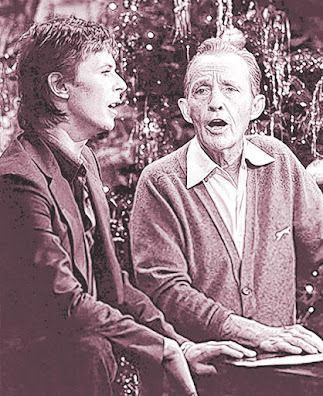
with David Bowie


With his 2nd family


With Rosemary Clooney


Sunday, September 29, 2019

BING, SINATRA, AND JFK

This article was written by the great Bing Crosby historian Steve Lewis. It is much too good for something I would write. Please see the link to Steve's article and his website below...

In 1962 President Kennedy planned a weekend trip to Palm Springs, California, where he would stay at the residence of Frank Sinatra from March 24-26. As the weekend approached, Bobby Kennedy, the President's brother and attorney general, became concerned about Sinatra's extensive links to organized crime. He persuaded the President to cancel his stay with Sinatra, and Peter Lawford was given the assignment of informing Sinatra. Lawford  was both a member of Sinatra's Rat Pack and a Kennedy relative by marriage. When Bobby asked Lawford to inform Sinatra of the President's change in plans, Peter pleaded with Bobby to reconsider. The attorney general was adamant, however, that the President could not stay at the house of a man who also played host to hoodlums.

Lawford told Sinatra biographer Kitty Kelley: "It fell to me to break the news to Frank, and I was frankly scared. When I rang the President I said that Frank expected him to stay at the Sinatra compound, and anything less than his presence there was going to be tough to explain. It had been kind of a running joke with all of us in the family that Frank was building up his Palm Springs house for just such a trip by the President, adding cottages for Jack and the Secret Service, putting in 25 extra phone lines, installing enough cable to accommodate teletype facilities, plus a switchboard and building a heliport. He even erected a flagpole for the Presidential flag after he saw the one flying over the Kennedy compound in Hyannisport. No one asked Frank to do any of this, but he really expected his place to be the President's Western White House."

"When Jack called me, he said that as President he just couldn't stay at Frank's and sleep in the same bed that [Sam] Giancana or any other hood had slept in. 'You can handle it, Petah,' he said to me."

Lawford continued, "I made a few calls but in the end it was Chris Dumphy, a big Republican from Florida, who arranged everything at Bing Crosby's house for him. The Secret Service stayed next door at Jimmy Van Heusen's, and Frank didn't speak to him for weeks over that one, but I was the one who really took the brunt of it. He felt that I was responsible for setting Jack up to stay at Bing's -- Bing Crosby, of all people -- the other singer and a Republican to boot. Well, Frank never forgave me. He cut me off like that -- just like that."


Frank could not believe what Lawford told him: that the President was coming to Palm Springs but would stay at Bing Crosby's Rancho Mirage residence near Palm Springs because Bobby didn't want him to stay with Frank. Frank called the attorney general in Washington. Bob explained it was impossible for the President to stay at his house because of the disreputable people who had been his houseguests.

"Frank was livid," said Peter. "He called Bobby every name in the book, and then rang me up and reamed me out again. He was quite unreasonable, irrational, really. George Jacobs told me later that when he got off the phone, he went outside with a sledgehammer and started chopping up the concrete landing pad of his heliport. He was in a frenzy."

When the President arrived at the Crosby home, he called Sinatra to smooth things out and to invite him for a visit to Bing's place. Sinatra declined, saying he had to leave for Los Angeles. After the conversation, the President told Lawford, "He's pretty upset, but I told him not to blame you because you didn't have anything to do with it. It was simply a matter of security. The Secret Service thought Crosby's place afforded better security."

Lawford told Kelley: "That's the excuse we used -- security -- and we blamed it all on the Secret Service. We'd worked it out beforehand, but Frank didn't buy that for a minute, and, with a couple of exceptions, he never spoke to me again. He cut me out of all the movies we were set to make together -- Robin and the 7 Hoods, 4 for Texas -- and turned Dean [Martin] and Sammy [Davis] and Joey [Bishop] against me as well."


Not only did Sinatra cut Lawford from his upcoming Rat Pack movies, he rubbed salt in his wounds by persuading Bing Crosby to play the role of Alan A. Dale intended for Lawford in Robin and the 7 Hoods!

The President used his stay at Bing's home to party with Hollywood celebrities. Bing was not present. Mimi Alford, a White House "intern" and presidential playmate, recalled the events in her 2012 book:
"The next day, we headed out to Bing Crosby's house in Palm Springs, where a large festive crowd -- many from the entertainment industry -- had gathered to greet President Kennedy. I felt like I'd been admitted into some wonderful, secret club.

But then the evening turned into a nightmare.

Crosby's house was a modern, sprawling single-story ranch in the desert, and the party was raucous. Compared to what I'd seen in Washington, this was another planet. There was a large group of people, a fast Hollywood crowd, hovering around the President, who was, as always, the center of attention. I was sitting next to him in the living room when a handful of yellow capsules -- most likely amyl nitrite, commonly known then as poppers -- was offered up by one of the guests. The President asked me if I wanted to try the drug, which stimulated the heart but also purportedly enhanced sex. I said no, but he just went ahead and popped the capsule and held it under my nose. (The President, with all his ailments, was accustomed to taking many medications and was reported to rely on amphetamines for energy. But he didn't use the drug himself that evening: I was the guinea pig.) Within minutes of inhaling the powder, my heart started racing and my hands began to tremble. This was a new sensation, and it frightened me. I panicked and ran crying from the room, praying that it would end soon, that I wasn't about to have a heart attack. Dave Powers, bless him, ran after me and escorted me to a quiet corner in the back of the house, where he sat with me for more than an hour until the effects of the drug wore off.

I didn't spend that night with President Kennedy. He was staying in a suite, now known as the Kennedy Wing, with its own private entrance on one side of the Crosby property. Was he alone? I do not know. For the first and only time since I met him, I was relieved not to see him -- and fell asleep in one of the guest rooms." (Alford, pages 80-81)JFK did not use Alford to satisfy his sexual needs at the Crosby mansion because he had a bigger conquest in mind -- Marilyn Monroe, who was an overnight guest. According to Monroe's biographer Donald Spoto, Monroe called her personal masseur, the actor Ralph Roberts, from the same bedroom where JFK was staying at Crosby's house. Roberts, JFK and Monroe then had a brief conversation about the President's back problems. Spoto later interviewed the masseur, who said Monroe told him that weekend at the Crosby home was her only sexual contact with the president. (Spoto, pages 487-505)

President Kennedy stayed one more time, Sept. 28-29, 1963, at Bing's Palm Springs home, after which he phoned Bing to thank him for the use of his home. Less than 2 months later the President was murdered in Dallas, Texas...

Saturday, August 3, 2019

BING'S TEN FAVORITE PERFORMERS - PART ONE

Bing Crosby is often considered one of the greatest singers of all time. It is interesting as to who was some of his favorite performers.  Mr. Crosby contributed this list of his 10 favorite all-time performers to the first edition of The Book of Lists in 1977. As the years go by and some of these great artists fade from the collective consciousness, I think it important and well worth the time to use Mr. Crosby’s list as a reason to revisit their work. After all, these entertainers were the Jay Z and Katy Perry of their own time.

Crosby states: “These are not listed in order of preference, and include no actors, only performers. I could, of course, list hundreds more.”


1. AL JOLSON (1886-1950)
The cantor’s son was considered one of the greatest performers of the 20th-century. He was beloved by millions and a great influence on later performers like Judy Garland and Bing Crosby. In fact, in the 1930s he was the highest paid performer in the United States.


2. ETHEL WATERS (1896-1977)
Ethel Waters was one of the best-loved performers of the last century. A blues, jazz, and gospel vocalist who is associated with many standards, including “Am I Blue?,” “Dinah,” and “Stormy Weather” (a song later associated with Lena Horne). As an actress, she starred in many films including Cabin in the Sky (1942) and Pinky (1949), for which she became only the second African American woman nominated for an Oscar.


3. JAMES BARTON (1890-1962)
Barton is, perhaps, the most obscure performer on Mr. Crosby’s list. He was a lauded vaudevillian and star of film and television. He began in minstrel shows and, according to Wiki, his years working with black performers led him to becoming one of the first white jazz dancers in the country. He played the Palace Theater, the apex of vaudeville, eight times. He later became recognized as serious actor, performing on Broadway in Tobacco Road (1934) and The Iceman Cometh (1946).

Barton was featured as the emcee (and last dancer) in the 1929 Paramount short After Seven. The film also featured the Chick Webb Orchestra and Shorty George Snowden, whom I learned in my research was one of the most famous lindy hop dancers of the period.


4. FRANK SINATRA (1915-1998)
In his superb book Why Sinatra Matters (1998, Little, Brown and Company), Pete Hamill wrote:

“His finest accomplishment, of course, was the sound. The voice itself would evolve over the years form a violin to a viola to a cello, with a rich middle register and dark bottom tones. But it was a combination of voice, diction, attitude, and taste in music that produced the Sinatra sound. It remains unique. Sinatra created something that was not there before he arrived: an urban American voice.”

Of course Frank Sinatra remains one of the most admired, imitated, and absolutely essential performers of all-time. Even if he hadn’t presided over 20th-century popular culture so intensely and for so long—by the 1990s there were t-shirts that said, “It’s Sinatra’s World, We Just Live in It”—he would still have earned a place on this list by dint of his prolific body of work. From 1940s crooner to Oscar-winning actor, Sinatra was an entertainer par excellence and a uniquely American phenomena. His Capitol Records with arrangements by artists like Nelson Riddle, Billy May, and Gordon Jenkins, remain the high watermark of mid-century cool; a different kind of cool from the concurrent sound of rock ‘n roll, but in some ways more timeless.


5. LENA HORNE (1917-2010)
Lena Horne was many things: one of the biggest African American film stars of her generation, a sex symbol, a civil rights crusader, and one of the greatest singers of her time. Like Ethel Waters before her, she began as a Cotton Club dancer before transitioning to films. A victim of the intense racial politics of the mid-century, her studio MGM could not fully exploit her talent and she languished, primarily doing specialty numbers in all-star revues or the occasional all-black musical (Stormy Weather) before becoming one of the greatest nightclub performers of the 1950s and 1960s. (For more on her fascinating life, read my friend James Gavin’s riveting Horne biography Stormy Weather: The Life of Lena Horne, which was published in 2009 by Simon and Schuster.)


TO BE CONTINUED...

SOURCE


Friday, February 1, 2019

JIMMY VAN HEUSEN: SWINGIN IN THE DESERT WITH FRANK AND BING

Jimmy Van Heusen: Swingin' in the Desert with Frank Sinatra and Bing Crosby


Tuesday, February 19, 2019

1:00 - 3:00 pm
Annenberg Theatre
Get Tickets Here $15


This composing genius created some of the most beloved melodies. Living in the desert for over five decades he played and collaborated with entertainment giants like Frank Sinatra and Bing Crosby creating classics such as "Swinging on a Star", "Love and Marriage", "Come Fly With Me" and "All the Way". Jimmy composed the songs for 23 Crosby movies and 76 songs for Frank Sinatra, more than any other composer.
Nominated 14 times Jimmy won 4 Academy Awards

Director Jim Burns, will introduce the film, Jimmy Van Heusen – Swingin’ with Frank & Bing, a documentary first aired on PBS, which looks at the life and music of the high-flying songwriter. Also shown will be a rare film tour of Jimmy’s mountaintop ranch near Yucca Valley from 1964.

The screenings will be followed by seldom-seen photos of Van Heusen enjoying the good life in the desert. A panel discussion moderated by Tracy Conrad, President of the Palm Springs Historical Society will follow the films.

Friday, September 7, 2018

PHOTOS OF THE DAY: BING AND HIS TELEVISION FRIENDS

Bing Crosby started out in radio and movies, but when television became the most popular entertainment medium in the 1950s, Bing dabbled on it quite often. He had the opportunity to work with a lot of great people on television, and here he is with some of his television friends...

Carol Burnett


Julie Andrews

Engelbert Humperdinck


Frank Sinatra and Dean Martin

Perry Como

Flip Wilson

Monday, May 30, 2016

HIGH SOCIETY: A 1956 REVIEW

High Society was released 60 years ago, and surprisingly here is a tough review from Bosley Crowther. It originally appeared in the NY Times of August 10, 1956...

INTELLECTUALLY speaking, there was never much sense or sanity to Philip Barry's "The Philadelphia Story," either as play or film. Its tale of a young society woman whose psyche was so confused that she could think herself thoroughly devoted to a priggish fiancé, a magazine writer and her ex-husband all within the span of one day was a sheer piece of comedy contrivance. And its attractiveness on stage and screen was due almost wholly to the sparkle of Katharine Hepburn as its erratic heroine.

But now that its brittle material has been cast into a musical film, there is little chance of disguising its bright but synthetic qualities. "High Society," its new name set to music, is as flimsy as a gossip-columnist's word, especially when it is documenting the weird behavior of the socially elite. And with pretty and lady-like Grace Kelly flouncing lightly through its tomboyish Hepburn role, it misses the snap and the crackle that its un-musical predecessor had.

To be sure, there are moments of amusement in this handsomely set and costumed film, which was served up in color and VistaVision at the Music Hall yesterday. One stretch is when Frank Sinatra as the magazine writer sent to do a story on the mores of society plies the haughty heroine with wine and somewhat unhooks her inhibitions. Mr. Sinatra makes hay with this scene.

Some others are when Louis Armstrong and his band are beating out some catchy tunes that have been borrowed from old Cole Porter albums or especially written by him for this show. In spite of the austere suroundings of a gold-plated Newport chateau, Mr. Armstrong beams as brazenly as ever and lets the hot-licks fall where they may.


In the musical line, Mr. Sinatra and Bing Crosby also sing some fetching songs that more or less contribute to a knowledge of what is going on. Their best is "Well, Did You Evah?", a spoof of the haughty and blasé, and Mr. Crosby makes "I Love You, Samantha" (whoever she is) a pleasingly romantic thing.

However, there do come tedious stretches in this socially mixed-up affair, and they are due in the main to slow direction and the mildness of Miss Kelly in the pivotal role. The part was obviously written to be acted with a sharp cutting-edge. Miss Kelly makes the trenchant lady no more than a petulant, wistful girl.


And we must say that Mr. Crosby seems a curious misfit figure in the role of the young lady's cast-off husband who gets her back at the very end. He wanders around the place like a mellow uncle, having fun with Mr. Armstrong and his boys and viewing the feminine flutter with an amiable masculine disdain. He strokes his pipe with more affection than he strokes Miss Kelly's porcelain arms.

Contributing to the general hubbub of pre-wedding day preparations in the Newport set are John Lund as the stuffy fiancé, Celeste Holm as a smart photographer, Louis Calhern as a wicked old uncle and Margalo Gillmore as the mother of the bride. Lydia Reed as an impish younger sister is kept pretty closely confined. She appears to have the waspish nature that Miss Kelly could use to good advantage...