Showing posts with label Little Boy Lost. Show all posts

Monday, June 29, 2020

BING ON FILM: LITTLE BOY LOST - PART TWO

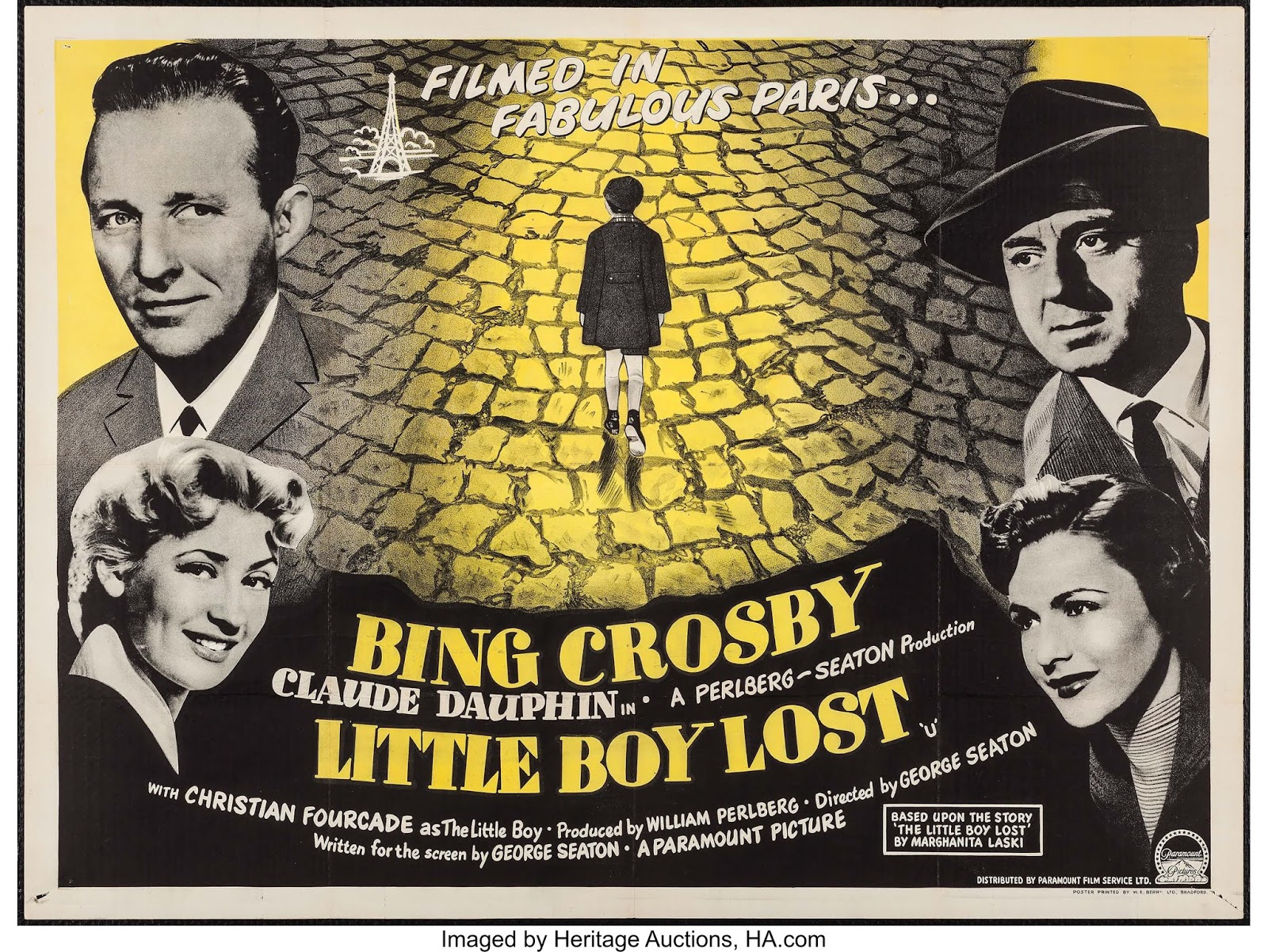
By 1953, Hollywood was ready to expose some of the horrors of war, and this movie really showed how lives were destroyed by the Nazis. The film Little Boy Lost was adapted from the book of the same name by Marganhita Laski. She originally sold the rights to actor John Mills, but he sold the rights then to Paramount Studios. The author was worried that the role that she created would be ruined by having an American singer play the title role, but after she saw the movie, she was extremely happy with the way Bing Crosby portrayed the title character. 

This movie Bing made at a tough part of his life. Urged by his ailing wife Dixie and her doctors, Bing traveled to Paris in September of 1952 to film the movie. In France Bing worked a little over a month on the film before going home to be with Dixie. Bing was not fully aware of how sick Dixie was. Dixie, weakened by cancer, met Bing at the train station. However, the next day she slipped into a coma and died five days later. This marked a dark time for Bing, but even though he filmed most of Little Boy Lost already, he still had some reshoots to do. He also had pivotal scene to film with Claude Dauphin, where Dauphin makes Bing’s character listen to how his wife in the movie was murdered by the Nazis. Everyone on the set was worried how Bing was going to film the scene after his own wife passing away. Reportedly Bing got through the scene in one take, but after the scene was done Bing excused himself to his trailer, and he remained in there the rest of the day. While I can not imagine what Bing was thinking as he filmed the movie, his own personal tragedy added to the emotion of what his character was going through.

This role for Bing was different than any other movie role to date, but his superb acting should not overshadow the performance of Christian Fourcade as the orphaned boy. Bing’s character could not believe at first that the boy could be his son, because the boy was sickly and meek – but Christian Fourcade not only conveyed that weakness but brought strength to the little boy’s character. As a boy, probably the same age as the character, I was a non-athletic kid with not many friends who lived a lonely life like the boy, so I have always felt a sense of kinship to the boy, even though I was not an orphan. Nicole Maurey, as Bing’s wife, was not in the movie long, but her and Bing definitely had a great chemistry. Bing enjoyed working with Nicole so much that almost a decade later he made sure she would be cast as his love interest in 1960’s High Time. The acting in the Little Boy Lost in general is top notch.

Even though the film was a drama, there was some music in the movie. Johnny Burke and Jimmy Van Heusen wrote most of the score. They wrote two French-styled songs “A Propos De Rien” and Cela M’Est EGal”, but the standout song for me was the song “The Magic Window” which he sang to the boy while they were bonding at the zoo. It’s slight song, but a song that has always stuck with me through the years. The movie also included a cute version of “The Dark Town Strutter’s Ball” which Nicole and Bing sing together in French as they are falling in love. I wish Bing would have recorded the song, but he never did except in 1962 for one of his sing-along albums.


The critics seemed to like the film, and it had its New York premiere on September 21, 1953. The following day Bosley Crowther of The New York Times wrote:

“…here Mr. Crosby is playing a straight dramatic role in a picture of deep emotional content and genuinely tragic, overtones. Except for two or three song numbers that are worked in consistently, there are few other points of contact with the bright and chipper Bingle of old. And yet it must be said for Mr. Crosby that he manages to convey a strong sense of real emotional torment in a tragically wracked character and that he serves as a credible buffer in a candidly heart-socking film..."


I watched this film as a young boy in the mid-1980s, feeling much like the little boy at the orphanage, but now over thirty years later I am viewing the film as a married man with two beautiful children, one being a son, and I can not fathom what Bing Crosby’s character was going through trying to find his son. It is a horror I would never want to face. Knowing now that Bing’s wife Dixie was dying during the making of the movie, makes Bing’s acting even more remarkable in the movie. It is a shame that this film has never been officially released on VHS, let alone DVD, but if you can find a copy to view, this is required Bing Crosby watching. It is a movie that will remain in your mind a long time after watching it.

MY RATING: 10 OUT OF 10


Wednesday, June 17, 2020

BING ON FILM: LITTLE BOY LOST - PART ONE

I had the pleasure of watching for the first time in over a decade Bing Crosby’s tense drama Little Boy Lost (1953), and even though the film is dark, it brought back many memories of the movie for me. Little Boy Lost was one of the first Bing movies that I had on VHS in the mid-1980s. To capture the music, I did not have any records of the songs Bing recorded for the film, so I had to put a microphone up to the television speaker and record the songs that way. Wow, how things have changed in 30 years! Digging out my copy of the film, I have a 4th generation of the movie on DVD, so I had to search for a DVD player that would play it in the house. Some of my DVD players refused to even play the disc! However, I got the movie going, and the film is as amazing as I remember it being. The whole movie in general is sad, but in the end, there was hope and optimism.

The movie starts during the beginnings of World War II. Bing plays an American journalist who lives in Paris. He meets a beautiful radio performer (played by Nicole Maurey), and they fall in love and have a little boy. Just as the boy is born the Nazis invade Holland, and it is only a matter of time before France will fall. Bing tries to get his wife out of Paris, but he is called up to join the Allied soldiers. France falls to the Nazis, and Bing is unable to return to Paris and his beautiful family. He still hears his wife on the radio, but one day her broadcasts abruptly stop. Bing later finds out that his beloved wife was murdered by the Nazis for being a part of the French resistance during the war. As you can see this is no happy-go-lucky Bing Crosby film! Bing really never accepts that his wife is dead, but he begins his search for his son who was placed in an orphanage after his mother’s murder. Bing goes to the orphanage where he meets the Mother Superior (played wonderfully by Gabrielle Dorziat), and she hesitates to get Bing’s hopes up but lets Bing meet a boy that could be his son. His potential son was played by Christian Fourcade, making his American film debut and deserving an award for his striking portrayal of the boy. Bing is frustrated, because he can not figure out if the boy is his son or not. Bing tries to stimulate the boy’s mind by singing songs from when he was a baby, spraying the boy’s mother’s old perfume that she wore, and even going to the apartment where they all first lived at before the war tore them apart. At the apartment the boy amazingly remembers things, but he remembers things incorrectly. 


Bing goes on to learn that the boy was told why Bing was there, so the boy tells Bing what he wants to hear so he can be adopted. Meanwhile Bing’s friend (played by Claude Dauphin), who knew Bing and his wife during the war years, finally makes Bing come to terms with his wife’s death by telling Bing her final moments, which included being tortured and beat by the Nazis before being shot. You can see Bing’s character is tortured, and he has never recovered. When his wife was pregnant, she had had a nightmare where she sees Bing all alone and hears shrieking. Bing brushes off the dream, but fast forward to the present time and Bing is all alone at the train station, a man without a direction or purpose, and he hears the shrieking of a train whistle which his wife described from her nightmare. It is at that point that Bing needs to move on and live his life. He finds a stuffed dog that his son had had called “Binky”, and he sends it to the orphanage to give to the boy. Bing returns to the orphanage just as the boy is opening it, and the boy exclaims “It’s Binky”, which proves that he was actually Bing’s son all along...

TO BE CONTINUED...


Sunday, June 10, 2012

LITTLE BOY LOST: AN APPRECIATION

This excellent review is by Ginny B. She runs a movie appreciation blog. Details of here blog follow the review...


Bing Crosby is remembered best for light comedy and his crooning. However, there were a few roles that brought out the more dramatic side of this actor and singer.

In Little Boy Lost (1953), Crosby plays Bill Wainwright, an American journalist, who is in search of his lost son. Bill was a war correspondent during WWII, and had married a French woman. The two had a baby boy, but soon after the child was born, Bill had to go on assignment. He was wounded, and by the time he recovered and was ready to return to France and his family, the Nazis had already taken over and denied him re-entry. His wife, who he later finds out was working with the French underground, was killed by the Nazis, and his son was passed hand to hand among the underground members. Bill's post-war search for his now 8 year old son leads him to a French orphanage where he is presented with Jean, played by an adorable Christian Fourcade.

Unsure if this is really his son, Bill take little Jean to Paris where he hopes introducing him to familiar sights, sounds and smells will bring memories of his lost wife to the little boy, which would prove Jean is his son.

Because I want you to enjoy the suspense of the movie as much as I did, I will refrain from sharing the ending with you. You will have to see for yourself whether Jean really is Bill’s son, or will Bill have to decide whether to keep searching or settle for the fact that he will never find his son.

Christian Fourcade does a wonderful job portraying Jean, a young orphan who grows to love Bill and wants to belong to him. You will fall in love with this little character. Like me, you will probably feel as though you would adopt him whether or not he was really your son...

SOURCE

Monday, August 8, 2011

LITTLE BOY LOST: A PERSONAL RESPONSE

Steve Fay is a huge authority on Bing Crosby. He runs an excellent Bing Crosby forum which you can visit here.

Here is Steve's excellent look at the Bing drama Little Boy Lost (1953)...

I am still a bit stunned, the film having concluded moments ago. I had read a bit about it a few times before, but did not realize how powerful of an effect it would have. In its dramatic weight it reminds me somewhat of "The Country Girl," this partly also because Bing's character is not altogether sympathetic at times.

I was born in the year before this movie was released, more or less during the present time of the second half of the action. It was a time when Europe's continuing recovery from WWII was not exactly center stage in the minds of average Americans, not enough that a youngster here would have noticed adults around him or her being very mindful of it. The war itself, in the decade following this movie's release, was mostly the subject of war-time adventure movies starring John Wayne, Van Johnson, Audie Murphy, and others, and the aftermath of the war in movies, with few exceptions, was more like "White Christmas." My uncles and my father, all in the service during the war, didn't talk much about it. A friend's father who served in the Marines in the Pacific pointedly refused to answer any of his son's questions about his time in the war, beyond that he found some lifelong friends who then lived in Austrailia. And we had no bombed out ruins in Illinois as reminders. What a surprise when I watched Winston Churchill's funeral on TV when I was in grade school to learn that some buildings in London had yet to be rebuilt as late as then.

When I was growing up, there must have been children around me who lost fathers in the war, but I don't recall this ever being spoken about. I recall families stricken by accidents and disease, divorce or even job loss, but not by the aftermath of WWII. Many unpleasant things were not spoken about, at least in front of children in those days -- "Little pitchers have big ears," my father would say and the subject of the adult conversation would change. Being rather confused, I thought he was talking about baseball. Of course, were I a child growing up in Europe or Britain at that very time, even if adults chose not to talk very much about the war, I still very likely might have seen some unignorable evidence of the war's violence to my town and the surrounding landscape. I might have known of war orphans in my town.
All of this makes me wonder what this kind reception this film might have had in American theaters, at a time when we here spoke little of that war anymore and called our involvement in Korea a "police action." Would movie-goers want to see our jaunty Bing Crosby living half in the past and half-tortured with the question of whether a somewhat odd and uncoordinated French orphan might actually be his son rather than someone elses? And, in the subsequent years, would such a movie be high on the list of those TV stations would replay in their program schedules (I don't remember seing it on TV)? While it is intensely the story of a war-broken family, representative of countless others, it might not have been regarded in 1950s and 60s America as "family entertainment." Perhaps others know much more than I about how well the film was greeted in the US and elsewhere.
Regarding the structure of the film, it is a story that spans several years, both for the characters involved and for international history. How to condense time and connect scenes scattered over a long period is a challenge for filmmakers. I wonder if there is any other film of Bing Crosby's in which he speaks anywhere near so many lines of narration. Could not action have been used to dramatize more, doing without so much exposition, one might certainly wonder as the film progresses. Yet, the pattern of Bing's character narrating makes it possible for him to speak his misgivings directly to the audience after his first meeting of the boy and the crusty Mother Superior who ran the orphanage in the film's second half. I'm not sure how we could have learned that so well otherwise.

Then, too, much of his misgivings are dramatized, as with his physical distance from the boy much of the time at the start of their first walk together, partly because he was counseled not to be too emotional by the old nun, but likely also the result of his doubts. The character of the old nun is quite fascinating, partly because she ultimately reveals two characters: the stern one administering the orphanage somewhat dispassionately, and then, toward the very end, a deeply caring protector of the children -- a war veteran certainly herself -- and a powerfully committed advocate for their having a future. What an interesting contrast this movie seems to make when compared with "Bells of St. Mary's," not only because the latter is more obviously a heart-warming movie throughout, but also because there is no Father O'Malley in this religious establishment ... unless there is a small touch of his street-wise insight and optimism in the old nun running the orphanage.
It was so, so long after the brief scene in which Bing sang at a party with Lisa, his wife-to-be whom he had just met, in the beginning of the film, before he sang again in this movie that I stopped expecting him to sing more. Then eventually I began to think, when a few more songs finally occurred rather naturally in later scenes, that these songs had to be there. What an intensely sad and troubling movie it might have been if not for those few songs slipping in during the second half.

That several people proceed (in inevitably conflicting ways) to try to help the boy and Bing unite as a family, and in doing so succeed more in complicating Bing's character's decision about whether he is his son and whether or not to take him in any case, certainly frustrates a viewer's expectations for how things might work out for the good. That near the end of the film, Bing and his old French friend from before the war reach what may be a breaking point in their friendship, because the friend insists Bing accept Lisa's violent death during the war, place's Bing's character in an even more troubled and psycologically ALONE position as he prepares to leave the town where the orphanage is located to return to Paris. He is saying this is to take time to come to a decision about the boy, but his secret agreement to travel with a blonde flusey promising to help him forget for a few days, creates another situation in which we not only must begin to agree with his old friend that he is self-delusional, but we also don't like him very much.

We don't like him (or is it his human frailty and self-doubt) until his own concience, triggered by a trainwhistle and a memory, makes him return to the orphanage, to discover that the boy (Jean /John) has recognized something from the past that no one could have prompted him about. I admit, I couldn't help misting up.
In one neighborhood where a I grew up a friend's mom, I learned, was a "war bride" from Italy. Maria was a very sweet lady, who my mother liked very much. If she had a sad tale to tell about her town during or after the war, I never heard of it. She was just Mickey's mom. In school, I read of the Marshall Plan, our helping Europe rebuild, but I don't think those paragraphs mentioned orphans or that the rebuilding was still going on. But in high school I had a teacher who had been about my age when his city of Stettin, Poland, was traded among armies during and just after WWII. His first library, in the basement of a bombed-out building, consisted of books he had collected from the rubble of his city at age fifteen. A college teacher I had years later, had grown up in utter poverty with her mother in a European town very slow to recover from that war.

Perhaps it is that "Little Boy Lost" is wholly set in France, and briefly Britain, without hardly any mention of life in the USA, that causes me to continually revisit what I knew (and when I knew it) about that setting, particularly Europe after the war. There is actually far less mention of life in America in this film than there is in "Casablanca." Mentionings of happy neighborhoods back in the old USA pepper nearly every war movie I can remember, but not this one. In this film, while we suspect Bing's character will return to his home country eventually, with his son if he determines he has found him, America is not held out as some dream place where they will live happily ever after, as is the case in more than a few American war movies. The film keeps us far too deeply worried about whether he will identify who he and his son are and what his true dream and future are, and whether that will include the boy. A peaceful and happy America isn't employed as shorthand for the solution in this film. As the old nun clarifies the question of whether Bing's character and the boy need each other in order to both find their futures is the key issue. And to her, the boy is one of many whose welfare and futures keep her awake at night. While the film lets this one family mend, we acknowlege gratefully, I don't think it means to let us forget that this orphan and his father are but representatives of many. That is a much more serious dose of reality than many people might expect from a Bing Crosby movie, or an American musical movie of its time.

SOURCE