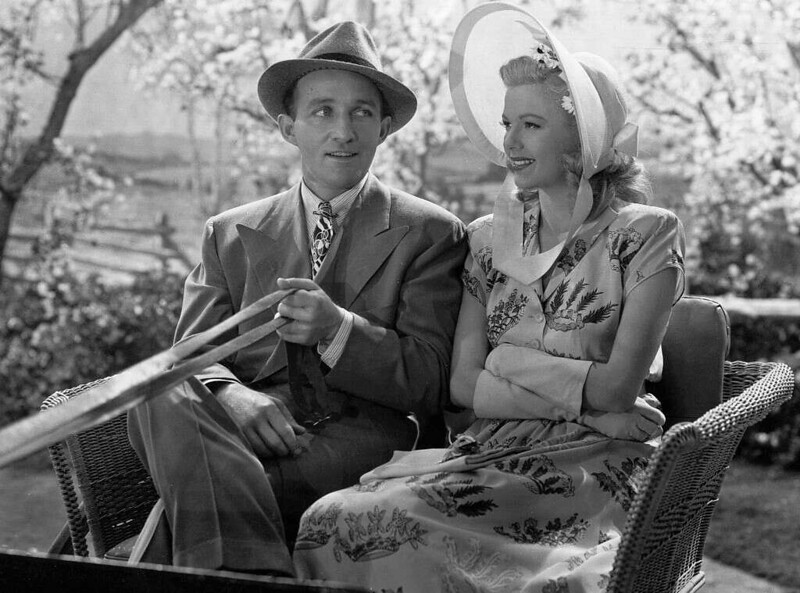
Showing posts with label Holiday Inn. Show all posts

Sunday, July 5, 2026

BING AND HIS MOST SUCCESSFUL MOVIES


Long before box-office weekends were measured in superhero billions, success in Hollywood meant something a little different. It meant longevity, audience devotion, and the rare ability to make moviegoers feel at home the moment you appeared on screen. Few actors embodied that kind of success more completely than Bing Crosby—a relaxed, warm, velvet-voiced star whose films defined popular entertainment from the 1930s through the 1950s. Crosby didn’t just star in hits; he helped shape entire genres. From heartfelt dramas to sparkling musicals and riotous road comedies, his most successful movies reveal why he became one of the highest-grossing and most reliable stars in American film history.

Going My Way (1944): The Role That Defined Him

If one film cemented Bing Crosby’s legacy, it was Going My Way. Playing the easygoing, modern-minded Father Chuck O’Malley, Crosby delivered a performance that felt effortless but deeply affecting. The film struck a nerve with wartime audiences eager for comfort, humor, and hope.

Its success was staggering. Going My Way became the top-grossing movie of 1944 and went on to win seven Academy Awards, including Best Picture and Best Actor for Crosby. More than trophies, the film established Crosby as a symbol of calm wisdom and decency—an image that would follow him for the rest of his career.

The Bells of St. Mary’s (1945): Lightning Strikes Twice

Few sequels surpass their predecessors, but The Bells of St. Mary’s came remarkably close. Reuniting Crosby with his priestly character and pairing him with Ingrid Bergman, the film expanded the emotional stakes while maintaining warmth and humor.

Incredibly, it outperformed Going My Way at the box office, becoming the highest-grossing film of 1945. Audiences returned not just for the story, but for Crosby himself, whose presence had become a guarantee of quality and reassurance in uncertain times.


Holiday Inn (1942): A Song That Changed Movie History

Holiday Inn might have been successful even without Crosby—but it’s impossible to imagine the film without him. Playing a song-and-dance man who retreats to the countryside, Crosby delivered one of the most famous musical performances of all time: the original rendition of “White Christmas.”

The film was a major hit, but its cultural impact proved even more enduring. The song would go on to become the best-selling single in recorded music history, tying Crosby forever to the sound of the holidays—and helping make Holiday Inn a perennial favorite.

White Christmas (1954): Old Hollywood at Its Grandest

By the 1950s, Crosby was no longer just a star—he was an institution. White Christmas, filmed in dazzling Technicolor and VistaVision, paired him with Danny Kaye in a lavish musical celebration of friendship, romance, and nostalgia.

The result was a phenomenon. White Christmas became the highest-grossing film of 1954, and for many viewers, it came to embody the very idea of the classic Hollywood musical. Crosby’s relaxed charisma anchored the spectacle, proving that even in a changing industry, audiences still wanted him front and center.

The Road to… Movies: Comedy Gold with Bob Hope

No discussion of Crosby’s success is complete without the Road pictures, his long-running comedy partnership with Bob Hope. Films like Road to Morocco (1942) and Road to Utopia (1946) were gleefully self-aware, anarchic, and wildly popular.

Commercially, they were dependable hits. Creatively, they showed Crosby’s underrated comic timing and willingness to poke fun at his own screen persona. Together, Crosby and Hope formed one of Hollywood’s most profitable and beloved duos.


High Society (1956): A Graceful Finale

One of Crosby’s last major film successes, High Society allowed him to revisit familiar territory—a lighthearted musical remake—while sharing the screen with Grace Kelly, Frank Sinatra, and Louis Armstrong. The film was a box-office success and served as a fitting late-career triumph.

By this point, Crosby had little left to prove. His success was no longer about dominance, but about refinement and legacy.

Bing Crosby’s most successful films weren’t just hits on release—they became cultural touchstones. They offered humor during war, music that endured across generations, and performances that felt natural in an industry built on glamour and excess.

Crosby’s genius wasn’t flash or intensity. It was ease. And in movie after movie, that ease translated into enormous success—both commercial and emotional. Long after the box-office receipts faded, his films kept playing on televisions, during holidays, and in the collective memory of Hollywood itself.

That, ultimately, may be the greatest measure of his success...

Monday, December 18, 2023

HOLIDAY INN: A 1942 REVIEW

 Here is the original review of the classic Holiday Inn. This appeared in the NY Times on August 5, 1942...


That man Irving Berlin has been whistling to himself again. Not content with turning out the most rousing Broadway show in years, he has scribbled no fewer than thirteen tunes for "Holiday Inn," the light-heartedly patriotic musical which opened last night at the Paramount in conjunction with a gala stage show for the benefit of the Navy Relief Society.

 Mr. Berlin may not know a great deal about notes, as he confesses, but he does know a lot about music. If there are no tunes in "Holiday Inn" that quite match those of his army show, Mr. Berlin still has created several of the most effortless melodies of the season—the sort that folks begin humming in the middle of a conversation for days afterward. At present Paramount prices Mr. Berlin's tunes are being sold dirt cheap.As it happily happens, the film has caught the same effortless moods of the music. Mark Sandrich, director and producer, has taken the inevitable melange of plot and production numbers and so deftly pulled them together that one hardly knows where the story ends and a song begins—a neat trick if you can do it. That it comes off, of course, is largely due to the casual performances of Bing Crosby, who can sell a blackface song like "Abraham" or turn an ordinary line into sly humor without seeming to try, and Fred Astaire, who still owns perhaps the most sophisticated pair of toes in Christendom. 


Mr. Astaire has rarely danced with more alert, carefree abandon than among the exploding torpedoes and red devils of "Say It With Firecrackers." And in Marjorie Reynolds, a very fetching blonde young lady, Mr. Astaire has a new partner who can hold her own at all speeds.Mainly "Holiday Inn" is a series of musical episodes, each of which takes an American holiday for cue. But they have been strung ever so neatly on the amorous rivalries of Mr. Astaire, who wins all the battles except the last, and Mr. Crosby, a musical lazybones who retires to a New England farm which he converts into a night club for holidays only—thus leaving him 300-odd days a year for pure loafing.


And while the pair desperately conspire against each other for the hand of Miss Reynolds, Mr. Berlin's music sets the moods from the romantic "Be Careful, It's My Heart," to nostalgic "Easter Parade," tender "White Christmas" and rollicking "Let's Start the New Year Right."Along the way the author and director have bobbed up with some engaging tricks such as the befuddled Thanksgiving turkey hopping from one Thursday to another or the Washington's Birthday Minuet, in which a bland Mr. Crosby continually breaks up Mr. Astaire's precise and dainty footwork with hot licks in the accompaniment. It is all very easy and graceful; it never tries too hard to dazzle; even in the rousing and topical Fourth of July number it never commits a breach of taste by violently waving the flag. Instead it has skipped back over the year in an affectionate and light-hearted spirit. In a month without a holiday, "Holiday Inn" offers a reason for celebration not printed in red ink on the calendar.

HOLIDAY INN, screen play by Claude Binyon; adaptation by Elmer Rice; based on an original idea by Irving Berlin; produced and directed by Mark Sandrich for Paramount; music and lyrics by Irving Berlin. At the Paramount.Jim Hardy . . . . . Bing CrosbyTed Hanover . . . . . Fred AstaireLinda Mason . . . . . Marjorie ReynoldsLillie Dixon . . . . . Virginia DaleDanny Reid . . . . . Walter AbelMamie . . . . . Louise BeaversCigarette Girl . . . . . Judith GibsonHat Check Girl . . . . . Katharine BoothGirls and Dancers . . . . . Barbara Slater, Aline Brandes, Louise La Planche, Laurie Douglas, Lynda Grey, Lora Lee


Monday, March 20, 2023

SPOTLIGHT ON MARJORIE REYNOLDS

Marjorie Reybolds starred in one of the most beloved movies of the 1940s Holiday Inn. However, she was not only overshadowed by co-star Bing Crosby's singing but she was in the background due to the introduction of the most popular song ever written "White Christmas". Bright, vivacious Marjorie Reynolds (née Marjorie Goodspeed) was born in Idaho on August 12, 1917 to a doctor and homemaker, and raised in Los Angeles.

Making her film debut at age 6, she "retired" after only a few years in favor of a normal education. She returned in the mid-30s, as a teenager this time, and began the typical assembly-line route of extra and bit roles for various mega studios, this time billed as Marjorie Moore. Her first speaking role was in Columbia Studio's programmer Murder in Greenwich Village (1937), this time billed as Marjorie Reynolds (her first husband's last name), a moniker she kept for the duration of her career.


The blonde (originally brunette) actress then went through a rather non-challenging prairie flower phase opposite Hollywood's top western stars such as Tex Ritter, Buck Jones, Roy Rogers and Tim Holt. It all paid off, however, when she won the top female role opposite Bing Crosby and Fred Astaire in the seasonal film classic Holiday Inn (1942), a role originally designed for Mary Martin. It remains Marjorie's most popular and cherished role on film, but it did not help her make a permanent transition into 'A' quality fare.I had the opportunity to interview Marjorie's daughter shortly after her mother's death, and she remembers her mother saying Bing was sometimes cold to herm because he had wanted Mary Martin for the role. However, she said Bing was professional. Despite what Bing might have thought of Marjorie in Holiday Inn, he thought there was enough chemistry to choose her as his leading lady again in 1943's Dixie, which was another hit for Bing.


Marjorie continued as a dependable "B" co-lead in such films as Up in Mabel's Room (1944), Meet Me on Broadway (1946), and Heaven Only Knows (1947), with an exciting movie offer such as Fritz Lang's Ministry of Fear (1944) coming her way on a rare occasion.

Along with maturity and a new entertainment medium (television) in the 50s came a return to her natural hair color. As William Bendix's patient, resourceful brunette wife on the comedy TV series The Life of Riley (1953), Marjorie became a semi-household name. Her career took a steep decline following its demise five years later and she was only sporadically seen in films, commercials and TV guest spots after that.

Married twice, her first husband was Jack Reynolds, who was an Assistant Casting Director for Samuel Goldwyn. They had one daughter, Linda, before divorcing in 1952 after 16 years. Linda was named after her mother's character from Holiday Inn. Second husband, film editor John Whitney, worked for a time in the 40s as an actor. They were married for 32 years until his death in 1985.

Long retired, Marjorie made her last movie appearance in 1962's The Silent Witness. However, she did continue to have sporadic television roles until 1978.  Marjorie died  on February 1, 1997 of congestive heart failure after collapsing while walking her dog. Though she didn't fully live up to her potential as a serious, formidable actress, her gentle charm and obvious beauty certainly spruced up the 60+ films in which she appeared...


Sunday, December 18, 2022

HOLIDAY INN VS WHITE CHRISTMAS


This is a well written comparison of Holiday Inn and White Christmas. I recommend not only reading this article but visiting this great blog from a fellow movie lover...


It’s hard to shoot down the movie that brought us the song, “White Christmas,” (talking about Holiday Inn), but it’s not thought of as a classic in the way White Christmas is. Both star Bing Crosby, both take place more or less around a hotel/inn, and both are full of music and a little dancing. If it wasn’t for Holiday Inn, there wouldn’t be a White Christmas movie, but White Christmas goes farther and leaves us with that warm, fuzzy feeling.

Holiday Inn revolves around Jim Hardy (Bing Crosby) wanting to leave show business for the “good life” where he doesn’t have to work much. He opens an inn which is only open on holidays and gets a pretty girl to perform there for him. When Ted Hanover (Fred Astaire) shows up, he wants the girl as his new dance partner, which would take her away from the inn and Jim, who loves her. It’s a bit stale, and has song and focuses too long on dance routines for holidays such as Abe Lincoln’s Birthday, Washington’s Birthday, Valentine’s Day, Independence Day. Though we think of it as a Christmas movie, there’s not a lot of Christmas in it.


White Christmas, on the other hand, takes place in the days leading up to Christmas. After WWII, song and dance act Wallace and Davis (Crosby and Danny Kaye) meet up with a sister act (Rosemary Clooney and Vera-Ellen) who are on their way to Connecticut. When they arrive there, they find their old army sergeant struggling to make ends meet at an old ski lodge when it’s too warm for snow, so they decide to help out by moving the act out there. In the meantime, there’s music and dancing and a little romance. And then it starts to snow.

White Christmas gives us that feeling that only comes once a year whereas Holiday Inn seems more like a farce – trying to pack in as much singing and dancing without a whole lot of plot. Without the one, we wouldn’t have the other, but we don’t need both. Sorry, Holiday Inn, but I’m dreaming of a White Christmas...


Monday, September 12, 2022

NEW CD: WHITE CHRISTMAS AND HOLIDAY INN SOUNDTRACK

Sepia has done it again with this new Bing release just in time for the holidays...


Title: White Christmas & Holiday Inn (2 CD Set)
Artist: Various
Catalogue No.: SEPIA 1376
Barcode: 5055122113768
Release Date: October 2022

This is the first CD release of the complete film scores for both 'White Christmas' and 'Holiday Inn' derived from pre-recordings made during the film making process. Also included is a previously unreleased 1942 recording of 'White Christmas' as sung by Bing Crosby, and Rosemary Clooney's thrilling 1953 soundtrack sessions recorded for Irving Berlin's White Christmas!


CD 1

WHITE CHRISTMAS

1. VISTAVISION FANFARE The Paramount Studio Orchestra
2. WHITE CHRISTMAS MAIN TITLE The Paramount Studio Orchestra 
3. SANTA CLAUS Bing Crosby, Danny Kaye
4. WHITE CHRISTMAS Bing Crosby
5. WE'LL FOLLOW THE OLD MAN Bing Crosby, Danny Kaye 
6. HEAT WAVE, LET ME SING AND I'M HAPPY, BLUE SKIES Bing Crosby, Danny Kaye 7. SISTERS Rosemary Clooney, Trudy Stevens
8. THE BEST THINGS HAPPEN WHILE YOU'RE DANCING Danny Kaye
9. SNOW Bing Crosby, Danny Kaye, Rosemary Clooney, Trudy Stevens
10. SISTERS (Reprise) Rosemary Clooney, Trudy Stevens
11. I'D RATHER SEE A MINSTREL SHOW, MANDY Bing Crosby, Danny Kaye, Rosemary Clooney
12. COUNT YOUR BLESSINGS INSTEAD OF SHEEP Bing Crosby, Rosemary Clooney
13. CHOREOGRAPHY Danny Kaye
14. THE BEST THINGS HAPPEN WHILE YOU'RE DANCING (reprise) The Skylarks 
15. ABRAHAM Instrumental
16. LOVE, YOU DIDN'T DO RIGHT BY ME Rosemary Clooney
17. WHAT CAN YOU DO WITH A GENERAL Bing Crosby
18. WE'LL FOLLOW THE OLD MAN (Reprise) Bing Crosby, Danny Kaye
19. GEE, I WISH I WAS BACK IN THE ARMY Bing Crosby, Danny Kaye, Rosemary Clooney, Trudy Stevens
20. WHITE CHRISTMAS FINALE (version 1) The Paramount Studio Orchestra
21. WHITE CHRISTMAS FINALE (version 2) Bing Crosby, Danny Kaye, Rosemary Clooney, Trudy Stevens
22. WHITE CHRISTMAS FINALE (version 3) Bing Crosby, Danny Kaye, Rosemary Clooney, Trudy Stevens
23. WHITE CHRISTMAS FINALE (version 4) Bing Crosby, Danny Kaye, Rosemary Clooney, Trudy Stevens
24. WHITE CHRISTMAS Rosemary Clooney
25. SISTERS Rosemary, Betty Clooney 
26. SNOW Rosemary Clooney
27. COUNT YOUR BLESSINGS INSTEAD OF SHEEP Rosemary Clooney
28. LOVE, YOU DIDN'T DO RIGHT BY ME Rosemary Clooney
29. IRVING BERLIN'S WHITE CHRISTMAS THEATRE LOBBY ANNOUNCEMENT Bing Crosby


CD 2

HOLIDAY INN

1. HOLIDAY INN MAIN TITLE The Paramount Studio Orchestra 
2. I'LL CAPTURE YOUR HEART Bing Crosby, Fred Astaire, Virginia Dale
3. LAZY Bing Crosby 
4. YOU'RE EASY TO DANCE WITH Fred Astaire
5. WHITE CHRISTMAS Bing Crosby, Martha Mears
6. HAPPY HOLIDAY Bing Crosby, Martha Mears
7. LET'S START THE NEW YEAR RIGHT Bing Crosby
8. YOU'RE EASY TO DANCE WITH Bob Crosby and his Band
9. ABRAHAM Bing Crosby, Martha Mears
10. BE CAREFUL IT'S MY HEART Bing Crosby 
11. I CAN'T TELL A LIE Fred Astaire
12. EASTER PARADE Bing Crosby
13. SAY IT WITH FIRECRACKERS / SONG OF FREEDOM Bing Crosby
14. SAY IT WITH FIRECRACKERS Bob Crosby and his Band
15. INSTRUMENTAL REPRISE: LET'S START THE NEW YEAR RIGHT, ABRAHAM, BE CAREFUL IT'S MY HEART, EASTER PARADE, YOU'RE EASY TO DANCE WITH, HAPPY HOLIDAY, WHITE CHRISTMAS
16. I'VE GOT PLENTY TO BE THANKFUL FOR Bing Crosby
17. WHITE CHRISTMAS (reprise) Martha Mears
18. CLOSING MEDLEY: I'LL CAPTURE YOUR HEART, LET'S START THE NEW YEAR RIGHT Bing Crosby, Fred Astaire, Martha Mears, Virginia Dale

HOLIDAY INN RADIO PREVIEW:

19. INTRODUCTION and HAPPY HOLIDAY Bing Crosby
20. I'LL CAPTURE YOUR HEART Bing Crosby, Fred Astaire, Betty Rhodes
21. BE CAREFUL IT'S MY HEART Bing Crosby, Betty Rhodes
22. I CAN'T TELL A LIE Fred Astaire
23. EASTER PARADE Bing Crosby
24. ABRAHAM Bing Crosby, Betty Rhodes
25. WHITE CHRISTMAS Bing Crosby
26. LET'S START THE NEW YEAR RIGHT Betty Rhodes, Bing Crosby
27. YOU'RE EASY TO DANCE WITH Fred Astaire
28. SONG OF FREEDOM Bing Crosby
29. CLOSING ANNOUNCEMENT
30. WHITE CHRISTMAS Bing Crosby  


SOURCE


Sunday, December 1, 2019

GUEST REVIEWER: HOLIDAY INN

Bruce Krogan is back to kick off our Christmas season with a review of the popular 1942 Bing flick Holiday Inn...

Finally Paramount gave Crosby a big budget musical and didn't rely on his charm and personality to carry the film. The budget went to hire such outside talent as Fred Astaire and Irving Berlin. And none of them disappoint.

In the first of two films Astaire and Crosby did together the characters are remarkably the same. Astaire is the elegant and charming show business professional who's ambitious for success. Crosby is the talented, but lazy partner who just wants a life of ease and comfort and not to work more than he has to. Small wonder that their double act broke up. But now enter a complication. They both get interested in the same girl who in this film is Marjorie Reynolds.

Crosby dreams up the idea of a nightclub/hotel called Holiday Inn where they only work on holidays. He wants Reynolds to help with the shows there. Astaire wants her for his act after his other girl partner Virginia Dale runs off with a millionaire. And the fun starts. Now since this was Crosby's home studio and he's first billed, just who do you think gets Reynolds in the end? As maid Louise Beavers put it, don't sit and mope because some slicker stole your gal.


Irving Berlin writes a majority of new songs to supplement a couple from his vast trunk of songs mostly about our holidays. By that time Berlin had extracted an agreement which became standard for all the films he wrote for. Not one note of non-Berlin music is ever heard in a score he writes. Just listen to this and just about any other film Berlin is associated with. Even music in the background is his.

The hit song in this was supposed to be Be Careful It's My Heart, the Valentine's Day song, sung by Crosby and danced to by Astaire and Reynolds. It did have a good deal of success. But the success of White Christmas was exponentially phenomenal. It netted Irving Berlin his one and only Academy Award and for Bing Crosby his number one item on vinyl. In fact everyone's number one item on vinyl.

I don't know if Bing Crosby ever set out to become the voice of Christmas, but if he did he was a marketing genius. If he's known and appreciated for anything with today's audience, it's for that. White Christmas became the first Yule song he was identified with although he had recorded some Christmas material before that. After this he started doing the holiday music in serious. Just think, along around Columbus Day, record companies even now reissue his Christmas stuff every year and his totals as largest selling recording artist in history grow once again. That's why the Beatles and Elvis, etc. don't have a prayer of overtaking him.


In fact White Christmas's initial success was so great that Decca wore out the original master putting out records to meet the demand. So in 1945, Decca got Bing, the Ken Darby Singers and John Scott Trotter to re-record it almost note for note. The original 78 had White Christmas with the flipside of Let's Start the New Year Right also from Holiday Inn. The newer version which most people hear has as it's flipside God Rest Ye Merry Gentlemen.

I don't want to ignore Fred Astaire's contribution here. He does a nice comic turn with I Can't Tell a Lie, the Washington's birthday number where Crosby keeps changing the tempo to upset him and Reynolds. The Fourth of July yields a number for each. Reynolds is kept from the show by Bing's machinations and Astaire has to "improvise" something. He "improvises" Firecrackers and anyone who knows anything about Astaire knows how hard he worked to get that spontaneous feeling in his dancing. Bing sings The Song of Freedom, reminiscent of James Cagney's Grand Old Flag number from Yankee Doodle Dandy also out in 1942 and Song of Freedom is also reminiscent of what Paramount could have given Bing in the 1930s had they hired someone like Busby Berkeley to give Bing some of the production numbers that Dick Powell had at Warner Brothers.

So what more is there to say, but sit back and enjoy the fun...

BRUCE RATING: 10 OUT OF 10
MY RATING: 10 OUT OF 10


Friday, May 3, 2019

THE FIVE BEST BING CROSBY MOVIES

Five years ago I published a list of my five favorite Bing Crosby movies, and in honor of what would have been Bing's 116th birthday, I figured I would update my list. I did not look at the 2014 list when writing this to see if there are any changes...


5. JUST FOR YOU (1952) - This Crosby film is not widely remembered today, but it should be. It is probably the closest Bing ever got to a biographical film about himself. In the film, Bing is a father to two children (Natalie Wood and Robert Arthur), but he is also trying to juggle fame and stardom. This was the second pairing of Bing with actress Jane Wyman, and the duo got to introduce the new song "Zing A Little Zong", which is a personal favorite.
2011 ranking:#7     2014 ranking: NA

4. HOLIDAY INN (1942) - This movie cemented Bing Crosby as a Hollywood movie superstar. This film was destined to be a classic with Bing, Fred Astaire, and an Irving Berlin song track. Bing got to sing countless Irving Berlin standards like "Easter Parade", "Be Careful It's My Heart", but it was in this movie that Bing got to introduce his signature song "White Christmas". This movie would be the first movie Bing would make with Fred Astaire, and it was also his first movie with songs by Irving Berlin.
2011 ranking:#3     2014 ranking:#3


3. BLUE SKIES (1946) - This was the second pairing of Bing, Fred Astaire, and Irving Berlin. It almost did not happen because Broadway dancer Paul Draper was supposed to be in the Astaire role, but due to his stutter and his disagreements with Bing, Draper was replaced. This was also supposed to be Fred Astaire's "swan song" from movies. Bing got to sing countless great Irving Berlin tunes like: "Blue Skies", "All By Myself" and the new "You Keep Coming Back Like A Song". The story was corny spanning the time between two World Wars, but this has always been one of my favorite Crosby films.
2011 ranking:#2     2014 ranking#2

2. HIGH SOCIETY (1956) - After Bing would leave Paramount Studios in 1956, after 24 years he moved to MGM for this great Cole Porter musical. Bing was paired with Grace Kelly, Frank Sinatra, Celeste Holm, and Louis Armstrong, and the result is film magic. Bing had a hit with Grace Kelly on the song "True Love", and I named my daughter after the Grace Kelly character and Cole Porter song "I Love You, Samantha". Bing and Sinatra were great together, and they got to duet on the great number "Well, Did You Evah". In my opinion, this is one of the last truly great MGM movie musicals made.
2011 ranking:#4     2014 ranking:#4


1. THE COUNTRY GIRL (1954) - I would always have a debate with my Grandfather about this movie. He hated this movie, because Bing played a different role that he was used to. The film was dark, and Bing played an alocholic actor who gets one last chance to make a comeback. Bing was nominated for the third time for this film, but lost to Marlon Brando. Grace Kelly won though for playing Bing's lost suffering wife. Reportedly for the one drunken scene, Bing paced and stayed up all night to get a more haggard look. Watch this movie, and I dare you to say that Bing Crosby was not a great actor!
2011 ranking:#1     2014 ranking:#1

Wednesday, March 20, 2019

BING AND FRED ASTAIRE: TOP BILLING

Here's a great article from Steve Lewis' "Bing Crosby Internet Museum"...

Virtually all the polls at the end of the 20th century placed Fred Astaire at the top or near the top of professional dancers.

Astaire made some 30 memorable movie musicals, including 10 highly-acclaimed films with co-star Ginger Rogers. The Astaire-Rogers collaboration included "The Gay Divorce," "Roberta," "Top Hat," "Follow the Fleet," "Swing Time," "Shall We Dance?," "Carefree," "The Story of Vernon and Irene Castle" and "The Barkleys of Broadway."

Astaire's success in the movies seemed as improbable as Bing Crosby's. He had a face the shape of a bartlett pear, a beanpole figure and a weak voice. In his first attempt at a movie career a Paramount executive wrote that Astaire "Can't act. Can't sing. Balding. Can dance a little." Astaire succeeded nonetheless. He sweated his way to the top. "He was a dictator who made me work harder and longer than anyone," said Nanette Fabray, one of his female costars.


Astaire introduced 36 hit songs in his movies from 1929 through 1951. According to Joel Whitburn, author of Pop Memories, eight Astaire recordings topped the pop charts: "Night and Day," "Cheek to Cheek," "I'm Putting All My Eggs in One Basket," "The Way You Look Tonight," "A Fine Romance," "They Can't Take that Away from Me," "Nice Work If You Can Get It" and "Change Partners."

In 1942 Astaire and Crosby were paired in the Irving Berlin musical Holiday Inn. In the movie Bing wins the girl (Marjorie Reynolds) to whom he sings what turned out to be the most successful movie song of the century, White Christmas. Bing also dances with Astaire, who later said that "Bing's the kind of dancer that I am a singer." Nevertheless, for many years Fred would answer "Bing Crosby" when asked to name his favorite dance partner -- to avoid alienating any of his female co-stars.

Astaire's best dance scene in Holiday Inn was not with Crosby but when he hot-footed alone on stage to the accompaniment of a 4th of July firecracker display. The famous scene took 38 takes during which Fred lost 14 pounds. The large number of takes were at Fred's insistance. According to Crosby: "Fred's a perfectionist .... Every step, every movement there was a firecracker let off. Some he'd throw down like torpedoes and some he'd kick-off. He had to be in certain positions all the time to hit the right firecrackers so he'd be on camera.... It was pretty elaborately contrivied and had to be done perfectly. I thought the first take he did was great. They all looked alike to me, but there was a little something he didn't like in each one. He about wore out the director and wore out the crew and the sequence took two or three days." (Thompson, pages 93-94)

The success of Holiday Inn led to another Astaire-Berlin-Crosby musical called Blue Skies in 1946. A third collaboration of the ABC boys was supposed to be White Christmas. But when Astaire read the script he found other work. Instead, Danny Kaye was hired to fill Astaire's dancing shoes. "White Christmas" became the leading box office attraction of 1954 and a perennial Christmas holiday tradition.


Astaire appeared several times on Bing's radio and TV shows through the years and they shared mutual interests in golf and horse racing. During World War II their paths crossed while entertaining the troops in Europe. At one point they feared for their safety when trapped for 45 minutes in a Glasgow railway baggage room while surrounded by 35,000 fans demanding a performance. (Crosby, 197-99)

Ken Barnes, Bing's last album producer, persuaded Bing and Fred to record an album of duets in London in 1975. Barnes later recalled the contrasting styles of the two stars:

"Once the material had been decided upon, we paid only one visit to Bing's house which consisted of one hour and a half around the piano during which time Bing would sing each song through no more than twice -- once for the key and then once again for the tempo.... That solitary visit to Crosby's house was in no way comparable to the nine visits we made to Fred's house, each lasting a minimum of three hours. Whereas Crosby would approach each song in a casual, seemingly off-hand manner, Astaire went to the other extreme. He would plan each song routine as though it were an intricate piece of choreography."


When Bing and Fred arrived in London in July, their contrasting styles posed a problem. According to Barnes:

I rang the Connaught and got through to Fred. His first question could not have been more direct. "What time do we meet with Bing tomorrow?" There was no beating around the bush with Astaire either and I plunged straight in. "Bing can't make it tomorrow. He's tied up all day." I waited for Fred's comment but there was only silence from the telephone. "But he'll meet you a half hour before the session," I went on, "and run down each of the songs individually."

For a moment I thought we had been disconnected but after a few seconds Fred spoke and his comments about Crosby were anything but complimentary. He accused Bing of being totally irresponsible and unprofessional, but eventually, after he had got the initial anger out of his system, Fred conceded that this was Bing's way of working and it was too late to expect him to change. "But," added Fred, "it's not my way of working. It may be OK for the great Crosby to stroll into a studio and turn on the magic, but I can't work that way. I've got to rehearse with somebody." (Barnes, pages 47-53)

The Crosby-Astaire duet album turned out to be a hit. Apparently, Astaire held no grudge against Bing, for he agreed to be Bing's guest on his 1975 Christmas TV special, recorded in November. The TV special would be the last time the two worked together. Fred died of pneumonia at age 88 in the wee hours of June 12, 1987, in a Los Angeles hospital, where he had been admitted 10 days earlier for a bad cold...


Tuesday, July 4, 2017

PHOTO OF THE DAY: BING THE FREEDOM MAN

On this 241st Independence Day, let's sing a song of freedom with Bing! This excellent screen shot if from Bing's 1942 epic musical Holiday Inn. Happy Independence day one and all...


Tuesday, October 21, 2014

REINVENTING HOLIDAY INN

 
"It's one of the best-loved scores ever," Gordon Greenberg says of Holiday Inn, the 1942 Bing Crosby-Fred Astaire musical film that launched the lives of now-classic Irving Berlin songs including "White Christmas" and "Easter Parade." Greenberg, the director and reinventor of musicals including Working and The Baker's Wife, is now helming the show in a new adaptation he coauthored with Chad Hodge. The world premiere production is currently running at the Goodspeed Opera House in East Haddam, Connecticut, through December 7.

The classic film revolves around Jim Hardy (Bing Crosby's role, here played by Tally Sessions) and Tim Hanover (Fred Astaire on film, now Noah Racey), longtime vaudeville performers whose partnership comes to an end when Ted announces that he's going to run off with Jim's girlfriend, the dancer Lila Dixon (Hayley Podschun taking on Virginia Dale's screen role). Jim, using this as the impetus to retire, buys a New England farmhouse and converts it into an inn that is open to the public only on major holidays. It's a relatively quiet existence, until Ted returns and sets his sights on Jim's new lady friend, Linda Mason (Patti Murin, in the Marjorie Reynolds role).
 
Gordon Greenberg, director
 
For Greenberg, it was the opportunity to make the story that had a surprising mature subject matter (for a family film) just a touch more family-friendly. "In the original, it was a romantic triangle," he says. "Fred Astaire was literally stealing his best friend's fiancée. In this version, it's not about him stealing his best friend's fiancée, but instead offering her a golden opportunity in show business." It's an idea that he finds more contemporary — "the pull of accomplishment and success and how one defines that" — and one that he hopes will resonate with today's audiences. That's not the only thing that's been changed. The painfully dated blackface number "Abraham," presented in honor of Abraham Lincoln's birthday, has been excised completely, as it is when the film is broadcast annually on television.
Despite the presence of a cast of Broadway regulars and the backing of none other than the Universal Stage Productions division of Universal Pictures, a New York run isn't guaranteed. Still, the success of the stage version of Berlin's White Christmas, which toured the United States and Europe before landing on Broadway in 2008 and 2009, is encouraging. But the two shows couldn't be more different, at least in terms of becoming a holiday perennial. "The difference between that and this is that this is a musical in ten holidays, as we like to say. Christmas is only a small percentage of the show. We spend just as much time on Easter," Gordon says. "Just in terms of Americana, it probably has more in common with The Music Man than it does with White Christmas."


SOURCE

Tuesday, September 2, 2014

HOLIDAY INN GOES TO BROADWAY

Bing Crosby's classic 1942 movie Holiday Inn is headed to Broadway...
 
 
Broadway's Tally Sessions (Big Fish) is set to star as Jim Hardy in the upcoming Goodspeed Opera House production of Irving Berlin's Holiday Inn, replacing the previously announced Corey Mach. The new musical runs from September 19-November 30, with opening night set for October 15 at the Goodspeed Opera House.

Inspired by the Fred Astaire-Bing Crosby film of the same title, Holiday Inn tells the story of a Connecticut farmhouse that is transformed into a holiday nightspot. The score includes classic tunes like "Easter Parade," "Happy Holiday," and "White Christmas." The stage musical features a book by Gordon Greenberg and Chad Hodge.

In addition to Sessions, the previously announced cast will feature Noah Racey, Danny Rutigliano, Patti Murin, Hayley Podschun, Susan Mosher, and Noah Marlow. The ensemble will include Alissa Alter, Abby Church, Darien Crago, Caley Crawford, Jeremiah Ginn, Juliane Godfrey, Laura Harrison, Bryan Thomas Hunt, Charles MacEachern, Karl Skyler Urban, and John T. Wolfe. The swings are Sarah Fagan and Darrell T. Joe.

Greenberg directs the production, which will feature choreography by Denis Jones, scenic design by Anna Louizos, costumes by Alejo Vietti, lighting by Jeff Croiter, sound by Jay Hilton, orchestrations by Dan DeLange, musical direction by Michael O'Flaherty, and assistant musical direction by William J...


SOURCE

Friday, May 9, 2014

THE FIVE BEST BING CROSBY MOVIES

Bing had so many facets to his career. He started out as a band singer with such bands as Paul Whiteman and Gus Arnheim. Then he moved on a recording contract first with Brunswick, and then a long term contract with Decca Records. In the early 1930s radio was the king, so Bing would conquer and dominate that genre for the next 30 years. Finally, Bing became full blown Hollywood movie star. He first starred in a string of Mack Sennett shorts, and then he moved to Paramount Studios where he would remain one of their biggest actors for the next twenty five years. To celebrate his remarkable life and what would be his 110th birthday, I wanted to spotlight my five favorite Bing Crosby films...


5. GOING MY WAY (1944)
The film Going My Way marked the high point of Bing's movie career. In the film Bing played Father Chuck O'Malley, and in the beginning he had some reservations playing a Catholic priest. However, the role won Bing an Academy Award, and it proved that Bing was not just a movie crooner. His take on Father O'Malley made priests seem more human and approachable. The chemistry that Bing had with his co-star Barry Fitzgerald also helped. The movie is full of everything from laughter to tears, and in the foreground is Bing's great role in the timeless film.

4. HIGH SOCIETY (1956)
Bing's first major rival to his status as head crooner was the boy from Hoboken Frank Sinatra. Sinatra rose to super stardom when he left the Tommy Dorsey band in 1943, and he wanted to follow in Crosby's footsteps and become a movie star. In the 1940s there was a fake rivalry that was stirred up between Crosby and Sinatra, but they both admired each other greatly. It would not be until 1956 that they would join forces for a movie. The MGM musical High Society is often considered Bing's last great movie, and it definitely was his last great musical. Bing starred as a lazy songwriter CK Dexter Haven, and Sinatra was a magazine photographer. Thrown in the mix was the beautiful Grace Kelly and the jazz genius Louis Armstrong. Do I need to list any more examples why this is one of Bing's best movies?!


3. HOLIDAY INN (1942)
I hope whatever genius decided to pair up Bing Crosby, Fred Astaire, and Irving Berlin songs got a bonus at Paramount, because it made a wonderful film. Of course, the film introduced the timeless Christmas classic "White Christmas" to the world, and it helped to secure Bing's place as Father Christmas, but also made audiences forget about the horror of a world war that we just entered. Bing sang wonderful songs like "White Christmas", "Easter Parade", "Be Careful, It's My Heart", and "Song Of Freedom" while Fred Astaire danced the quickest tapping ever put on film with his number "Say It With Firecrackers". The black face "Abraham" number may seem dated and some cable channels even delete the number now, but it is a wonderful number that shows that in 1942 the world was much more different than it is now 70 years later. A supporting cast of Marjorie Reynolds, Virginia Dale, and Walter Abel help to make this movie one of my all-time favorite holiday films - even though most of the film does not take place at Christmas!

2. BLUE SKIES (1946)
The movie Blue Skies was unique because it reunited Bing, Fred Astaire, and Irving Berlin on film. During the making of the film, Astaire also announced that it would be his last film he made. He wanted to retire from Hollywood. As we know that was not to happen. When Gene Kelly broke his ankle during rehearsals for another Irving Berlin film Easter Parade in 1948, Astaire was lured back to movie making and never stopped. Fred was not even supposed to be in Blue Skies as it was. Dancer Paul Draper was originally cast as Bing's co-star, but Bing had not chemistry with Draper, and he had him removed from the film. There is also a rumor that Paul Draper disliked the leading lady Joan Caulfield, but Bing was having a relationship with her at the time and was very protective of the novice actress Caulfield. Whatever the reason, I am glad that Fred Astaire signed on.

Again the movie featured a slew of great numbers, and this time they were all filmed in glorious technicolor. Bing had the opportunity to croon such great songs as "Blue Skies", "All By Myself", "You Keep Coming Back Like A Song" and "I've Got My Captain Working For Me Now", while Astaire had career toppers with terrific numbers like "Puttin On The Ritz" and "Heat Wave". The film like Holiday Inn is about two guys and a girl. Most of the film is spent with them fighting over the girl, but in the end happiness prevails. Many consider the plot of Blue Skies corny by today's standards, but years later the film can always bring a smile to my face or a tear to my eye.


1. THE COUNTRY GIRL (1954)
By the 1950s the music scene was changing, and Bing tried branching out to more dramatic roles. Like Going My Way a decade earlier, The Country Girl was Bing's role of a lifetime. He played a drunker washed up singer so convincingly that some bios of Bing in recent years erroneously say that he was an alcoholic. For some of the scenes that required Bing to look tired and completely hung over, he had his sons walk with him all night and keep him up so he would have a believable haggard look for the scene the next morning. At first the film was going to have no music, but Bing insisted that a few songs would be in the film so he would not alienate his regular movie fans. The one song that has always stuck with me is "The Search Is Through. Written by Harold Arlen and Ira Gershwin, the song is used throughout the film to not only show his downfall but also to show his rise from the bottom. It is one of Bing's most underrated recordings in my humble opinion.

The cast is not huge in The Country Girl, but rounding out the film was Grace Kelly and William Holden. Kelly played Bing's long suffering wife, and it would win her an Academy Award. William Holden played a director that was giving Bing his last chance resurrect his career and his life. I don't want to give away the plot, but I have not been able to watch the film since having children. However, it remains my favorite Bing Crosby film. It is a great movie to demonstrate Bing's fine voice as well as his underrated acting ability. It is a prime example of why Bing should always be fondly remembered as one of our greatest entertainers...

Monday, October 21, 2013

PHOTOS OF THE DAY: BING IN HOLLYWOOD

Bing Crosby is the undisputed king of Hollywood. He was the top box office draw longer than any other actor before or since. He held that position from 1944 until 1949. Slowly, his movies are starting to see the light of day on DVD, but many of his movies are currently unavailable. Here are a few different pictures that you might not have seen before from Bing's movies...

DR. RHYTHM (1938) with Mary Carlisle


HOLIDAY INN (1942)

BLUE SKIES (1946)


JUST FOR YOU (1952) with NATALIE WOOD


SAY ONE FOR ME (1959) with Debbie Reynolds


THE STAGE COACH (1966)


Saturday, December 17, 2011

PHOTOS OF THE DAY: HOLIDAY INN

It's hard to believe but nearly 70 years ago the classic holiday favorite HOLIDAY INN was first shown. The movie started off as just a little film combining the talents of singer Bing Crosby, dancer Fred Astaire, and song writer Irving Berlin, but the film spawned the hit song "White Christmas" as well as shot Bing further up the ladder of super stardom. Here are some great scenes and pictures from that classic movie...


BING CROSBY (1903-1977), FRED ASTAIRE (1899-1987), MARJORIE REYNOLDS (1917-1997) and VIRGINIA DALE (1917-1994)


THIS IS A DIFFERENT PUBLICITY PHOTO, SHOWING BING WITH VIRGINIA DALE AND FRED ASTAIRE WITH MARJORIE REYNOLDS


HERE IS THE GREAT SCENE WHERE BING FIRST SANG WHITE CHRISTMAS ON FILM. IT WAS SUNG AS A DUET WITH MARJORIE REYNOLDS. HOWEVER, REYNOLDS VOICE WAS DUBBED IN BY MARTHA MEARS (1910-1986).


HERE IS THE NOW CONTROVERSIAL "ABRAHAM" BLACKFACE SCENE. IN 1942, IT WAS NOT CONSIDERED RACIAL AT ALL.


HERE IS BING AND FRED ASTAIRE WITH THE GREAT CHARACTER ACTOR, WALTER ABEL (1898-1987).


A FEW YEARS AGO, THE MOVIE WAS RE-RELEASED AS A COLORIZED MOVIE. I RECOMMEND EVERYONE TO SEE THIS VERSION. IT IS EXCELLENT!