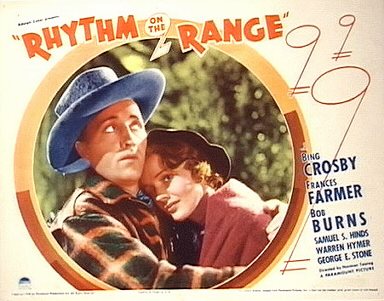
Showing posts with label Rhythm On The Range. Show all posts

Friday, November 26, 2021

RHYTHM ON THE RANGE: A 1936 REVIEW

Here is the NY Times review of Bing's RHYTHM ON THE RANGE, which was made 85 years ago! Written by Frank Nugent, it appeared in the Times on July 30, 1936...

Bing Crosby rides a broncho, milks a wild cow, croons a lullaby to a 2,200-pound Hereford bull and has a box-car romance with a runaway heiress in his new picture at the Paramount. All of which may be interesting and amusing—in fact, it is—but we prefer to think of "Rhythm on the Range" as our screen introduction to Martha Raye. 

Miss Raye is a stridently funny comedienne with a Mammoth Cave, or early Joe E. Brown, mouth, a dental supply vaguely reminiscent of those frightening uppers and lowers they used to hang over the portals of painless extraction emporia, and a chest which, in moments of burlesque aggressiveness, appears to expand fully ten inches. It is entirely possible that she had several clever lines of dialogue in the picture; we wouldn't know, because every time she opened her mouth the audience started laughing. There remains, then, only the conviction that Hollywood has found a remarkable pantomimist, an actress who can glare in several languages, become lovelorn in Esperanto and register beatific delight in facial pothooks and flourishes. She sings, too; swing music in a voice with saxophonic overtones and an occasional trace of pure fog horn. Puzzling at first, but you grow accustomed to it.


Assisting her in the genial task of stealing the picture from the laryngeal Mr. Crosby and the decorative Frances Farmer is Bob Burns, radio's monologist and bazooka player from Van Buren. Ark. Mr. Burns is tall, dry and drawling. A loquacious and philosophic humorist trained to the vocal requirements of radio, virtually his only concession to Hollywood is that he shifts from foot to foot as he talks instead of remaining rooted to a spot before a microphone. His foot-shifting is intricate, however, and his somnolent phrasing amusing, so we may bid him welcome too. And now we come to the plot, a small matter which would find an appropriate use for agate type. It deals with Mr. Crosby's participation in the rodeo at Madison Square Garden; his purchase of Cuddles, a prize bull, and his discovery of a smartly gowned stowaway in Cuddles's box car on the westbound trip. She, it develops, would rather be a pioneer woman than a polo player's bride; Mr. Crosby, it develops, would rather croon than give her a serious thought; their romance, it develops, develops. There is no point in being bitter about these things, sneering at Hollywood or chanting a disrespectful litany of "so whats?" A musical comedy story is a musical comedy story, and not many of them toss in a rodeo, a prize bull called Cuddles, a bazooka player and Martha Raye. Everything considered, Paramount has dealt fairly generously with us; of course, we could have had a mite more of Miss Raye. Still, it's something to anticipate later when her next pictures come along...


Sunday, October 7, 2018

BING ON FILM: RHYTHM ON THE RANGE - PART TWO

Rhythm On The Range ambles along, and basically it was the story about a poor man falling for a rich socialite. Bing’s 1934 movie We’re Not Dressing had a similar plot. One of Rhythm On The Range’s most curious moments was the speech given by Lucile Gleason as Penelope 'Penny' Ryland, who owned the rodeo that Bing worked for. As an amazing coincidence, she was also the aunt of Frances Farmer’s character. The speech was about pioneer women and how women should have their own mind to make their own decisions. However, at the end of the movie when she thinks that her niece ran off with Bing, she chastises Bing for taking her niece away. I know that was 1936 and way before the #Me Too movement was even thought about, but as a viewer some 80 years later I find the whole scene annoying. It slowed down the film a bit and did not really further the plot. I have seen Lucille Watson in other roles, but in my opinion her role and acting in this movie was the worst part of the film.


As I wrote earlier, the music and the singing is the top draw of the film. Although for most musicals, only one songwriting works on the film, in Rhythm On The Range numerous songwriters contributed to the film. Three great songs that spotlighted Bing’s soaring vocals were written for the film: “I Can’t Escape From You (written by Richard Whiting and Leo Robin), “Empty Saddles (written by Billy Hill), and “Round Up Lullaby” (Gertrude Ross and Charles Badger Clark). Another great song that was a favorite song of mine for years was “I’m An Old Cowhand from the Rio Grande”, which was written by a young Johnny Mercer. It was one of Mercer’s first hits in Hollywood, and the version filmed for the movie was one of the most charming pieces of the film as the whole cast joined into the song. Martha Raye had a great solo effort with a song that became her signature tune until Ella Fitzgerald made it her own. "(If You Can't Sing It) You'll Have to Swing It (Mr. Paganini)" written by Sam Coslow) was performed by Martha and accompanied by Bob Burns on his Bazooka, Louis Prima, and The Sons of the Pioneer. It was another high point of the film. Bing recorded most of the song for Decca Records, and there was even a song that Bing recorded called “The House That Jack Built For Jill” that was supposed to be in the film but was omitted from the released film.

Like some of the critics said in 1936, Rhythm On The Range was no western movie. John Wayne had nothing to be nervous about. However, the movie captured Bing really having fun. I have seen enough Bing Crosby movies enough times to notice what movies he had fun doing, and it really looked like Bing had fun on this flick. The movie was a great showcase for Bing’s talent, which was still being discovered in 1936. I highly recommend this breezy film for a fun afternoon viewing, and Bing Crosby definitely puts the rhythm into Rhythm On The Range!

MY RATING: 9 OUT OF 10


Friday, September 28, 2018

BING ON FILM: RHYTHM ON THE RANGE - PART ONE

Some of Bing Crosby’s movies from the 1930s are pretty forgettable. The plots are light and even the movie run times are short – some do not even surpass the 90 minute mark. We all know that the main draw of the films was Bing Crosby and his singing. It was singing that was new to popular music and new to movie musicals as a whole. Bing’s 1936 film Rhythm On The Range may not be an epic cinematic adventure, but it was enjoyable, fun, and it featured some great Bing moments! I had not watched the film in years, but I was home sick with a cold and figured it would be a great chance to revisit the movie.

Based on a story by Mervin J. Houser, the film is about a cowboy who meets a beautiful young woman while returning from a rodeo in the east, and invites her to stay at his California ranch to experience his simple, honest way of life. Rhythm on the Range was Crosby's only western film (apart from the 1966 remake of Stagecoach. Bing starred as Jeff Larabee, a simple man who would rather sleep under the stares than be burdened by city living. It was not really a stretch for Bing, because Bing loved the outdoors and western life that he even had a ranch built in Elko, Nevada in the 1940s. So basically, Bing played himself or at least one facet of whom he was.


In addition to Bing Crosby, troubled actress Frances Farmer was cast as Bing’s leading lady. Farmer played Doris Halliday. She was the daughter of a big New York millionaire who left her fiancĂ© at the altar, so she could try to live her life the way she wanted to. Things like that just did not happen in 1936! Frances Farmer was brought to Hollywood after having a successful Broadway career in the early 1930s. Frances soon found herself co-starring with Hollywood’s biggest star Bing Crosby and then loaned out for the Howard Hawks film Come And Get It (also from 1936), where she was given the challenging dual roles of mother and daughter. Hawks called her “the greatest actress I have ever worked with”. However, depression and alcoholism caused Farmer’s star power to fade, and she spent most of her later years in and out of mental hospitals. You would not think that Bing and Frances Farmer would be compatible as star and co-star, but they were very good together. They made the romance seem believable, even though I found Farmer’s acting to be somewhat wooden.

Rounding out the cast was comedian Bob Burns, who I have to say I never got. I did not think he was that funny or even interesting. Was he trying to replace Will Rogers as a “down home” comedian? I never was too sure. Bob Burns plays Bing’s best friend and fellow rodeo employee. Making her debut in the film was the great Martha Raye. Raye plays a woman that Bob Burns’ character meets on the train, and she instantly falls for him. Raye’s character is pretty forgettable, but she is really bubbly and enjoyable in this debut role. Bing worked well with Martha Raye’s comedy, and they would make a few movies together. (Martha Raye would also appear on Bing’s 50th Anniversary Special on television in 1977.) There are also great cameos in the film like musician Louis Prima, future singing cowboy Roy Rogers, and the singing group The Sons Of The Pioneers...

TO BE CONTINUED...


Monday, February 7, 2011

GUEST REVIEWER: RHYTHM ON THE RANGE

Our guest reviewer Bruce Kogan is back for another insightful review of one of Bing Crosby's films. This time around he reviews Bing's only "western", RHYTHM ON THE RANGE (1936).

Another source of recording material for Bing Crosby were western songs. He recorded a good many of them in his career. About the time Rhythm on the Range was being made the singing cowboy was just getting started as a movie staple. When Bing's 78s were being compiled into vinyl albums in the 1950s he had recorded enough for several albums. Lots of the songs of Gene Autry and Roy Rogers are in the Crosby catalog in fact a young Roy Rogers can be spotted in the I'm An Old Cowhand number.

Runaway heiresses were another movie staple especially in the 1930s and that's Frances Farmer's part. She's running away from a marriage she's not terribly thrilled about and stowing away on a freight boxcar she finds Bing Crosby who unbeknownst to her works as a ranchhand on her aunt's Frying Pan Ranch out in Arizona. Bing is nursemaiding a bull named Cuddles and Bing, Frances and Cuddles make their way west with several adventures. Trailing them are a trio of hoboes played very well by James Burke, Warren Hymer, and George E. Stone who have found out who Frances is and are looking to make a quick buck. Their machinations go for naught of course. In Frances Farmer's book, Will There Ever Be A Morning, she describes a not very happy life in Hollywood. However she liked this film, as it had no pretensions and similarly her leading man. She described Bing Crosby as a pleasant unassuming fellow who she liked, but didn't get to know real well. Frances had a best friend, a matron of honor to be, for the wedding that didn't come off. She was played by Martha Sleeper and I think a lot of her part was edited out. Sleeper gave some hints of a really juicy Eve Arden type character that could have been used more.


The second leads were played by Bob Burns and Martha Raye. Burns, the Arkansas Traveler and regular on Crosby's Kraft Music Hall, played his usual rustic type and in this film introduced his patented musical instrument, the bazooka. Made out of two gas pipes and a funnel, the bazooka was a kind of countrified bassoon. The army's anti-tank device in World War II looked something like it and it was named as such. Martha Raye made her debut in this film and would go on to do two other films with Crosby. She sings her famous Mr. Paganini number here and her bumptious character complement Burns quite nicely. Crosby sings A Cowboy's Lullaby to Cuddles trying to calm him down during the train ride and the famous Empty Saddles during a scene at the Madison Square Garden Rodeo. He gets a ballad entitled I Can't Escape From You to sing while on the road with Farmer.

The most famous song to come out of this film is I'm An Old Cowhand which was a big seller for him. It's an ensemble number with just about everyone in the cast participating including as I said before, Roy Rogers and also a young Louis Prima. Now there's an interesting combination. I'm An Old Cowhand was written with words and music by Crosby's good friend and sometime singing partner Johnny Mercer. IT's a good film and I'm surprised Paramount didn't come up with any more Western type material for Bing considering he did a lot of recording of that material. The only other western type ballads he ever sung on the screen were The Funny Old Hills from Paris Honeymoon and When The Moon Comes Over Madison Square from Rhythm on the River. Crosby would have to wait until he essayed Thomas Mitchell's part in the remake of Stagecoach during the 1960s to be in another western. And there he sang no songs at all.

One song that was cut out from the film was a duet by Crosby and Farmer called The House Jack Built for Jill. Crosby did record it for Decca as a solo and it is heard towards the end of the film in background. I was lucky to get a bootleg recording from the cut soundtrack. Frances talk/sings a la Rex Harrison and Bing sings it in his inimitable style. I think this was supposed to be a finale and it was cut at the last minute. The film does end somewhat abruptly and you can tell there was more shot. Maybe one day it will be restored. Rhythm on the Range was remade by Paramount with Martin and Lewis as Pardners. Dean and Jerry are good, but it ain't a patch to the original.