This is a one stop place to find news and stories about the greatest singer of all-time, Bing Crosby. From his days with Paul Whiteman to his final performances in 1977, we will examine this remarkable entertainer's life and times!
Wednesday, December 28, 2016
REMEMBERING: DEBBIE REYNOLDS (1932-2016)
Rest in peace legendary actress Debbie Reynolds. She appeared with Bing in the movie Say One For Me (1959), and she appeared on his televisions special celebrating Bing's 50 years in show business in 1977...
Labels:
death,
Debbie Reynolds,
news,
photos,
remembering
Sunday, December 25, 2016
WHAT DID BING THINK OF DAVID BOWIE?
Bing may have been somewhat aware 0f Bowie by word of mouth from a relative or colleague, but I doubt Bowie would have been on the Pop culture radar of the 73 year old Crosby, esp. when Pop culture wasn’t as widely disseminated as it is today.
A month after the special featuring their duet, Crosby was dead of a heart attack. The special was broadcast on CBS about a month after his death.
"Peace on Earth," an original tune that Bowie sings an arrangement that weaved “Little Drummer Boy together was written in about 75 minutes, Bowie and Crosby nailed the performance with less than an hour of rehearsal.
It's unclear, however, whether Crosby had any idea who Bowie was.
If anyone has definitive clues as to what Bing thought of David Bowie, I would be interested in hearing your comments...
Sunday, December 18, 2016
GUEST REVIEWER: WHITE CHRISTMAS
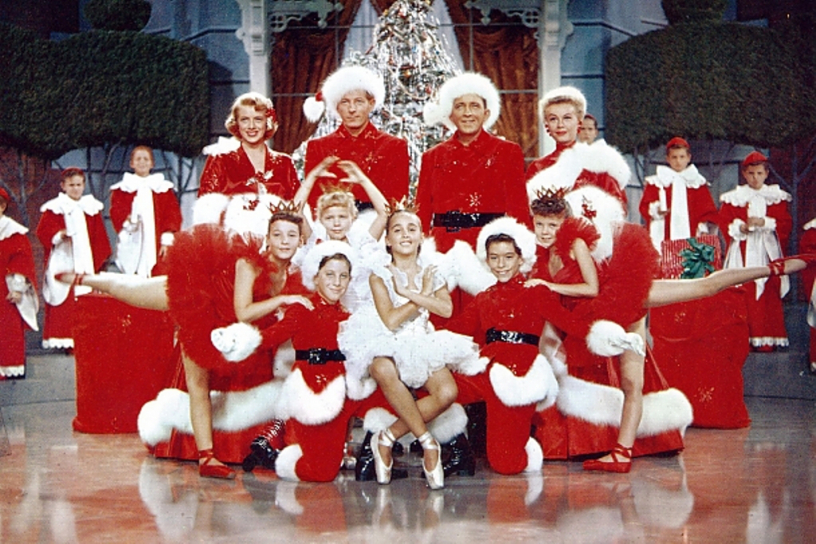
By 1954 the song White Christmas had become such a timeless classic that it was inevitable that a film would be made around it. And of course the star would be none other than Bing Crosby. But who to star with him.
Originally this was to be the third Irving Berlin outing for Bing and Fred Astaire. Then Donald O'Connor was to co-star, but finally Danny Kaye teamed with Der Bingle. Proved to be a felicitous combination.
By then Rosemary Clooney had worked in a few films well and more importantly, she had clicked with Crosby on the radio. Bing had teamed with several girl singers over the years, like Connee Boswell, Frances Langford, Mary Martin, Trudy Erwin, Carole Richards, Peggy Lee and a trio of sisters named Andrews. But he always said Rosemary Clooney was it for him and besides Mary Martin, the only other one who did became a leading lady for him.
It's not remembered because of the success of her solo career, but Rosemary Clooney started as a duo with her sister Betty who retired early to raise a family. So with Vera-Ellen as her sister in the movie, that was an aspect of the plot Rosemary could handle with ease.
The plot such as it is involves Bing and Danny as a song and dance duo who've expanded into the production end of show business. Through a little bit of a con game worked by Vera Ellen, the two meet a singing sister act like the Clooney sisters were. The sisters turn out to be headed to Vermont to work at a resort and the smitten guys go along with them.
Problem is there ain't any snow there. It's an unheard of 68 degrees Fahrenheit in early December. And the place is owned by Crosby and Kaye's former commander from World War II, played by Dean Jagger. He's about to lose his shirt and his pride. So our intrepid quartet go to work.
Irving Berlin's score for White Christmas is about half new songs and the other half from previous scores. That's how it was when you got Irving to work for you. Listen carefully even to the background music. You will not hear one note of a non-Berlin song.
One of those songs was a personal favorite of mine, Count Your Blessings Instead of Sheep. I recall in grade school in Brooklyn it was a song that the teachers had us sing in the school assemblies. Little did I know that it was introduced by the guy who proved to be my favorite entertainer. It's a patented philosophical Bing Crosby song that he did best and it serves as a ballad to woo and win Rosie. Bing sings it and then Rosie joins him in the reprise.
Danny Kaye has two good numbers. The first The Best Things Happen While Your Dancing is clearly originally for Fred Astaire, though Kaye and Vera Ellen make a lovely couple on the dance floor. The Choreography number I think was also done for Astaire, but here dancer John Brascia does the complicated dance routine while Kaye sings. I'm sure Astaire would have handled both jobs had the film been made with him.
All the stars do the Minstrel Show/Mandy number, but Vera Ellen really shines in it. She was a great dancer, really sparkled in every film she did.
Besides Sisters, Rosemary Clooney has a grand torch ballad that sold a few platters for her in Love, You Didn't Do Right By Me. She had a wonderful singing voice and the most impeccable diction of any female singer ever. You don't miss one throbbing word on any of her ballads.
White Christmas was Paramount's first film done in their wide screen process called VistaVision. And of course it was proper that their number one star for over 20 years be in this film. Of course jokes about Bing's derrière and the wide screen got into the repertoire of a certain comedian named Hope.
Just like the song that inspired it, White Christmas has proved to be a timeless holiday classic and will remain so...
BRUCE'S RATING: 9 OUT OF 10
MY RATING: 10 OUT OF 10
Monday, December 12, 2016
REMEMBERING: JOAN CARROLL (1931-2016)
Joan Carroll, a former child star who appeared in Meet Me in St. Louis opposite Judy Garland and The Bells of St. Mary's with Bing Crosby, has passed away, it was recently accounced.
Carroll died Nov. 16 near her home in Puerto Vallarta, Mexico, her son, Joe Krack, said.
Carroll played Garland's younger sister Agnes, who pulls a dangerous prank with the youngest sister, Tootie (Margaret O'Brien), in Meet Me in St. Louis (1944). The actress was sidelined for a few days during filming after she needed an emergency appendectomy.
Carroll then portrayed the struggling eighth-grade parish student Patsy who at first doesn't get any sympathy from Ingrid Bergman in The Bells of St. Mary's (1945).
Carroll made quite the impression as Ginger Rogers' younger sister Honeybell in Primrose Path (1940), then was loaned by RKO so she could appear on Broadway as Geraldine in Panama Hattie, a Cole Porter musical comedy about sailors in the Panama Canal Zone that starred Ethel Merman and ran from October 1940 to January 1942. (Shirley Temple had turned down the part.)
"For sunshine and sentiment, little Joan Carroll, who is now fully 8 years old, is wholly captivating," Brooks Atkinson wrote in his review for The New York Times. "She and Miss Merman get along together beautifully, and gruff old codgers are going to choke a little this Winter when tot and temptress sing 'Let's Be Buddies' and bring the house down."
Carroll also appeared opposite Ruth Warrick in two films: Obliging Young Lady (1942), in which she played the daughter of wealthy divorcing parents, and Petticoat Larceny (1943), where she was a young radio star who goes undercover to better understand her roles (and then gets kidnapped).
The Bells of St. Mary's was her last film. She continued to live in Beverly Hills, got married and then moved with her family to Colorado, her son said.
Born Joan Marie Felt in Elizabeth, N.J., Carroll and her folks came to California in 1936 when she was 5. She made her film debut in One Mile From Heaven (1937) opposite Claire Trevor and later appeared in Mr. Moto's Last Warning (1939), Basil Rathbone's Tower of London (1939), Anne of Windy Poplars (1940) and Tomorrow, the World! (1944).
Survivors include her other children Ann Marie, Mary Anne and James; her brother James; 14 grandchildren; and 19 great-grandchildren. A donation in her name may be made to Sacred Heart Jesuit Center, P.O. Box 128, Los Gatos, CA 95031.
Carroll was 85 years of age.
Labels:
child star,
death,
Ingrid Bergman,
Joan Carroll,
news,
remembering,
The Bells Of St. Marys
Saturday, December 10, 2016
PHOTOS OF THE DAY: BING AND VERA-ELLEN
It's that time of the year to dust off the 1954 musical White Christmas and watch Bing and Danny Kaye dance upon your yuletide screen. Bing's leading lady in the film was Rosemary Clooney, but I wanted to see if I could find any pictures of Der Bingle with Danny Kaye's love interest in the film - Vera-Ellen. Here's what I found...
Labels:
Danny Kaye,
photos,
Rosemary Clooney,
Vera-Ellen,
White Christmas
Saturday, December 3, 2016
MOVIE REVIEW: GOING HOLLYWOOD
Many people love films about Hollywood like Sunset Boulevard (1950) and Singin In The Rain (1952) and rightfully so. However, there are some hidden film gems about Hollywood that I really love to watch. One such film is a 1933 offering from MGM - Going Hollywood.
Going Hollywood was primarily a starring vehicle for rising crooner Bing Crosby. Bing had become a superstar a year earlier with a popular radio show and his first feature film for Paramount Studios, The Big Broadcast (1932). However, the studio was still unsure what to do with their instantly hot product. Was Bing a singer who acted or an actor that could sing? Paramount loaned Bing to MGM, which is something they would really not do much in the future. This film would be Bing's first film for MGM studios, which at the time was the biggest film studio in the world. Bing would not make another film at MGM for 20 years and the only other movies he made for the studio would be: High Society (1956), Man On Fire (1957), and That's Entertainment(1974).
Back to Going Hollywood, the film was also a vehicle for actress Marion Davies. Despite a lifelong relationship with paper tycoon William Randolph Hearst, Davies was a star who was becoming more famous for her relationship with Hearst than for her movies. This film did little for Davies' career, but she did look beautiful in the film. Rounding out the cast were great supporting stars as Stuart Erwin, Fifi D'Orsay, Ned Sparks, and Patsy Kelly.
The plot of the movie has Bing basically playing Bing Crosby. He is a crooner going to Hollywood for his first starring role. Fifi D'Orsay is his girlfriend and uptight French leading lady. When I first saw the movie as a teenager I really hated her, but that is a sign of a good actress. Her role in the film was to make you hate her. Marion Davies, basically plays a stalker. She plays a school teacher at an uptight private girl's school who dreams of a relationship with the crooner. When she quits the school, she hitches a train to Hollywood to meet Crosby. She gets a small role in the film Bing is working on with D'Orsay, and as the relationship between Bing and Fifi disintegrates, the career and love life of Marion Davies looks up as she makes Bing realize that she is the woman of his dreams.
Despite a great opening in Grand Central Station, not much of the "real" Hollywood is used, which is unfortunate. The music is written by the great Nacio Herb Brown and Arthur Freed, and the film shows the debut of the popular torch song "Temptation". Other musical highlights include Bing singing "Beautiful Girl" to a young Sterling Holloway (of Winnie The Pooh fame), the bizarre Busby Berkeley-like number "We'll Make Hay While The Sun Shines", and the underrated "Our Big Love Scene". Bing and Marion Davies both looked great in the movie, and the film holds up well 72 years after it was made.
The Hollywood plot of stars going to Hollywood for fame and fortune is a plot line that is still used to do this day. Also the storyline about a failing production, an out of touch director (Ned Sparks), a naive producer (Stuart Erwin), and an uptight prima donna (Fifi D'Orsay) is again something that is a part of modern Hollywood as well as this vintage 1933 Hollywood. The movie is about Hollywood, but like in many movies, the personality of Bing Crosby overshadows the whole film...
Labels:
Going Hollywood,
Marion Davies,
movie review
Friday, November 25, 2016
REMEMBERING: FLORENCE HENDERSON (1934-2016)
Florence Henderson was everyone's favorite mother on TV's "The Brady Bunch", and she appeared with Bing on his TV special. She was also friends with his widow Kathryn Crosby...
Labels:
death,
Florence Henderson,
Kathryn Crosby,
Mary Crosby,
photos,
remembering
Thursday, November 24, 2016
Monday, November 21, 2016
FLASHBACK: 1952
Monday, November 14, 2016
NINE THINGS YOU DIDN'T KNOW ABOUT BING
Great info on Bing...
Nine things you might not know about legendary crooner Bing Crosby.
1. He got his name from a comic strip in The Spokesman-Review: Born Harry Lillis Crosby in Tacoma, Bing moved with his family to Spokane when he was 3 years old. The new name found him when he was 7. At the time, The Spokesman-Review ran a comics-page feature called “The Bingville Bugle,” which was a parody of hillbilly newspapers. Little Harry thought it was a real hoot and laughed uproariously whenever he read it. A neighbor, 15-year-old Valentine Hobart, noticed the laughter and started calling him “Bingo from Bingville.” The nickname was soon shortened to Bing and stuck with him for the rest of his life.
2. He might have been a lawyer if only it paid better: Before heading for Hollywood in 1925, Bing was a law student in his third year at Gonzaga University. In addition to his studies, he worked part-time in the office of Spokane attorney Col. Charles S. Albert and performed in a popular local dance band. “It began to dawn on me that I was making as much money on the side, singing and playing drums, as Col. Albert was paying his assistant attorney,” Bing later recounted. “This gave me to think: what was I doing pursuing the law when singing offered fatter financial possibilities.”
3. He scored 13 holes in one: Bing was no duffer on the golf course. He was a five-time club champion who was good enough to play in both the U.S. Amateur and the British Amateur championships. He was beset by throngs of fans when word got out that Bing Crosby was playing the U.S. Amateur, so he quietly entered the 1950 British tournament as Harry L. Crosby. Again, word leaked that it was Bing on the greens and record crowds filled the gallery. During his lifetime, he scored 13 holes in one, testament both to Bing’s ability and how often he played the game.
4. He saved the seventh game of the 1960 World Series: Bing was an owner of the Pittsburgh Pirates baseball team from 1946 until his death in 1977. When his Pirates played the New York Yankees in the 1960 World Series, Bing decided to take his wife to Paris rather than attend the game and risk jinxing his beloved ballclub. With the Series tied at three games each, Bing hired a private crew to film the seventh and deciding game so he could watch it when he got home. It turned out to be one of the greatest games in World Series history, with the Pirates winning 10-9 on second baseman Bill Mazeroski’s ninth-inning home run. Bing no doubt enjoyed watching the game upon his return, then quietly packed it away in the cool, dry basement of his California home. In 1960, baseball games were aired live but not typically recorded and it was long believed that dramatic game had been lost forever. But in 2009, a man cataloguing tapes of Crosby TV appearances for the crooner’s estate discovered five dusty metal film canisters labeled “1960 World Series.” The New York Times ran the story of the lost game found on its front page.
5. He also loved the hot ponies: When Bing and a few partners opened the Del Mar Racetrack just north of San Diego in 1937, he showed up to take tickets and shake hands at the entrance on opening day. For years, the track’s Turf Club was a hot spot for Hollywood star sightings and the horse racing was pretty good, too. In 1938, Del Mar hosted the famous winner-take-all two-horse race between Seabiscuit and Ligaroti, which NBC aired as the first-ever national radio broadcast of a horse race.
6. He was dreaming of a white Christmas in the film “Holiday Inn”: Bing’s rendition of “White Christmas” is still the best-selling single of all time, nearly 40 years after his death. Irving Berlin wrote the song for the 1942 musical film “Holiday Inn,” which starred Bing and Fred Astaire. Twelve years later, Bing starred with Danny Kaye in the film “White Christmas,” which borrowed the name and reprised the Academy Award-winning song. In between, Bing won the Academy Award for best actor in the 1944 film “Going My Way,” playing Father Chuck O’Malley, a character he based on a priest he had known at Gonzaga.
7. His last hit song was a duet with David Bowie: Bing’s televised Christmas TV specials were an American holiday staple until he died in 1977. The programs always featured Bing and his family, along with popular musical stars of the day, singing seasonal songs and performing skits. Bing invited the British glam rocker David Bowie to appear on his 1977 program and the two performed a strangely successful duet called “Peace on Earth,” complete with a corny intro sketch. The pre-recorded show actually aired two months after Bing died. In 1982, RCA released a single of the Bing-Bowie Christmas song, which has showed remarkable seasonal staying power over the years, climbing to No. 3 on the charts in December 2006.
8. He drove an Edsel to help Gonzaga: Bing built a new library for Gonzaga University back in the 1950s and raised some of the money for the project by starring in “The Edsel Show.” The television special, which aired in place of Ed Sullivan on Sunday, Oct. 13, 1957, starred Bing and friends Frank Sinatra, Rosemary Clooney, Louis Armstrong and, of course, Bob Hope. Although Bing was the real driver behind the show, his alma mater was by contract the producer and as a result received a tidy $250,000 payday. The show was notable as the first CBS entertainment program recorded on videotape for rebroadcasting in the West after the show was performed live for the TV audience in the East. It was also a hit, earning Look Magazine’s TV award for best musical show of the year. However, to the disappointment of sponsor Ford Motor Co., the show’s success did not transfer to the popularity of the new-for-1958 Edsel brand of automobiles.
9. His childhood home is open to the public: Bing grew up at 508 E. Sharp Ave. in Spokane in a Craftsman-style house built in 1913 by his father and two uncles. The family lived there until they sold the home to a neighbor in 1936. The house still sits at the edge of the campus of Gonzaga University, which today owns the property. The well-preserved Crosby home contains displays that celebrate Bing’s life and accomplishments – photographs, gold records, golf mementos, even the Oscar he won in 1944. It is open to the public 9 a.m.- 4:30 p.m. weekdays and 1-4 p.m. on Saturdays. There is no charge for admission.
Subscribe to:
Posts (Atom)