Showing posts with label White Christmas. Show all posts
Showing posts with label White Christmas. Show all posts
Thursday, December 25, 2025

Monday, December 22, 2025
BING, IRVING BERLIN, AND WHITE CHRISTMAS

In 1940, he wrote another quintessential American song, “White Christmas,” which the popular entertainer Bing Crosby eventually made famous.
But this was a profoundly sad time for humanity. World War II – what would become the deadliest war in human history – had begun in Europe and Asia, just as Americans were starting to pick up the pieces from the Great Depression.
Today, it can seem like humanity is at another tipping point: political polarization, war in the Middle East and Europe, a global climate crisis. Yet like other historians, I’ve long thought that the study of the past can help point the way forward.
“White Christmas” has resonated for more than 80 years, and I think the reasons why are worth understanding.
Christmas in America had always reflected a mix of influences, from ancient Roman celebrations of the winter solstice to the Norse festival known as Yule. Catholics in Europe had celebrated Christmas with public merriment since the Middle Ages, but Protestants often denounced the holiday as a vestige of paganism. These religious tensions spilled over to the American colonies and persisted after the Revolutionary War, when slavery divided the nation even further.
After the Civil War, many Americans pined for national traditions that could unify the country. Protestant opposition to Christmas celebrations had relaxed, so Congress finally declared Christmas a federal holiday in 1870. Millions of Americans soon adopted the German tradition of decorating trees. They also exchanged presents, sent cards and shared stories of Santa Claus, a figure whose image the cartoonist Thomas Nast perfected in the late 19th century.
The Christmases that Berlin and Crosby “used to know” were those of the 1910s and 1920s, when the season expanded to include the nation’s first public Christmas tree lighting ceremony and the appearance of Santa Claus at the end of Macy’s Thanksgiving Day Parade.
Despite these evolving secular influences, Christmas music and entertainment continued to emphasize Christianity. Churchgoers and carolers often sang “Silent Night” and “Joy to the World.” Berlin’s inspiration for the song came in 1937, when he spent Christmas in Beverly Hills. He was near the film studios where he worked but far from his wife, Ellin – a devout Catholic – and the New York City home in Manhattan where they had always celebrated the holiday with their three daughters.
Being apart from Ellin that Christmas was particularly difficult: Their infant son had died on Dec. 26, 1928. Irving knew his wife would have to make the annual visit to their son’s grave by herself.
By 1940, Berlin had come up with his lyrics. In his Manhattan office, he sat at his piano and asked his arranger to take down the notes.
“Not only is it the best song I ever wrote,” he promised, “it’s the best song anybody ever wrote.”

Berlin had connected his lonesome Christmas to the broader turmoil of the time, including the outbreak of World War II and fraught debates about America’s role in the world.
This new song reflected his response: a dream of better times and places. It evoked a small town of yesteryear in which horse-drawn sleighs crossed freshly fallen snow. It also imagined a future in which dark days would be “merry and bright” once again.
Berlin soon took “White Christmas” back to Hollywood. He wanted it to appear in his newest musical, one that would tell the story of a retired singer whose hotel offered rooms and entertainment, but only on American holidays. He titled the film “Holiday Inn” and pitched it to Paramount Pictures, with Crosby as the lead.
Raised in Spokane, Washington, Bing Crosby had launched his music career in the 1920s. A weekly radio show and a contract with Paramount led to stardom during the 1930s. With his slim build and protruding ears, Crosby did not look the part of a leading man. But his easygoing demeanor and mellow voice made him immensely popular.
“Holiday Inn” premiered in August 1942. Reviewers barely mentioned the song, but ordinary Americans couldn’t get enough of it. By December it was on every radio, in every jukebox and, as the Christian Science Monitor newspaper noted, in nearly “every home and heart” in the country.
“White Christmas” was not overtly patriotic, but it made Americans think about why they fought, sacrificed and endured separation from their loved ones. As an editorial in the Buffalo Courier-Express concluded, the song “provided a forcible reminder that we are fighting for the right to dream and for memories to dream about.”
This made it a song all Americans could embrace, including those not always treated like Americans. During World War II, aspects of the Christmas holiday – family, home, comfort and safety – took on
Berlin and Crosby didn’t set out to change how Americans celebrate Christmas. But that’s what they ended up doing. Their song’s universal appeal and phenomenal success launched a new era of holiday entertainment – traditions that helped Americanize the Christmas season.
Like “White Christmas,” popular songs such as “Have Yourself a Merry Little Christmas” (1943) tapped into a longing for being with friends and family. “Rudolph the Red-Nosed Reindeer” (1949) and other new songs celebrated snow, sleigh rides and Santa Claus, not the birth of Jesus.
“White Christmas” had already sold 5 million copies by 1947 when Crosby recorded “Merry Christmas,” the first Christmas album ever produced. On the album, “White Christmas” appeared alongside holiday classics such as “Jingle Bells” and “Santa Claus Is Coming to Town.”

Saturday, December 20, 2025
Sunday, November 9, 2025
COMING SOON - NEW BING CROSBY RECORD

Last year, UME celebrated the holidays with a selection on 7” vinyl. This year, they’re continuing the series, complete with a new snow white-colored 7” of Bing Crosby’s beloved “White Christmas.”
The 2024 collection included pressings of The Beach Boys’ “Little Saint Nick,” Brenda Lee’s “Rockin’ Around The Christmas Tree,” Burl Ives’ “A Holly Jolly Christmas,” Chuck Berry’s “Run Rudolph Run,” Ella Fitzgerald’s “Sleigh Ride,” Frank Sinatra’s “Jingle Bells,” and Nat King Cole’s “The Christmas Song.” Each 7” features a beloved holiday hit on the A-side and another festive favorite on the B-side.
“White Christmas” will come out as part of the 2025 lineup. It is set to be released on its own as well as part of a carrying case that will include the full lineup of 2024 and 2025 releases...
Wednesday, December 25, 2024
Sunday, December 18, 2022
HOLIDAY INN VS WHITE CHRISTMAS

It’s hard to shoot down the movie that brought us the song, “White Christmas,” (talking about Holiday Inn), but it’s not thought of as a classic in the way White Christmas is. Both star Bing Crosby, both take place more or less around a hotel/inn, and both are full of music and a little dancing. If it wasn’t for Holiday Inn, there wouldn’t be a White Christmas movie, but White Christmas goes farther and leaves us with that warm, fuzzy feeling.
Holiday Inn revolves around Jim Hardy (Bing Crosby) wanting to leave show business for the “good life” where he doesn’t have to work much. He opens an inn which is only open on holidays and gets a pretty girl to perform there for him. When Ted Hanover (Fred Astaire) shows up, he wants the girl as his new dance partner, which would take her away from the inn and Jim, who loves her. It’s a bit stale, and has song and focuses too long on dance routines for holidays such as Abe Lincoln’s Birthday, Washington’s Birthday, Valentine’s Day, Independence Day. Though we think of it as a Christmas movie, there’s not a lot of Christmas in it.

White Christmas, on the other hand, takes place in the days leading up to Christmas. After WWII, song and dance act Wallace and Davis (Crosby and Danny Kaye) meet up with a sister act (Rosemary Clooney and Vera-Ellen) who are on their way to Connecticut. When they arrive there, they find their old army sergeant struggling to make ends meet at an old ski lodge when it’s too warm for snow, so they decide to help out by moving the act out there. In the meantime, there’s music and dancing and a little romance. And then it starts to snow.
White Christmas gives us that feeling that only comes once a year whereas Holiday Inn seems more like a farce – trying to pack in as much singing and dancing without a whole lot of plot. Without the one, we wouldn’t have the other, but we don’t need both. Sorry, Holiday Inn, but I’m dreaming of a White Christmas...

Monday, September 12, 2022
NEW CD: WHITE CHRISTMAS AND HOLIDAY INN SOUNDTRACK
Sepia has done it again with this new Bing release just in time for the holidays...
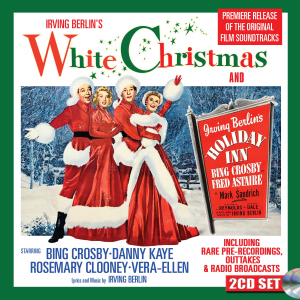
Title: White Christmas & Holiday Inn (2 CD Set)
Artist: Various
Catalogue No.: SEPIA 1376
Barcode: 5055122113768
Release Date: October 2022
This is the first CD release of the complete film scores for both 'White Christmas' and 'Holiday Inn' derived from pre-recordings made during the film making process. Also included is a previously unreleased 1942 recording of 'White Christmas' as sung by Bing Crosby, and Rosemary Clooney's thrilling 1953 soundtrack sessions recorded for Irving Berlin's White Christmas!

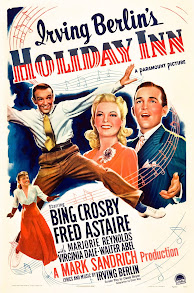
CD 2
HOLIDAY INN
1. HOLIDAY INN MAIN TITLE The Paramount Studio Orchestra
2. I'LL CAPTURE YOUR HEART Bing Crosby, Fred Astaire, Virginia Dale
3. LAZY Bing Crosby
4. YOU'RE EASY TO DANCE WITH Fred Astaire
5. WHITE CHRISTMAS Bing Crosby, Martha Mears
6. HAPPY HOLIDAY Bing Crosby, Martha Mears
7. LET'S START THE NEW YEAR RIGHT Bing Crosby
8. YOU'RE EASY TO DANCE WITH Bob Crosby and his Band
9. ABRAHAM Bing Crosby, Martha Mears
10. BE CAREFUL IT'S MY HEART Bing Crosby
11. I CAN'T TELL A LIE Fred Astaire
12. EASTER PARADE Bing Crosby
13. SAY IT WITH FIRECRACKERS / SONG OF FREEDOM Bing Crosby
14. SAY IT WITH FIRECRACKERS Bob Crosby and his Band
15. INSTRUMENTAL REPRISE: LET'S START THE NEW YEAR RIGHT, ABRAHAM, BE CAREFUL IT'S MY HEART, EASTER PARADE, YOU'RE EASY TO DANCE WITH, HAPPY HOLIDAY, WHITE CHRISTMAS
16. I'VE GOT PLENTY TO BE THANKFUL FOR Bing Crosby
17. WHITE CHRISTMAS (reprise) Martha Mears
18. CLOSING MEDLEY: I'LL CAPTURE YOUR HEART, LET'S START THE NEW YEAR RIGHT Bing Crosby, Fred Astaire, Martha Mears, Virginia Dale
HOLIDAY INN RADIO PREVIEW:
19. INTRODUCTION and HAPPY HOLIDAY Bing Crosby
20. I'LL CAPTURE YOUR HEART Bing Crosby, Fred Astaire, Betty Rhodes
21. BE CAREFUL IT'S MY HEART Bing Crosby, Betty Rhodes
22. I CAN'T TELL A LIE Fred Astaire
23. EASTER PARADE Bing Crosby
24. ABRAHAM Bing Crosby, Betty Rhodes
25. WHITE CHRISTMAS Bing Crosby
26. LET'S START THE NEW YEAR RIGHT Betty Rhodes, Bing Crosby
27. YOU'RE EASY TO DANCE WITH Fred Astaire
28. SONG OF FREEDOM Bing Crosby
29. CLOSING ANNOUNCEMENT
30. WHITE CHRISTMAS Bing Crosby
SOURCE

Artist: Various
Catalogue No.: SEPIA 1376
Barcode: 5055122113768
Release Date: October 2022
This is the first CD release of the complete film scores for both 'White Christmas' and 'Holiday Inn' derived from pre-recordings made during the film making process. Also included is a previously unreleased 1942 recording of 'White Christmas' as sung by Bing Crosby, and Rosemary Clooney's thrilling 1953 soundtrack sessions recorded for Irving Berlin's White Christmas!

CD 1
WHITE CHRISTMAS
1. VISTAVISION FANFARE The Paramount Studio Orchestra
2. WHITE CHRISTMAS MAIN TITLE The Paramount Studio Orchestra
3. SANTA CLAUS Bing Crosby, Danny Kaye
4. WHITE CHRISTMAS Bing Crosby
5. WE'LL FOLLOW THE OLD MAN Bing Crosby, Danny Kaye
6. HEAT WAVE, LET ME SING AND I'M HAPPY, BLUE SKIES Bing Crosby, Danny Kaye 7. SISTERS Rosemary Clooney, Trudy Stevens
8. THE BEST THINGS HAPPEN WHILE YOU'RE DANCING Danny Kaye
9. SNOW Bing Crosby, Danny Kaye, Rosemary Clooney, Trudy Stevens
10. SISTERS (Reprise) Rosemary Clooney, Trudy Stevens
11. I'D RATHER SEE A MINSTREL SHOW, MANDY Bing Crosby, Danny Kaye, Rosemary Clooney
12. COUNT YOUR BLESSINGS INSTEAD OF SHEEP Bing Crosby, Rosemary Clooney
13. CHOREOGRAPHY Danny Kaye
14. THE BEST THINGS HAPPEN WHILE YOU'RE DANCING (reprise) The Skylarks
15. ABRAHAM Instrumental
16. LOVE, YOU DIDN'T DO RIGHT BY ME Rosemary Clooney
17. WHAT CAN YOU DO WITH A GENERAL Bing Crosby
18. WE'LL FOLLOW THE OLD MAN (Reprise) Bing Crosby, Danny Kaye
19. GEE, I WISH I WAS BACK IN THE ARMY Bing Crosby, Danny Kaye, Rosemary Clooney, Trudy Stevens
20. WHITE CHRISTMAS FINALE (version 1) The Paramount Studio Orchestra
21. WHITE CHRISTMAS FINALE (version 2) Bing Crosby, Danny Kaye, Rosemary Clooney, Trudy Stevens
22. WHITE CHRISTMAS FINALE (version 3) Bing Crosby, Danny Kaye, Rosemary Clooney, Trudy Stevens
23. WHITE CHRISTMAS FINALE (version 4) Bing Crosby, Danny Kaye, Rosemary Clooney, Trudy Stevens
24. WHITE CHRISTMAS Rosemary Clooney
25. SISTERS Rosemary, Betty Clooney
26. SNOW Rosemary Clooney
27. COUNT YOUR BLESSINGS INSTEAD OF SHEEP Rosemary Clooney
28. LOVE, YOU DIDN'T DO RIGHT BY ME Rosemary Clooney
29. IRVING BERLIN'S WHITE CHRISTMAS THEATRE LOBBY ANNOUNCEMENT Bing Crosby

CD 2
HOLIDAY INN
1. HOLIDAY INN MAIN TITLE The Paramount Studio Orchestra
2. I'LL CAPTURE YOUR HEART Bing Crosby, Fred Astaire, Virginia Dale
3. LAZY Bing Crosby
4. YOU'RE EASY TO DANCE WITH Fred Astaire
5. WHITE CHRISTMAS Bing Crosby, Martha Mears
6. HAPPY HOLIDAY Bing Crosby, Martha Mears
7. LET'S START THE NEW YEAR RIGHT Bing Crosby
8. YOU'RE EASY TO DANCE WITH Bob Crosby and his Band
9. ABRAHAM Bing Crosby, Martha Mears
10. BE CAREFUL IT'S MY HEART Bing Crosby
11. I CAN'T TELL A LIE Fred Astaire
12. EASTER PARADE Bing Crosby
13. SAY IT WITH FIRECRACKERS / SONG OF FREEDOM Bing Crosby
14. SAY IT WITH FIRECRACKERS Bob Crosby and his Band
15. INSTRUMENTAL REPRISE: LET'S START THE NEW YEAR RIGHT, ABRAHAM, BE CAREFUL IT'S MY HEART, EASTER PARADE, YOU'RE EASY TO DANCE WITH, HAPPY HOLIDAY, WHITE CHRISTMAS
16. I'VE GOT PLENTY TO BE THANKFUL FOR Bing Crosby
17. WHITE CHRISTMAS (reprise) Martha Mears
18. CLOSING MEDLEY: I'LL CAPTURE YOUR HEART, LET'S START THE NEW YEAR RIGHT Bing Crosby, Fred Astaire, Martha Mears, Virginia Dale
HOLIDAY INN RADIO PREVIEW:
19. INTRODUCTION and HAPPY HOLIDAY Bing Crosby
20. I'LL CAPTURE YOUR HEART Bing Crosby, Fred Astaire, Betty Rhodes
21. BE CAREFUL IT'S MY HEART Bing Crosby, Betty Rhodes
22. I CAN'T TELL A LIE Fred Astaire
23. EASTER PARADE Bing Crosby
24. ABRAHAM Bing Crosby, Betty Rhodes
25. WHITE CHRISTMAS Bing Crosby
26. LET'S START THE NEW YEAR RIGHT Betty Rhodes, Bing Crosby
27. YOU'RE EASY TO DANCE WITH Fred Astaire
28. SONG OF FREEDOM Bing Crosby
29. CLOSING ANNOUNCEMENT
30. WHITE CHRISTMAS Bing Crosby
Sunday, December 15, 2019
THE MAKING OF WHITE CHRISTMAS

Bing Crosby first performed the song “White Christmas” on his CBS radio show on Christmas Day in 1941. He reprised it in the 1942 film Holiday Inn, in which he starred with Fred Astaire, when his character impresses a love interest by crooning a new song he’d just written called “White Christmas.” It impressed the Academy too, winning the Oscar for Best Song. The song hit the charts and became the all-time best-selling single for over 50 years. (Until Elton John’s tribute to the late Princess Diana, “Candle in the Wind,” finally took that honor.)
So it seemed a no-brainer to build another movie around the hit song. Irving Berlin wrote new songs and repurposed some earlier ones, and a story was strung together featuring a male song-and-dance act and singing sisters on their way to a Vermont inn run by a general the men knew from the war. The set for the Vermont Inn appears in both Holiday Inn and White Christmas. By the time principal photography began, Paramount had acquired the new wide-screen Technicolor and VistaVision technologies, which would show off the song and dance numbers in vibrant color.

White Christmas was supposed to reunite Bing Crosby with Fred Astaire, who’d appeared together in both Holiday Inn and Blue Skies (1946). But there was a snag: Fred Astaire didn’t like the script and refused to participate. Paramount replaced him with Donald O’Connor (who’d later gain acclaim as Cosmo the piano player in Singin’ in the Rain), but when O’Connor fell ill right before production was to begin, he had to pull out. Desperate for a replacement, Paramount contacted Danny Kaye, who asked for, and received, a then unheard-of fee: $200,000 plus 10 percent of the gross.
“It is the first movie that I’ve been connected with since Holiday Inn that has the feel of a Broadway musical,” an excited Berlin wrote to his friend Irving Hoffman as production began.
As the song-and-dance team, Crosby and Kaye had fun together, improvising on set, as did the singing sisters played by Vera-Ellen and Rosemary Clooney (yes, the cousin of George). The classic number “Sisters,” in which Crosby and Kaye vamp around waving blue-feathered fans, wasn’t even in the original story. But the actors were goofing around on set, and director Michael Curtiz found their capers so funny, he wrote them in. The actors kept cracking up during the take, but everyone loved the authenticity of the moment, so the laughter stayed. The scene where Crosby’s character tells Clooney’s his theory of what foods cause which dreams before launching into “Count Your Blessings” was almost completely improvised. Crosby even made up words like “weirdsmobile.”

Rosemary Clooney, a trained vocalist, sang her own songs in the movie, and sometimes those of her co-star Vera-Ellen. (The other vocalist covering Vera-Ellen’s songs was Trudy Stevens). Vera-Ellen came to White Christmas an accomplished dancer—at 18 she’d been one of the youngest Radio City Rockettes. Danny Kaye could cut the rug, but wasn’t nearly as nimble on his feet as Vera-Ellen, and toward the end of “The Best Things Happen When You’re Dancing,” he accidentally tripped her. (Luckily he caught her gracefully, saving the take.) Though he wasn’t the principal choreographer, Bob Fosse, who would go on to create the distinctive dance moves in Chicago, Cabaret, and All That Jazz, staged some of the dance numbers.
While the public adored the sweetly good-natured musical, some critics felt it was too saccharine. Bowley Crowther wrote a harsh review in The New York Times on October 15, 1954, saying, “The confection is not so tasty as one might suppose. The flavoring is largely in the line-up and not in the output of the cooks. Everyone works hard at the business of singing, dancing and cracking jokes, but the stuff that they work with is minor.”
But audiences didn’t care. White Christmas took in $12 million, the biggest box office hit of the year. And it endures as a heart-warming Christmas classic to revisit at this time of year. Even the New York Times admitted it was a good-looking film, saying, “The colors on the big screen are rich and luminous, the images are clear and sharp, and rapid movements are got without blurring.”

Tuesday, December 10, 2019
HARRY CROSBY, HIS FATHER, AND WHITE CHRISTMAS

Here is a really nice article that was featured in the British newspaper Express. It was written by Deborah Collcutt...
The highlight of the day is a rendition of Christmas songs, performed live by the children for assembled friends and family. All hardly surprising, perhaps, given the household in question is that of Bing Crosby’s son Harry, whose late father’s name encapsulates the magic of Christmas as much as Santa Claus himself. Bing’s grandchildren even perform their grandpa’s world-famous song White Christmas every year in tribute to the master crooner. “My son, Nicholas, and daughter, Thea, sing and play White Christmas on the piano for everyone,” says Harry, who lives in New York.
Harry, 61, continues: “It’s funny, I used to cringe at the idea of playing my father’s music but not now. People really love it – it’s a sustainable thing.”
Nearly 80 years after its 1942 release, White Christmas remains the world’s biggest-selling single – a whopping 50 million copies globally. Unsurprisingly, it remains a staple of radio and in-store music playlists over the festive season.
Now it is back in the Top 10 after 40 years and on course for a Christmas Number One after a new album, Bing at Christmas, a remastered recording with the London Symphony Orchestra, was released last month.

And the family is making a concerted effort to keep Bing’s memory alive and introduce him to new audiences. To that end, they are in talks about a dramatization of his life, along the lines of hit series The Crown on Netflix.
Harry was just 19 when his famous father died aged 74 on a golf course in Spain. At the time, Harry had been performing with Bing and singer Rosemary Clooney, aunt of movie star George, on an international tour, which had started in Britain.
“We had played several shows at the Palladium in London and were due to tour Japan and Australia but Dad wasn’t feeling well,” recalls Harry, who had classical training in piano, composition and orchestration.
“He terminated the tour because he wasn’t feeling up for stuff, travelling for six months over the world.”
Father and son closed the tour in Brighton on October 10, 1977 – Dame Gracie Fields was there to see the show – then went their separate ways. It was the last time Harry would see his father alive.
“I had just turned 19 and I decided to go back to school. I applied to Rada (Royal Academy of Dramatic Art) and Lamda (London Academy of Music and Dramatic Art) to major in theatre and music but they were full up. The school year had started.
“I invited the dean of Lamda to come and see me perform at the Palladium with my dad. I sang a duet with Rosemary and I sang alone. Afterwards he said, ‘Start Monday!’
So I went to school during the day and performed with dad at night. I didn’t go out of my way to tell people who my dad was.
My objective was to assimilate as part of the group. But, of course, I couldn’t join them for a pint in the pub in the evenings because I was performing, plus Dad and I were living in an apartment in Mayfair.”

So Bing, who had been in generally good health according to his son, went to Spain on his own to play golf. Harry believes his father never recovered after falling off the stage seven months earlier at his 50th anniversary concert in California.
Having toppled 30 feet into the orchestra pit and ruptured a disc in his back, he spent a month in the hospital. In Spain, four days after their last concert, Bing collapsed and died of a massive heart attack at the end of his first day’s game of golf.
Harry, the only family member in Europe, had to fly home to California with his father’s body.
There his mother, Bing’s second wife, actress Kathryn Grant, now 86, his actress sister, Mary, and young brother Nathaniel, an amateur golfer, were waiting. After the funeral, Harry returned to Britain to continue his studies.
Harry Crosby says his father never pushed him into the music business.

“Certainly at that time I didn’t feel guilty that I wasn’t with him – you can’t change the outcome of things – but you grow up quickly when you lose a parent that young,” he says.
“Dad and I had a really strong relationship, both professionally and personally. As a father and a son, we were exceptionally close.”
Harry remains deeply saddened by comments made by his late half-brother, Gary – Bing’s eldest son from his first marriage to actress and nightclub singer, Dixie Lee – after their father’s death.
In a highly critical memoir, Going My Own Way, Gary depicted Bing as cruel, cold, remote, and physically and psychologically abusive.
But it is a description that Harry does not recognise. “I don’t know where it came from. I only know my own experience with my dad which was one of love, support, friendship and respect,” he says.
“My dad never pushed us into music or entertainment – we were exposed to it and I loved working together.

“We went fishing together and golfing and he was able to impart on us not just that we were loved but also the rules of the road – the way to behave. So I was sad to read those things.”
But there have been disputes between Bing’s two families dating back to Dixie’s death from cancer in 1952 when she left her share of their estate in trust to her sons.
Bing left his estate to Kathryn, and HLC Properties, Ltd was formed to manage his interests. In 1999, the families settled a dispute over the estates for a reported £1.2million. Now Harry and descendants of his half-siblings no longer see each other.
“It’s sad. I wish we did but we were raised in a different town and we never did see much of each other because of the age difference.
While Bing dedicated his life to singing –he didn’t play an instrument, apart from drums early on in his career – he also helped develop recording equipment so artists didn’t always have to perform live to preserve their voices.

After Bing’s death, Harry went into banking.
He studied business after a spell writing jingles for commercials but he maintains a passionate interest in music and he and his Croatian wife, Mihaela, support the performing arts Lincoln Center in New York.
These days, Harry plays at home for pleasure with Nicholas, 15, and Thea, 11, and loves the anonymity living in New York affords him.
“Mihaela is from Zagreb and her background is in microbiology,” he says.
“It was a joy she didn’t know who my father was,” laughs Harry.
“When we met, she said, ‘I love the fact your dad likes music, like you. Can I meet him?’”
The Crosby and Clooney families remain close although Harry hasn’t seen George for some time.
Now Harry is preparing to start his Christmas shopping, always a poignant moment because it means going into a mall where a certain song is always playing.
But while his younger sister Mary, says she found White Christmas heartbreaking to listen to after their father’s death, it’s always been a pleasure for Harry.

“It’s always wonderful to hear, it makes me feel good,” he says. “Mind you Little Drummer Boy is great, too.”
Bing recorded the latter as a duet with David Bowie in London a month before he died for a television special, Bing Crosby’s Merrie Olde Christmas, which was to be his last. It was broadcast posthumously on Christmas Eve 1977.
“They just banged it out. They were going to cover it as a duet and then it turned into a single,” says Harry.
“They barely rehearsed but they were both such pros and of course they had a lot of respect for each other.”
But if he had to choose one festive single to save from the waves on a desert island? “White Christmas. Absolutely. Game over"...

Sunday, December 23, 2018
BING ON FILM: WHITE CHRISTMAS - PART TWO

Trudy Stevens provided the singing voice for Vera-Ellen, who did not have a suitable singing voice. It was not possible to issue an "original soundtrack album" of the film, because Decca Records controlled the soundtrack rights, but Clooney was under exclusive contract with Columbia Records. Consequently, each company issued a separate "soundtrack recording": Decca issuing Selections from Irving Berlin's White Christmas, while Columbia issued Irving Berlin's White Christmas. On the former, the song "Sisters" (as well as all of Clooney's vocal parts) was recorded by Peggy Lee, while on the latter, the song was sung by Rosemary Clooney and her own sister, Betty.
Berlin wrote "A Singer, A Dancer" for Crosby and his planned co-star Fred Astaire but when he was unavailable, Berlin re-wrote it as "A Crooner – A Comic" for Crosby and Donald O'Connor, but when O'Connor left the project so did the song. Another song written by Berlin for the film was "Sittin' in the Sun (Countin' My Money)" but because of delays in production, Berlin decided to publish it independently.] Crosby and Kaye also recorded another Berlin song ("Santa Claus") for the opening WWII Christmas Eve show scene, but it was not used in the final film. Their recording of the song survives though, and the song is cute but not great.

One of the greatest moments of the film is a bit Bing and Danny Kaye did off the cuff. According to Rosemary Clooney, Bing and Danny’s “Sisters” performance was not originally in the script. They were clowning around on the set, and director Michael Curtiz thought it was so funny that he decided to film it. In the scene, Crosby’s laughs are genuine and unscripted, and he was unable to hold a straight face. Clooney said the filmmakers had a better take where Crosby didn’t laugh, but the version with Crosby laughing was one that they used.
I find myself always comparing White Christmas to Holiday Inn, and I think that is unfair. The movies were done a decade apart and movie musicals were much different in 1954 than 1942. I prefer Holiday Inn, but I have a much better appreciation for White Christmas now that I have seen the film in a move theater. From the understated performance of Dean Jagger as the retired general to the superb dancing of Vera-Ellen to the banter of Crosby and Kaye, White Christmas is really a great film. Yes, the film is sentimental and cheesy at times. While I went to see the film in a theater my wife and kids ran errands, and I am glad. I had tears in eyes at the end when the general was recognized and realized he was not forgotten. I think that is a sign of a great movie that a movie made more than 60 years ago can still evoke emotion in 2017. At the end of the movie screening, the audience stood up and applauded, and I smiled to myself and thought of what a great Christmas gift this film was and is. Thanks again Bing!
MY RATING: 10 OUT OF 10

Tuesday, December 11, 2018
BING ON FILM: WHITE CHRISTMAS - PART ONE

The beloved classic that everyone watches during the holiday season is a lot different from what was proposed in the beginning. At first, Bing Crosby turned down the role due to the recent death of his wife Dixie Lee. However, Bing knew working on a musical with Irving Berlin tunes was destined to be a hit so he signed. Bing had co-star approval, and had wanted Fred Astaire for the role of his Army buddy. Crosby and Astaire had previously starred in Holiday Inn (1942) and Blue Skies (1946) earlier. Astaire read the script, but he then turned it down. The last movie that Astaire had made for Paramount was the 1950 disastrous musical Let’s Dance with Betty Hutton, and by 1954 Astaire was really being choosy on what roles he was accepting at that point. Next Bing wanted to work with dancer Donald O’ Connor again. Donald had played Bing’s younger brother in an earlier Paramount musical Sing You Sinners in 1938, and Bing and Donald had work together on radio shows since then. O’Connor was all set to be in the film, until he broke his ankle right before film rehearsals were set to begin. This sent Paramount scrambling, and they came up with the idea of pairing Bing with comedian Danny Kaye.

Even though Kaye was third choice for the film, he had this to say about Bing:
"I loved to work with him. I had the feeling he was my close personal friend. The real truth is that everybody knows Bing, but no one knows him. Through the years, he has created a legendary character that is so vivid, no one knows where the legend begins and the real Crosby leaves off. I thought I knew Bing--thought I knew all about him until we started to make White Christmas. Then I realized I actually didn't know the man at all. The truth of the matter is, there isn't a lazy bone in Bing's body. He works harder than any man I've met--but he does it with an easy casualness that makes him look lazy." (The Danny Kaye Story pg 198).
The movie plot, as flimsy as it may be, does has some serious overtones. By 1954, World War II had been over for almost a decade, and the film touches on what happens to soldiers after the fighting is over. Like many of Irving Berlin’s movie musicals, the plot of White Christmas is basically a vehicle to move from song to song. Many of Berlin’s standards are present like “Blue Skies”, “Heat Wave”, “Abraham” and of course the title song that was sung in the first minutes of the movie by Bing, and then by the group at the end. The new songs that Berlin wrote for the film were good but not up to par with the songs he was writing two decades earlier. My favorite of these new songs was the torchy number “Love You Didn’t Do Right For Me” which was sung in the movie by Rosemary Clooney. Other new songs like “Snow” and “Sisters” have also become standards.... TO BE CONTINUED...

Wednesday, December 20, 2017
ROSEMARY CLOONEY AND MEMORIES OF WHITE CHRISTMAS

When Rosemary Clooney sang seasonal standards like "Let It Snow" and "I'll Be Home For Christmas" in her recent show at Feinstein's at the Regency Hotel here, it brought back happy memories of her in the classic 1954 movie "White Christmas." But her flawless rendition of the more sentimental "Count Your Blessings," which she sang with costar Bing Crosby in the film, is the heart and soul of her Christmas show (to be repeated in Salt Lake City and Los Angeles later this month) and her amazing career.
In an interview, the internationally famous star, who celebrated her 50th year singing professionally in 1995, called family her biggest blessing. "I'm so grateful for my family. My children. My 10 grandchildren and my husband, Dante. He's the love of my life," Ms. Clooney said. "But I've never quite forgiven Dante because he chose to be in the movie 'Seven Brides for Seven Brothers' over 'White Christmas,' " Ms. Clooney joked. "He has on occasion sung with me in nightclub acts, but he would prefer to sing by himself because he likes to sing all of his songs in Italian!"

Ms. Clooney and Mr. DiPaolo, a former dancer and singer, married three years ago after having been close friends for more than 20 years. Ms. Clooney was first married to the late stage and screen star José Ferrer, with whom she had five children. "I'll never forget one Christmas when Joe [Mr. Ferrer] was doing a play on Broadway. We had a suite at The Plaza; a Christmas tree from FAO Schwartz; a live tree that they had decorated. It was one of the nicest Christmases I ever had," she reminisces.
Ms. Clooney's career started when she sang duets with her sister Betty for WLW Radio in Cincinnati in 1945. Two years later, "The Clooney Sisters," as they were billed, made their debut at the famed Steel Pier in Atlantic City, N.J. Ms. Clooney became a star when she recorded her first single, "Come On-a My House" in 1951, and it became a huge hit.
Ms. Clooney, who sees her better-known nephew, TV and movie star George Clooney, at family gatherings ("he's very close to my oldest son," she said), applauds him for pursuing his career so vigorously even though it seems to have been at the expense of having a family.

"Let me tell you, I know that this is a time to focus on career, when you're young," Ms. Clooney said. "In my own case, I had the more portable career. As a singer I could take my work under my hat so if Joe [Ferrer] was doing a picture in Europe, I could go, too, and be there with the kids."
Having recorded more than 20 albums and sung in some of the world's most famous nightclubs, Ms. Clooney is perhaps best known for costarring in "White Christmas" opposite Bing Crosby, Danny Kaye, and Vera-Ellen.
Ms. Clooney intersperses her live Christmas show with banter about and film clips from "White Christmas," much the same as on her recent DVD album about the movie. She says costar Kaye was a much better singer and actor than he was a dancer; she couldn't dance very well, either; and costar Vera-Ellen could dance but not sing, and her songs were dubbed. So it's little wonder why there were plenty of laughs from the audience at Feinstein's when she wryly concluded before showing a film clip: "So here you have a singer who can't dance and a dancer who can't sing!"

"I have never understood the whole plot of 'White Christmas,' " Ms. Clooney continued at her live show. "It has many plot turns, but there was one that took the cake. I got mad at Bing, and I go racing off to New York and get a job - just like that was the easiest thing in the world! And I'm singing in this very beautiful nightclub, and Bing comes down from Vermont to get me."
Asked why Ms. Clooney didn't marry Bing Crosby, a great friend and screen costar but someone with whom Ms. Clooney says she was never romantically involved in real life, Mr. DiPaolo, who never misses a live performance of Ms. Clooney's, said with a laugh, "She liked me better!"

SOURCE
Sunday, December 18, 2016
GUEST REVIEWER: WHITE CHRISTMAS

By 1954 the song White Christmas had become such a timeless classic that it was inevitable that a film would be made around it. And of course the star would be none other than Bing Crosby. But who to star with him.
Originally this was to be the third Irving Berlin outing for Bing and Fred Astaire. Then Donald O'Connor was to co-star, but finally Danny Kaye teamed with Der Bingle. Proved to be a felicitous combination.
By then Rosemary Clooney had worked in a few films well and more importantly, she had clicked with Crosby on the radio. Bing had teamed with several girl singers over the years, like Connee Boswell, Frances Langford, Mary Martin, Trudy Erwin, Carole Richards, Peggy Lee and a trio of sisters named Andrews. But he always said Rosemary Clooney was it for him and besides Mary Martin, the only other one who did became a leading lady for him.
It's not remembered because of the success of her solo career, but Rosemary Clooney started as a duo with her sister Betty who retired early to raise a family. So with Vera-Ellen as her sister in the movie, that was an aspect of the plot Rosemary could handle with ease.

The plot such as it is involves Bing and Danny as a song and dance duo who've expanded into the production end of show business. Through a little bit of a con game worked by Vera Ellen, the two meet a singing sister act like the Clooney sisters were. The sisters turn out to be headed to Vermont to work at a resort and the smitten guys go along with them.
Problem is there ain't any snow there. It's an unheard of 68 degrees Fahrenheit in early December. And the place is owned by Crosby and Kaye's former commander from World War II, played by Dean Jagger. He's about to lose his shirt and his pride. So our intrepid quartet go to work.

Irving Berlin's score for White Christmas is about half new songs and the other half from previous scores. That's how it was when you got Irving to work for you. Listen carefully even to the background music. You will not hear one note of a non-Berlin song.
One of those songs was a personal favorite of mine, Count Your Blessings Instead of Sheep. I recall in grade school in Brooklyn it was a song that the teachers had us sing in the school assemblies. Little did I know that it was introduced by the guy who proved to be my favorite entertainer. It's a patented philosophical Bing Crosby song that he did best and it serves as a ballad to woo and win Rosie. Bing sings it and then Rosie joins him in the reprise.
Danny Kaye has two good numbers. The first The Best Things Happen While Your Dancing is clearly originally for Fred Astaire, though Kaye and Vera Ellen make a lovely couple on the dance floor. The Choreography number I think was also done for Astaire, but here dancer John Brascia does the complicated dance routine while Kaye sings. I'm sure Astaire would have handled both jobs had the film been made with him.
All the stars do the Minstrel Show/Mandy number, but Vera Ellen really shines in it. She was a great dancer, really sparkled in every film she did.
All the stars do the Minstrel Show/Mandy number, but Vera Ellen really shines in it. She was a great dancer, really sparkled in every film she did.

Besides Sisters, Rosemary Clooney has a grand torch ballad that sold a few platters for her in Love, You Didn't Do Right By Me. She had a wonderful singing voice and the most impeccable diction of any female singer ever. You don't miss one throbbing word on any of her ballads.
White Christmas was Paramount's first film done in their wide screen process called VistaVision. And of course it was proper that their number one star for over 20 years be in this film. Of course jokes about Bing's derrière and the wide screen got into the repertoire of a certain comedian named Hope.
Just like the song that inspired it, White Christmas has proved to be a timeless holiday classic and will remain so...
BRUCE'S RATING: 9 OUT OF 10
MY RATING: 10 OUT OF 10
Saturday, December 10, 2016
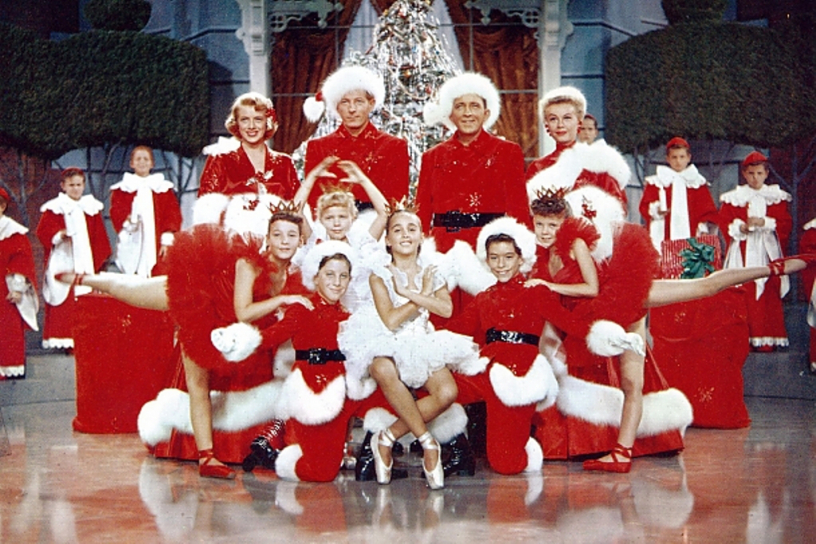
PHOTOS OF THE DAY: BING AND VERA-ELLEN
It's that time of the year to dust off the 1954 musical White Christmas and watch Bing and Danny Kaye dance upon your yuletide screen. Bing's leading lady in the film was Rosemary Clooney, but I wanted to see if I could find any pictures of Der Bingle with Danny Kaye's love interest in the film - Vera-Ellen. Here's what I found...


Monday, December 21, 2015
UNKNOWN FACTS ABOUT WHITE CHRISTMAS
Even though I much prefer the earlier holiday themed musical Holiday Inn (1942), the musical White Christmas is remembered much more. Here are some fun facts about the 1954 movie that you might not know about...

2. Produced by Paramount Pictures, filming took place between Sep. and Nov. 1953. The movie premiered in October of 1954 and Paramount introduced a new mountain in their logo. That mountain would be in use for all Paramount films until the end of 1986.
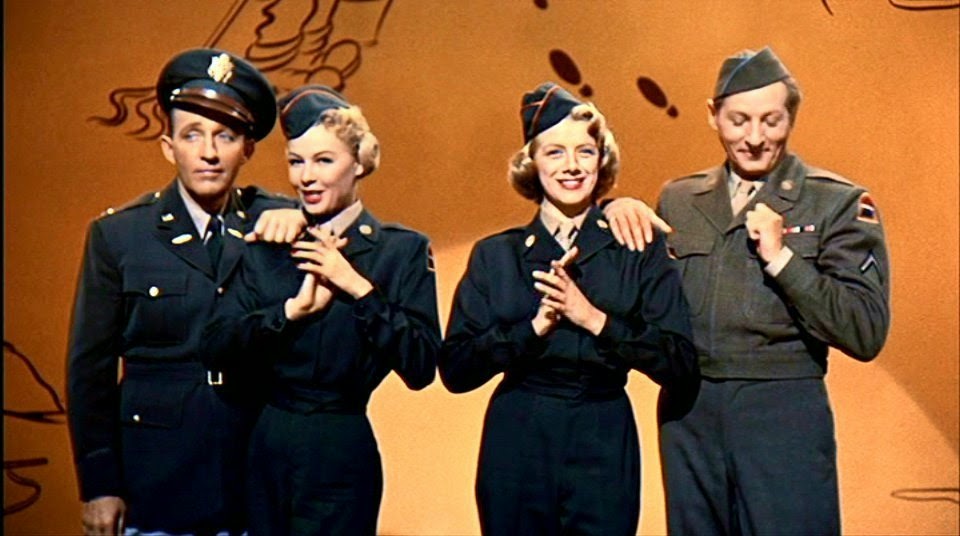
3. The choreography was directed by an uncredited Bob Fosse. Fosse appears in three dance numbers including a riveting performance in the Abraham number.
4. Vera-Ellen’s singing was dubbed by Trudy Stevens. Clooney’s and Steven’s voices are what is heard in the film. However, when the time came to record the soundtrack album, Rosemary Clooney’s contract with Columbia Records made it impossible for her to participate. Thus, Peggy Lee stepped in. A soundtrack with Crosby, Kaye, Clooney, and Stevens was never made!
5. The photo Vera-Ellen shows of her brother Benny is actually a photo of Carl Switzer, who played Alfalfa in The Little Rascals, in an army field jacket and helmet liner.
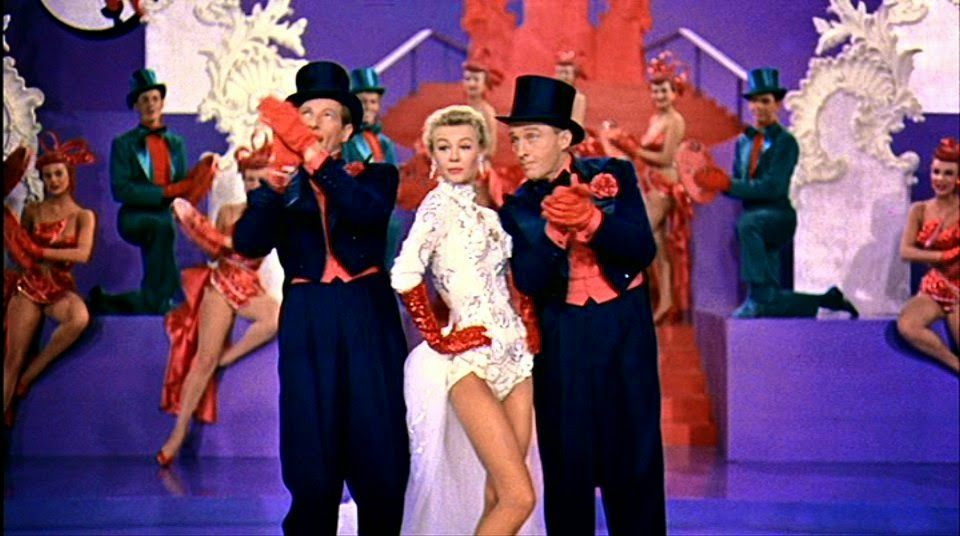
6. At 18 Vera-Ellen was one of the youngest Rockettes at Radio City Music Hall, although she was not tall. During the 1950s, she was reputed to have the “smallest waist in Hollywood” and is believed to have suffered from anorexia nervosa. Rumours of her high necked, long sleeved costumes being designed to hide her neck and arms still run rampant. She retired from the screen in 1957 and became more reclusive when her 3 month old daughter Victoria died of Sudden Infant Death Syndrome in 1963.
7. White Christmas was enormously popular with audiences, taking in $12,000,000 at the box office, making it the top moneymaker for 1954 by a wide margin. Count Your Blessings Instead of Sheep won White Christmas an Academy Award nomination for Best Original Song...

1. White Christmas was intended to reunite Crosby and Fred Astaire for their third Irving Berlin showcase musical. Crosby and Astaire had previously co-starred in Holiday Inn (1942) (of which ‘White Christmas’ was a partial remake) and Blue Skies (1946). Astaire declined the project after reading the script and Danny Kaye would eventually take the role. Vera-Ellen and Rosemary Clooney starred as the leading ladies.
2. Produced by Paramount Pictures, filming took place between Sep. and Nov. 1953. The movie premiered in October of 1954 and Paramount introduced a new mountain in their logo. That mountain would be in use for all Paramount films until the end of 1986.
3. The choreography was directed by an uncredited Bob Fosse. Fosse appears in three dance numbers including a riveting performance in the Abraham number.
4. Vera-Ellen’s singing was dubbed by Trudy Stevens. Clooney’s and Steven’s voices are what is heard in the film. However, when the time came to record the soundtrack album, Rosemary Clooney’s contract with Columbia Records made it impossible for her to participate. Thus, Peggy Lee stepped in. A soundtrack with Crosby, Kaye, Clooney, and Stevens was never made!
5. The photo Vera-Ellen shows of her brother Benny is actually a photo of Carl Switzer, who played Alfalfa in The Little Rascals, in an army field jacket and helmet liner.
6. At 18 Vera-Ellen was one of the youngest Rockettes at Radio City Music Hall, although she was not tall. During the 1950s, she was reputed to have the “smallest waist in Hollywood” and is believed to have suffered from anorexia nervosa. Rumours of her high necked, long sleeved costumes being designed to hide her neck and arms still run rampant. She retired from the screen in 1957 and became more reclusive when her 3 month old daughter Victoria died of Sudden Infant Death Syndrome in 1963.
7. White Christmas was enormously popular with audiences, taking in $12,000,000 at the box office, making it the top moneymaker for 1954 by a wide margin. Count Your Blessings Instead of Sheep won White Christmas an Academy Award nomination for Best Original Song...
Monday, December 14, 2015
SPOTLIGHT ON VERA-ELLEN

She was born Vera Ellen Westmeier Rohe on February 16, 1921 in Norwood, Ohio , an enclave within Cincinnati, to Martin Rohe and Alma Catherine Westmeier, both descended from German immigrants. She began dancing at age 10 and quickly became very proficient. At 16 she was a winner on the Major Bowes Amateur Hour, and embarked upon a professional careerIn 1939, Vera-Ellen made her Broadway theatre debut in the Jerome Kern/Oscar Hammerstein musical Very Warm for May at the age of 18. She became one of the youngest Rockettes at Radio City Music Hall, although she was not tall. This led to roles on Broadway in Panama Hattie, By Jupiter, and A Connecticut Yankee, where she was spotted by Samuel Goldwyn, who cast her opposite Danny Kaye and Virginia Mayo in the film WONDER MAN(1945).

She danced with Gene Kelly in the Hollywood musicals WORDS AND MUSIC(1948) and ON THE TOWN(1949), while also appearing in the last Marx Brothers film, LOVE HAPPY(1950). She received top billing alongside Fred Astaire in Three Little Words and The Belle of New York (1952). Then came co-starring roles with Bing Crosby in the blockbuster hit WHITE CHRISTMAS(1954). The warm and fuzzy yuletide favorite WHITE CHRISTMAS (1954) is usuallly considered her best-remembered movie in which she played one-fourth of a glamorous quartet consisting of Bing Crosby, Danny Kaye and (sister) Rosemary Clooney.
Musicals went out of vogue by the late 50s and, as Vera-Ellen was practically synonymous with musicals, her career went into a sharp decline. During the 1950s, she was reputed to have the "smallest waist in Hollywood", and is believed to have suffered from anorexia nervosa. She retired from the screen in 1957. Guest appearances on the television variety shows of Dinah Shore and Perry Como in 1958 and 1959 were among the last of her entertainment career.
Vera-Ellen was married twice. Her first husband was fellow dancer Robert Hightower (from 1941 to 1946).Her second husband, from 1954 to 1966, was millionaire Victor Rothschild. Both marriages ended in divorce. While married to Rothschild, she gave birth to a daughter, Victoria Ellen Rothschild, who died at three months old of Sudden Infant Death Syndrome in 1963. Following the death of her child, Vera-Ellen withdrew from public life and never recovered from it. She died of cancer in Los Angeles, California in 1981...
For more on Vera-Ellen's later years go to this article:
VERA-ELLEN: THE LATER YEARS

Subscribe to:
Posts (Atom)